Exploring the Underwater Wrecks of the African Slave Trade with Ken Stewart, and the Incredibly Bad Idea of Quibbi's "Ten Ton Chum"


 Apple Podcasts
 Spotify
 Amazon Music
 Overcast
 Castro
 iHeartRadio
 PocketCasts
 Podchaser
 TuneIn
 Deezer
 RSS Feed
 YouTube
 In Episode 18, you'll hear the latest news in the last week from around the world underwater including details on Deepspot, the new deepest pool in the world at 45m, and the incredibly bad idea of Quibbi's "Ten Ton Chum" series.
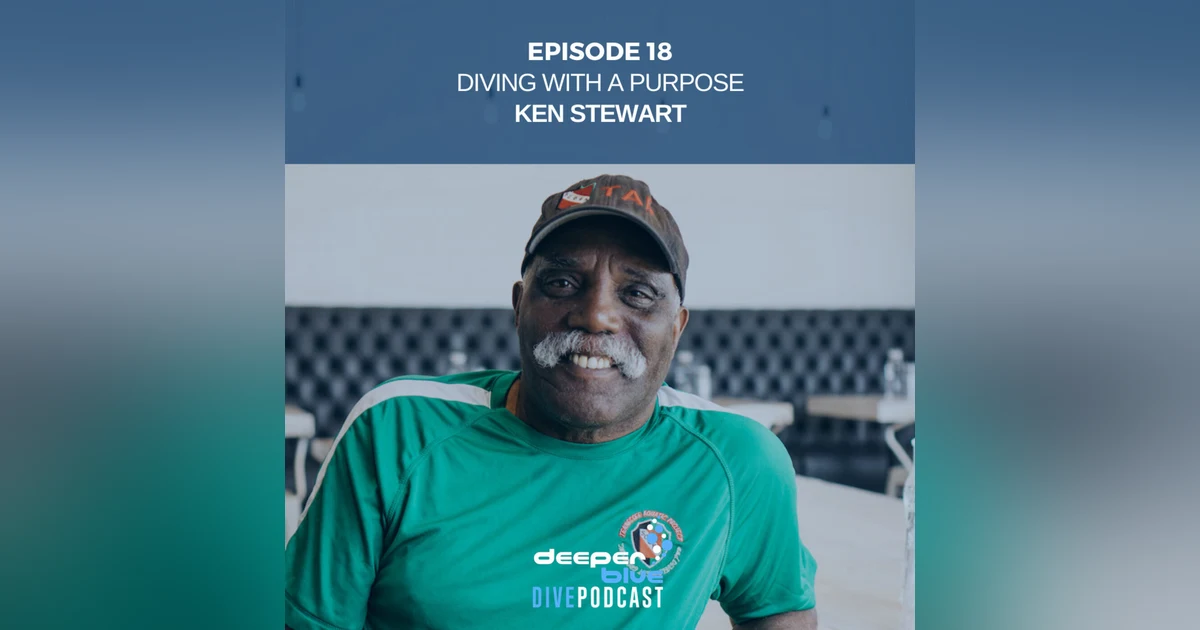
Then freediver and co-host Mehgan Heany-Grier talks to Ken Stewart, founder of Diving With A Purpose - a fantastic organization that teaches qualified divers the basics of maritime archaeology, with a special focus on exploring the ocean legacy of the African slave trade.
We then hear from underwater camerawoman Kat Brown - who gives a very practical tip for anyone looking to start making diving their career.
And then finally we hear from Ted Harty on his Best Dive Ever.
Don't forget to give us ★★★★★, leave a review, and tell your friends about us - every share and like really makes a difference!
Welcome to the Deeper Blue Podcast, your weekly guides and everything that is happening around the world underwater. My name is Stephen Whelan. I'm the founder of DeeperBlue.com, the world's most popular diving website. Every week, the Deeper Blue Podcast covers everything that's happening in the scuba diving, freediving, diving travel, and ocean advocates world. So join us as we explore the Deeper Blue. Hi everyone, welcome to episode 18 of the Deeper Blue Podcast. Comp today, in this episode, we've got the latest news in the last week from around the world underwater. Then iconic free diver and co-host Megan Heaney Greer interviews Ken Stewart, founder of Diving with a Purpose. This is a fantastic organization that teaches qualified divers the basics of maritime archaeology with a special focus on exploring the ocean legacy of African slave trade. We're then here from underwater camerawoman Kat Brown, who gives us a very practical tip for anyone who's starting to make diving their career. And finally, we're here from Ted Harty on his best dive ever. So let's dive straight in to this week's diving and ocean news. We've been following the news and progress of what will be the world's deepest swimming pool. It's called the Deep Spot and it's situated a short drive outside of Warsaw in Poland. The 45-metre, 168-foot pool is coming to the end of its construction phase and is due to be opening sometime in October this year. Social media has been set ablaze with short videos showing the construction of the pool, along with some absolutely amazing videos of the pool being filled with water. When it's full, it's going to need the equivalent of 27 Olympic size swimming pools. The Deep Spot is designed for divers to practice and train in. It even has structures that simulate diving into caves, but ultimately it'll be open to all types of divers no matter what level that you are. It also isn't just a pool. It's going to be a full-on destination built to accommodate underground restaurants, hotel rooms, and conference spaces, most of which will have windows looking directly into the pool, so you can see all the action. Hopefully, not someone peeing in their wetsuit, though. Because it's indoors and heated, the pool will be accessible year-round. So even in the dead of winter, you can live out your mermaid fancies or merman fancies anytime you want. Deep Swap though probably won't hold on to its crown as the deepest pool in the world for long, though. The blue abyss that is going to be built in Liverpool here in the UK is due to be completed at 50 metres, that's 164 feet deep, when it is finally built. Next, we've got something I can't quite believe is likely to see the light of day. Quibi, which is a subscription-based streaming platform designed to deliver short-form scripted and unscripted content to your mobile, has announced that it's given the green light for a new series hosted by the fast and furious actress Michelle Rodriguez. The new series has a working title of 10-ton chum, which in itself just doesn't sound like a good idea, but they've gone on to announce that they hope to create, in what they are calling a scientific first, the largest controlled feeding frenzy in the ocean. To achieve this, the company is engineering an enormous 10-ton, £20,000 chum ball. If that wasn't amazing enough, the ball will actually build around a shark cage so divers will be able to view and film the action from inside the cage. Apparently, Rodriguez has agreed to be inside that cage as the feeding frenzy occurs. I mean, what comes to mind is what could possibly go wrong. It is unfortunately a real shame as a series like this could really be used to drive awareness of the terrible plight of sharks. Instead, we're going to be subjected to scenes of sharks tearing apart a ball of chum which will do nothing but fill people with dread. In other shark news, this time it's from Project Aware, they're drumming out support from passionate shark advocates to help and preserve the Mako Shark. They're looking to harness the might of the dive community so that the people who make legislation know that they are not acting on behalf of the public that they're meant to represent. European Union and US citizens are being asked to reach out to public officials to get them to change their positions and act fast before it's too late for the Mako Shark. The sad news here is scientists currently believe that even if we were able to reduce immediately Mako shark fishing to zero, there's only a 50-50 chance that the species can rebuild to acceptable levels by 2050. If you'd like to get involved, head to projectaware.org and have some advice on how to contact your local representative, including some buttons you click to just go and send a tweet from your Twitter account. I've done that and the Deeper Blue Twitter account has done it as well. So spare a couple of minutes and go to projectaware.org to find out more. The impact of COVID-19 to diving agencies continues to be felt. We've heard of multiple initiatives by agencies to continue encouraging divers into the water. But I think the reality for all agencies that unless people continue to get in the water and either take up diving or continue their education, fees coming in for agencies are starting to dry up. This week Paddy announced their offer to their membership to try and stem the impact for both the agency and for its members that are impacted financially. The agency is offering its members who renew their membership a number of options, including 20% off renewal rates, as well as deferring 75% of the fee into March 2021. Ultimately, this is a difficult situation for everyone involved. Diving has always been an aspirational travel-related sport. So without people flying to destinations to go diving, the whole industry is really truly feeling the effects. We really must do our best to get diving locally and encouraging people to experience the wonders of the underwater world, no matter where you live in the world. I myself am actually currently getting all my kit prepared and getting ready to head out around the UK and do some local diving with friends over the coming weeks as various different lockdowns and regional lockdowns start easing. And I can't wait to get back in the water locally and experience local British diving. You may remember the slightly mad cross between an underwater scooter and those monofins that freedivers use that we mentioned a few episodes ago called the AMFI. Well, we've just heard that they've hit their crowdfunding goal of $15,000 to finalise developments and produce the first batch of the AMFI scooter. I still think it looks a little bit mad and this Frankenstein monofin with a rocket attached to it. But it does seem to be going to production. People seem to be excited by it. So I do look forward to seeing it shipping out to those who backed them, especially since these crowdfunding campaigns are never 100% certain that you're going to get the product at the end. We are contacting the team behind the AMPI, and one of the Deefer Blue team will give it a go in due course and look out for a review around it. Finally, some sad news coming out of Australia. As scientists have found that more than half the coral that make up the Great Barrow Reef have been lost since 1995. Lead author Dr. Andy Ditzel from the ARC Centre of Excellence for Coral Reef Studies in Queensland says there are numerous studies over the centuries on the changes in the structures of populations of humans or in the natural world trees, but there still isn't an equivalent information on the changes in coral populations. He and his co-authors assessed coral communities and their colony size along the length and breadth of the Great Barrier Reef between 1995 and 2017. Ultimately, their results show a depletion of coral populations. The study found that climate change is driving an increase in the frequency of reef disturbances such as marine heat waves. The study records deeper deteriorations of coral colonies in the northern and central barrel reef after the mass coral bleaching events in 2016 and 2017. And the southern part of the reef also exposed to record-breaking temperatures in early 2020. It's absolutely devastating news, especially as the Great Bear Reef is such an iconic landmark in our oceans for divers of all types. And I know I've never managed to actually get to the Great Bear Reef, but it is absolutely on my bucket list. So I mentioned last week David Asenborough has his Netflix documentary, A Life on Our Planet, talks a little bit about how we can change our habits of what we eat and what we do to help protect the oceans and the planet we live on. So take a moment, watch the Netflix documentary and think about what you're doing and what we can do to help protect our oceans. That's it for the news this week. Remember, you can catch up on all the latest news from around the world underwater by heading to deeperblue.com or checking us out on social media. And finally, if you like what you heard, please subscribe, like, and comment wherever you hear your podcasts.
SPEAKER_06You're listening to the world's only weekly podcast for scuba diving, free diving, dive travel, and ocean advocacy. I'm Kat Brown, an underwater filmmaker. And this is the Deeper Blue Podcast.
SPEAKER_04I'm Megan Haney Greer, free diver and co-host here on the Deeper Blue Podcast. Today we are joined by legendary diver Kenneth B. Stewart. He goes by Ken, and Ken was first bitten by the diving bug 30 years ago. When I first came across Ken's name and began reading more about his work and the Diving with a Purpose organization, I was really intrigued by the work they are doing. Ken started DWP in 2003 as a partnership between the National Park Service and the National Association of Black Scuba Divers, and they have a special focus on minority divers and exploring the maritime legacy of the African slave trade. Ken has spent his time underwater searching for slave shipwrecks and working with organizations from around the world to preserve these pieces of history and reveal some of the untold stories. Hello, Ken. Thank you so much for joining us today.
SPEAKER_01Well, thank you for having me.
SPEAKER_04Absolutely. I'm really excited to dig into some of these dive stories. What do you love the most about diving, or what part of it do you connect with the most?
SPEAKER_01So the thing that I love is the personal freedom. Once you get over the fear of just diving, of just being in the water and being a in a strange environment, you witness Mother Nature at her best. Now, a lot of people like the big fish, the sharks, the man or race. I love the little fish because they have personality. You know, the big fish, you know, they'll run away from you when you a lot of people say, Well, shark, shark, you know. Usually when you hit the water, sharks go. They don't want to be bothered with you. But the little fish don't. Right? You know, they're very territorial and they have little personalities. And you see, it's like a a neighborhood, right? You see all the different fish in the little neighborhood and they all have little different jobs to do. So to me, I mean, I love the little fish.
SPEAKER_04I love the big fish too, but I love the little I would love to hear some about diving with a purpose and how that came to be and what kind of work you do through the organization.
SPEAKER_01So this is our 16th year, and I partnered with a young lady named Kruna Emerell, who was the producer of a documentary called the Gorilla Project. And I'd be honest with you, I've never a big history book. Didn't know what the grill was. For you listen to the grill was a slave ship that saw we think in Biscayne National Park. There were 561 Africans on board, 41 of them died at the night of the grounding, and the rest were either enslaved or went back to Liberia. How do we know the story? Because the British kept very good records. So we knew everything about the guerrilla, but where it is. So the star of that documentary was a young lady named Brenda Lazendorf, who was the park archaeologist at Biscayne National Park. So I made a special visit to meet her, and we became very good friends. And the last thing she said to me after our first initial meeting was, you know, Ken, I'm the park archaeologist, and I can't dive alone. And there's a lot of wrecks in this park, and I need help. So I went back and I sent out an email. You're tired of the same old dive and let's dive with a purpose. That's exactly how it started. At least 10, 12 people responded, and we had our first session that following year. Brenda and I laid the ground, working for the dive with the purpose program. And that's how it started. Some people did it from a spiritual standpoint, some did it because of the love of history. But you know, the thing we all have in common is that we all dive.
SPEAKER_04So then with the organization Diving with a Purpose, you recruit divers and then basically put them through training to work alongside marine archaeologists and document these shipwrecks, and many of them are slave ships.
SPEAKER_01Yes, that's exactly what we do. So dive with a purpose, we focus on the African diaspora, and we do give people an opportunity to document a slave wreck. There's a wreck down in Costa Rica where we partner with an organization there called Ambassadors of the Sea, and they just found a Danish slave ship there, so we'll be partnering with them. Of course, we're still looking for the grill. Hopefully, we are closing in on it, and we're still looking for others.
SPEAKER_04So you do some looking for ships, and then in the case with the one down in Costa Rica, what will that look like? What will your divers through diving with a purpose be working on?
SPEAKER_01This is a Danish slave ship down in Costa Rica, and it has a heck of a story. The group down there called Ambassadors to Young People who actually found it. What they don't have is the name of it. They just determined that it was a Danish ship and because there's a lot of bricks there. They were able to send the bricks back to Finland and they identified the bricks as Danish. The other thing is trying to put the history of the ship together. They do know that when the ship sunk, a lot of the Africans on board went to the mountains and created their own community. So now they've got a community project where they're going to the community and trying to get these tales from the residents about their ancestors. So they're trying to identify it. They have not. So we could be a part of that. So when we go and do the DWP training, we will just be a part of helping identify that shift.
SPEAKER_04So you must have so many incredible dives, but I would love to hear from you if you have one specific dive, big or small, just something that really stands out to you as a pivotal dive in your life.
SPEAKER_01I've been all around the world diving, right? But the dive that stands out to me is one of my first dives. I remember it's in Panama City, Florida. In Panama City, colors are not as vibrant as on the East Coast. But it's a good dive. There was a wreck called Joe's Tug. And it's a tugboat in 56 feet of water. So me being a new diver, we went down and I got into the wheelhouse. I actually'm just standing there with my fingers up on the floor of the boat. The wheel with the tugboat captain steers, and it's just a big opening there. Right in front of me are all these bait fish just swirling around, everything. Thousands of thousands of them. So it was like me being inside the aquarium looking out. And to me, it was like, wow, this is incredible. That is the dive that put me where I'm at now in terms of loving God. Kind of just lit this fire under me.
SPEAKER_05Tagline number three. Hi, I'm Sofia Gomez, and I'm a free diver from Colombia. And you're listening to the first 30 minutes of our diving, the Deeper Blue Podcast.
SPEAKER_00Hi, it's Jason Elias, producer of the Deeper Blue Podcast. Today's top tip comes from Kat Brown, a South African underwater camerawoman who keeps it short and sweet, and whose work includes such incredible documentaries as Planet Earth as narrated by Sir David Attenborough.
SPEAKER_06Hi, I'm Kat Brown, an underwater camerawoman. My top tip for anyone going into the industry, especially girls, is to not worry about looking in the mirror on the job because you probably won't get a chance.
SPEAKER_02To be prepared to go to the toilet in some very strange places.com.
SPEAKER_03My most memorable dive is not a deep dive, not a competition or a PB dive. It was actually a specific dive during a private class that I taught. I was teaching a private class for Jeremy and Becky Gamble, owners of Spearing Magazine. Becky was not excited about this course. She was extremely nervous, but we were able to get through it. And then we got to the spring of our water work. And she got in the spring. She was not having it, extremely nervous, started having a panic attack, almost just bolted and was just gonna run to the car. But she was able to get her to stay in the water, do some breathing, get a little calmer, and then we started diving, right? And it was 10 foot, 15 foot. She was making progress. There was nothing relaxed about it. It was just very mechanical and doing it, and there was nothing calm and involved. But then on the last dive, she went to the plate at 55 feet. She touched the plate at 55 feet, and for the first time ever, she stopped. She didn't bolt to the surface. She looked around and she saw how beautiful the spring is, right? There's the sunlight that comes in at an angle, it lights up the walls. It's so pretty. She sees it for the first time. She's got this huge grin on her face, and she slowly and calmly swims to the surface. She hits the servers, does her three hook three cleansing, high five, and cheering. It was the coolest thing to see because I saw someone turn into a free diver on one dive. Hour before. And that is one of the things that we are so lucky as instructors to see, but I've never seen it that dramatic and that quick.
SPEAKER_02We'd love to hear your story about diving. So at the end of the show, you'll find out all the info you need to submit your best dive ever. Thanks for listening to the Deeperblue Podcast. Find out more on all the stories you've heard this week, plus connect to the world's largest online dive community at deeperblue.com. And if you like what you've heard, please subscribe, like, and comment wherever you hear your podcasts. These comments and subscribes really make a difference. Before we go, I want to give a big shout out to Jason Elias, our producer. In case you didn't know, he has an amazing podcast about people who have a deep connection to our world's oceans. Connections strong enough that I've dedicated some part of their lives to being in or working on behalf of the water. Take a listen when you get a moment to Jason's show, the Big Deep Podcast. Every week, we want to hear your stories and share them with the world. So please record and send in your short story of your best dive ever. Keep it brief, no longer than two minutes, please. And in it, tell us your name and location, where you were on the dive, what happened that make it so great, and why it's meant so much to you. You can get that over to us at bestdive ever at deeper blue dot com. Or head to our website podcast.deeperblue dot com forward slash best dive ever. Join us again next week and explore much more of the Deeper Blue.