Luke Inman On Bringing The Most Hated Star Wars Character Of All Time To Life, and Freediver & Environmentalist Tanya Streeter


 Apple Podcasts
 Spotify
 Amazon Music
 Overcast
 Castro
 iHeartRadio
 PocketCasts
 Podchaser
 TuneIn
 Deezer
 RSS Feed
 YouTube
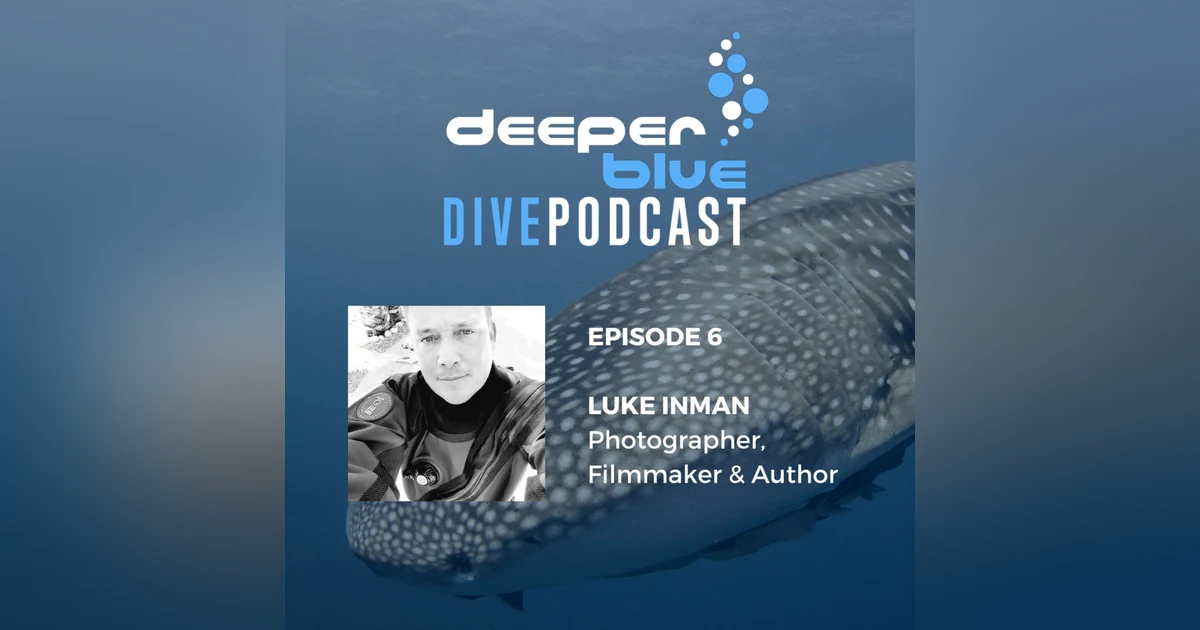
 In Episode 6, we talk sea lions, humpback whales, bringing Star Wars characters to life, and some powerful connections with the oceans.
We have an interview with Luke Inman - underwater photographer, filmmaker, and author. He talks to us about what it's like diving with the Sea Lions in La Paz, Mexico - where he is based - an amazing encounter with a humpback whale and what part he played in bringing to life the most hated star wars character of all time.
Then we hear from Tanya Streeter, the famous TV presenter, Freediver, and environmentalist who gives us some advice about being comfortable in the water by tapping into your diving mammal physiology.
And then finally we hear from Bernhard Hofmann on his Best Dive Ever.
Don't forget to give us ★★★★★, leave a review, and tell your friends about us - every share and like really makes a difference.
Welcome to the Deeper Blue Podcast, your weekly guide to everything that is happening around the world underwater. My name is Stephen Wheeler. I'm the founder of Deeperblue.com, the world's most popular diving website. Every week, the Deeper Blue Podcast covers everything that's happening in the scuba diving, free diving, diving travel, and ocean advocates world. So join us as we explore the Deeper Blue. Hi everyone. Welcome to episode six of the Deeper Blue Podcast. In a minute, we'll have the latest news from around the diving and ocean worlds. Then we talk to Luke Inman, an underwater photographer, filmmaker, and author. He'll talk to us about what it's like diving with sea lions in La Paz, Mexico. That's where he's based, an amazing encounter with the humpback whale, and what part he played in bringing the most hated Star Wars character of all time to life. We then hear from Tanya Streeter, the famous TV presenter, free diver, and environmentalist, who gives us some advice about being comfortable in the water by tapping into your diving mammal physiology. And then finally, Bernard Hoffman on his best dive ever. Now, before we get onto the news, I want to highlight something that I've been hearing about recently, and it's likely to be a growing problem in protecting our oceans from plastic. The reality before COVID-19 hit is that we're producing around 300 million tons of plastic every year and dumping over eight million of that plastic into our oceans. I think this equates to about five plastic bags of rubbish every foot of beach that we have. Now, today, single-use plastic, latex gloves and other personal protective equipment or PPEs, we've come to know it, become a daily feature of our lives. And all that is for good reason. At the same time, the use of plastic in retail and other sectors that have been hit hard by the crisis has likely decreased. Now, the question is, when the pandemic ends, will we end up producing a larger amount or small amount of plastic footprint? I think some evidence is suggesting that yes, PPE is trickling into our oceans. But our feeling is, and a lot of the experts out there, feel that the net result is likely to be a net increase. To be clear, what we're not going to be starting to suggest is that our frontline medical professionals and key workers suddenly stop spending time saving lives and sourcing through their recycling just doesn't seem to make any sense. And frankly, PPE's critical role during the crisis is an important reminder of the fact that plastic does have numerous benefits that can be offered to society. And has been things like face masks and test kits have proved some of our most potent weapons against COVID-19. Getting rid of all that plastic is really not the answer. However, if we're not going to quit plastic, then we need to develop a healthier relationship with it. That means reducing our use of plastic wherever possible, reimagining how we source, design, and reuse, and dispose of the plastic materials upon which communities around the world have depended. And to do that, we'll need some big changes in consumer behaviour and big changes in the private sector's approach to production and waste management. We're all ocean ambassadors, and it's part of our duty to help protect those oceans that we love. So we all need to keep a close eye on what's happening in this space and help advance the message that we need to find a different way of dealing with plastic. Now, onto the news from the week. First up, Shearwater Research has announced the launch of a new scuba diving computer called the Peregrine. It's a simple and accessible full-colour multi-gas dive computer that should be easy for divers of all experience levels to use. With simplified recreational dive modes, full decompression support, and a built-in quick dive planner, the Peregrine is probably your ideal companion for many adventures to come. Interestingly, this week, to prove that people will buy absolutely anything, we have a reminder of a story that was picked up originally back in 2017. American designer Tom Brown let you tap into your inner bonds with a new creation. A wetsuit that looked like a tuxedo. The downside around this, there's the wetsuit, which was called Optical Illusion, cost a whopping $3,900 and sold out almost immediately. When this first popped up three years ago, I have to say there were cartoon-like characters coming out of the water looking at the pictures that there were of this suit. Never actually got to try it ourselves, uh, probably a little bit out of our price range. And luckily, it hasn't really become a thing around dive sites, which uh we're all, I think, pleased about. In the UK, there's been an 11-year-old UK diver who's completed a charity underwater Lego challenge raising money for the National Health Service in the UK. Sophie O'D spent 57 minutes in 12 metres of water that was 14 degrees Celsius, that's 57 Fahrenheit, building a Lego rescue aeroplane on top of a real aeroplane that sunk in Cape and Ray quarry. It's a fantastic effort by Sophie has raised £649 for the National Health Service to thank them for their efforts during the COVID-19 pandemic. Over to South Africa now, and South African freediver Beth Neal magic capture some really amazing footage of the sardine run whilst freediving recently. The footage is totally crazy. There's millions of sardines, hundreds of sharks around her as she is taking this footage on a whole series of cameras, including a uh a 360-degree camera, a drone, and a GoPro. When you have a few minutes, when you have two minutes, go and check out the film on Beth Neal's Instagram profile page. Totally amazing. Now, we've all been anticipating the new Avatar sequel from James Cameron that we've heard a little bit about from the likes of Kirk Croc, who did our top tip last week and is coming on the um on the show later in the series. It's a movie that's going to feature a high amount of underwater scenes with all its actors freediving, in fact. The disappointing news this week was that due to COVID-19, the release date has been pushed back from December 2021 to December 2022, and it was announced via Instagram by James Cameron himself. Lots of fans really disappointed, including ourselves. We are really looking forward to seeing this. In fact, when we spoke to Kirk, he has spent the best part of two years working on the film between Los Angeles and New Zealand. And he's going to talk a little bit about it when we uh he comes on the show in a few weeks' time. Over in Australia, there is a new sculpture by artist Jason DeCare's Taylor that's been unveiled on the Great Barrier Reef. And the unique thing about this art structure is that it is about taking the temperature of the Great Barrier Reef in real time. It's titled Ocean Siren, it's placed on Davies Reef and towers an impressive 12 foot or 3.6 metres above the surface of the water. And the way it highlights the real-time temperature of the ocean is it changes colour from a deep blue to a dark red. In Florida, off the Gulf Coast, scientists are flocking to catch a glimpse of mysterious 425 feet deep blue hole that's appeared on the ocean floor. This glowing, mysterious hole, which is about 155 feet below the water surface, is very similar to the sinkholes we see on solid land. It's a hot topic for scientists and deep sea explorers who've been hoping to capture a glimpse of this phenomenon from afar. Amazingly, actually, the the first reports of this blue hole came from fishermen and recreational divers, not scientists or researchers. And these holes in particular hold scientists' attention because they tend to host diverse biological communities full of marine life. They include things like corals, sponges, mollusks, sea turtles, and sharks. In this case, remarkably, they've also found two dead but intact small-tooth sawfish, which is an endangered species of shark, at the bottom of the hole. So one of these sharks has been recovered by for examination by NOAA scientists, and they're planning a second expedition in August to a deeper area of the hole. So we'll be reporting back as we hear more on that. Finally, our co-host Sarah Richards, who is the founder of Girls at Scuba, has told us about a rather cool initiative that they've launched this week. Girls at Scuba have announced a new ambassadorship program for 10 female divers around the world who'll work closely with the female diving community to promote diverse women in diving. The hope of doing this is that they will be celebrating the success of female divers and championing diverse role models. And by doing that, they can encourage women of every age, race, sexuality, religion, ability, and body type to pursue scuba diving as a hobby or even as a career. So we absolutely love the idea, Sarah, and we've already had a conversation with Sarah to bring some of these ambassadors onto future episodes of the podcast. So keep tuned for that in coming weeks. That's it for the news this week. And as always, if you like what you hear, please subscribe, like, or comment wherever you hear your podcasts. These really do make a huge difference to us.
SPEAKER_03Hi, this is Sarah Richard, founder of Girls at Scuba. And you're listening to the Deeper Blue Podcast.
SPEAKER_01Hi, this is Jason Elias, producer of the Deeper Blue Podcast. Today we have an interview I did with Luke Inman, an underwater filmmaker, photographer, and writer. Originally from London, Luke is now the owner of Cortez Expeditions, a dive shop in La Paz, Mexico, down in Baja, California. In our interview, Luke shared why he loves the diving in Baja so much, an amazing moment he had with a humpback whale, and what part he played in the most hated Star Wars character of all time. So, Luke, thanks so much for doing this.
SPEAKER_05You're welcome.
SPEAKER_01Can you tell us a little bit of who you are and where you're based and what you do there?
SPEAKER_05I'm originally from London, and I have been in La Paz, Mexico for 20 years. I consider myself a jack of all trades and master of none. I'm a photographer, I'm a filmmaker, I've had a book published. I recently just completed being the dive safety officer for parts of Planet Earth 3 for the BBC. And here I am in La Paz. I love living here. It's a beautiful town. I get to live on the Sea of Cortez.
SPEAKER_01For the divers that are listening to this show, what is it about the diving La Paz that is so special?
SPEAKER_05There's a very cliched, very famous statement about the Sea of Cortez from that French pirate, Jacques Cousteau. He christened the Sea of Cortez the world's aquarium. And it has this incredible mixture of marine mammals and animals that you would only see in cold or temperate water, blue whales, grey whales, humpback whales. And then a mixture of reef fish and nudibranks and small invertebrates that you can only see further south, sort of close to the equator. It's part of that eastern Pacific chain that starts from the Galapagos, the Malpelo, the Cocos, the Socorro Islands, or the Riviera Higheros, as they're called in Spanish. And then that sort of link of all those underwater seamounts goes up into the Sea of Cortez, and it's famous for its pelagics. You know, you encounter big stuff here. Such as the biggest whale shark I've ever seen, I saw here, that was a good 12 to 14 meters. I've had sailfish underwater, marlin underwater humpbacks, schooling hammerhead sharks, blue whales, sperm whales, grey whales, humpback whales, force killer whales, pilot whales, common dolphin, or you name it, everything.
SPEAKER_01One of the things you mentioned though, one of the reasons you said you're in La Paz was the California sea lion.
SPEAKER_05The Californian sea lion is the underwater dog. Technically, they evolved from weasels and mongooses, and they just do this inquisitive, beautiful ballet. And in the 20 years I've been here, I'm pretty convinced I know how to communicate with them. I'm not going to pretend I'm some kind of sea lion whisperer. But the first book I wrote is about sea lions, and they are just beautiful creatures. And what's incredible about La Paz is the sea lion colony is approximately an hour and a half from the marina. And to enter a marine protected area that's only an hour and a half from 300,000 people and the center of government for this part of Mexico and be able to interact with a wild animal is it's a privilege, incredible privilege. And it's probably one of the main reasons I'm still here.
SPEAKER_01That was amazing and very heartfelt. And in the past you did some pretty amazing cinema stuff. Could you just kind of briefly tell us any of the kind of fun stuff you did?
SPEAKER_05I started in cinema. I went to the London Film School. I have to say I was a little frustrated because I never really wanted to be in cinema. I always wanted to work in natural history. I wanted to be in the middle of nowhere shooting animal behavior. And immediately upon leaving film school, the first year, 18 months, I found myself in tanks, swimming pools, and movie sets in chlorinated water, which is fascinating. It was an incredible experience. But it's a very, very different environment to shooting with a crew of two or three people for the BBC Natural History Unit or National Geographic. And I think the one that people always talk about, because I worked on Star Wars Phantom Menace. I helped build the set. I was one of the safety divers. I shot some of the behind-the-scenes footage. The thing that I get teased about by some of my peers and colleagues is I carried the digitizing dome underwater to beat Jar Jar Binks. And what an achievement for me is I I got to be with Ewan McGregor and Liam Neeson, Obi-Wan Kenobi, Quee Gonjin underwater, and I helped contribute to the worst Star Wars character in history. That is my legacy.
SPEAKER_01That's fantastic. If you could share one story underwater that really resonates with you, and I know you've probably had thousands of experiences underwater, but if there's one story you could say, this story really meant something to me and kind of walk me through that story briefly, that'd be fantastic.
SPEAKER_05Back in 2003, 2004, I've been working with a project with Dr. Salvador Jürgensen, who's one of the main shark investigators and researchers at the Monterey Bay Aquarium. And we were completing an expedition to the Socoro Islands, where we were tagging scalloped hammerhead sharks using rebreathers. On that trip, we had Dr. Mauricio Oyos, a very famous Mexican great white researcher. We had Dr. Peter Klimley, who discovered schooling hammerheads in the Sea of Cortez in the 70s. And we'd finished diving for the day. And some of the other investigators who were ironically enough working with nudie brains couldn't be anything more different than what we were trying to do. Came back onto the boat and they were like, There's a tiger shark just off of this point. And it was a place called Cabo Pierce in the Socoro Island. And I'd showered, I was having a cup of tea, and Salvador came and sort of prodded me. When come on, we're going diving. And I'm like, I'm not going anywhere. And he was like, Come on, you'll regret this for the rest of your life. Let's go find this tiger shark. So we get in the zodiac, we see this humpback breach, and it's quite close to us. It almost tipped the zodiac, and we're like, Well, that was amazing. Let's go find the tiger shark. And the sun's going down. So you've got that beautiful rays of light. And so we jump in the water and we've both got these rebreathers on. So you're doing a bubble check. The rebreather has such a big mouthpiece that after thousands of dives together over two years, we could hear what we were saying to one another. And Salvador said to me, Look, there's the reef. And I'm like, the reef's moving, you muppin. No, no, no, there's the reef. The reef's moving. And then literally the reef just bellowed up. And this humpback just goes vertical alongside us. And literally high-five Sal with one of his flukes. And then literally along the other side, I hear this. And then we spent the next 40 minutes, eye to eye, completely interacting with two humpbacks. They were rolling, they were looking at us, they investigated us, and we kept kind of looking over at each other, like this is too good to be true. This isn't happening, you know. Because it happened with such a good friend. It happened with someone that I spent hours and hours underwater. Somebody that had a sort of telepathic understanding with underwater. And it was our gift after two years of very hard scientific guiding together to literally spend just under an hour with these two animals. We got back to the boat and everyone's like, Did you see the tiger shark? And we're like, no, we spent the entire time with you on Backson. Nobody believed us until the video went on. And then this beautiful gentleman who paid to be on the expedition, he paid to be a guest, burst into tears. He was elderly, he was in his mid-70s then. He was so impressed with what he said was our energy and our souls. And he was so impressed that we were trying to educate and find viable business alternatives for Mexican shark fishermen with the non-profit we formed, that he underwrote the cost of retraining about 25 Mexican fishermen to find a viable alternative for their lifestyle. Because you know they don't read, they don't write. So out of this incredible experience came incredible opportunity. That is always one of the experiences underwater that really sticks with me. Of all the productions I've worked on, actors, models, brands, animals, all kinds of experiences, the one that is constantly up there is that particular one with those two humpbacks that day.
SPEAKER_02And you're listening to the best 30 minutes about diving, the Deeper Blue Podcast.
SPEAKER_00Hi, everybody, I'm Tanya Streeter. I'm a free diver, and my top tip for anybody getting in the ocean, especially while holding their breath, is just to remember your physiology. Don't forget that we're marine mammals. We're designed to be in the water, to even hold our breath in the water. So if you just think back to our ancestral history and even our connection with other marine mammals, you'll feel a sense of peace come over you, which just allows you to relax and enjoy and take it all in. So don't forget your physiology.
SPEAKER_04Finally, every episode we share a story from you, the dive community, where we ask you to tell us about your best dive ever.
SPEAKER_06My name is Bernard Hoffman. I live in Exmouth in the UK. My best dive ever was in Maldives, a place called Commando. I had seen a couple of turtles and I decided on this particular dive to orient myself parallel to the turtle. And it was just amazing to be with the turtle in the water in such a way that it didn't seem at all bothered by me. And I followed it as we swam sort of across to the shallow reef. And when we got to the drop-off, I decided to dive down first rather than chase the turtle down. And I turned round and I was filming it at the surface and it dived down almost on top of me. And as it passed me, I realized there was another turtle coming up from a little bit deeper down. The two of them parawettered, and it was just such an amazing thing to witness. And after that I sort of swam a little bit with it on the drop-off, just cruising along. Definitely the best dive I've ever had.
SPEAKER_04We'd love to hear your story about diving. So at the end of the show, you'll find out all the info you need to submit your best dive ever. Thanks for listening to the Deeper Blue Podcast. Find out more on all the stories you've heard this week, plus connect to the world's largest online dive community at deeperblue.com. And if you like what you've heard, please subscribe, like, and comment wherever you hear your podcasts. These comments and subscribes really make a difference. Before we go, I want to give a big shout out to Jason Elias, our producer. In case you didn't know, he has an amazing podcast about people who have a deep connection to our world's oceans. Connections strong enough that they've dedicated some part of their lives to being in or working on behalf of the water. Take a listen when you get a moment to Jason Show, the Big Deep Podcast. Every week, we want to hear your stories and share them with the world. So please record and send in your short story of your best dive ever. Keep it brief, no longer than two minutes, please. And in it, tell us your name and location, where you were on the dive, what happened that make it so great, and why it's meant so much to you. You can get that over to us at best dive ever at deeper blue dot com. Or head to our website podcast.deeperblue dot com forward slash best dive ever. Join us again next week and explore much more of the deeper blue