Isaac "Shrek" Daly on how 20 seconds on the ocean floor changed his life, and Stephan Whelan on why there is no such thing as an ocean media mogul


 Apple Podcasts
 Spotify
 Amazon Music
 Overcast
 Castro
 iHeartRadio
 PocketCasts
 Podchaser
 TuneIn
 Deezer
 RSS Feed
 YouTube
 Welcome to Season 4 of the DeeperBlue Podcast! In episode 10 you can look forward to:
- The latest scuba diving, freediving, ocean, and diving travel news that has happened in the last week from around the world underwater with host Stephan Whelan and producer Jason Elias.
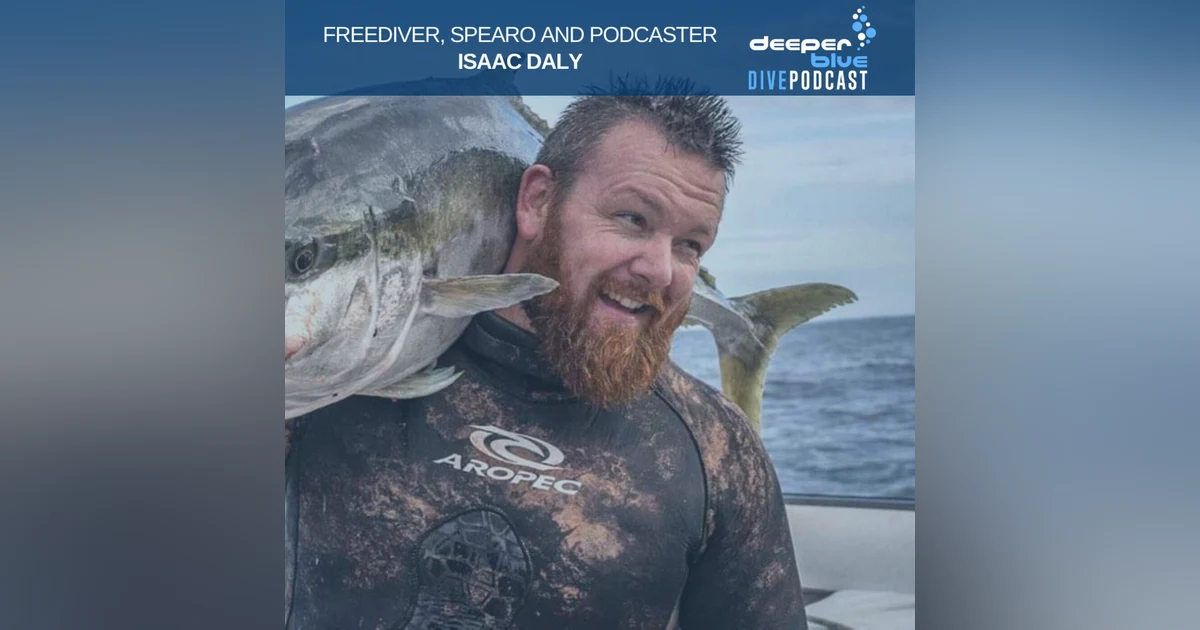
- Then Stephan speaks with Isaac "Shrek" Daly - founder of the Noob Spearo podcast. They discuss his journey into Scuba Diving, Freediving, and then Spearfishing which took him onto the journey to help people via his podcast and his Kickstarter books.
- We then hear a top tip from our Founder and Host Stephan on why there is no such thing as an ocean media mogul.
- And then finally we hear a listener-submitted Best Dive Ever from Sara Revell about diving off a liveaboard in the Pacific.
If you’d like to be notified when new shows air, please subscribe to the show in your favorite podcast app or head to deeperblue.com/podcast to signup for the newsletter.
Season 4 of the DeeperBlue Podcast is brought to you by Suunto. Finnish engineering pioneering adventure from mountain top to ocean floor since 1936.
Don't forget to give us ★★★★★, leave a review, and tell your friends about us - every share and like really makes a difference.
Season four of the Deeper Blue Podcast is brought to you by Sunto. Finnish engineering, pioneering adventure from mountaintop to ocean floor since 1936. Sunto.
SPEAKER_02Welcome to the Deeper Blue Podcast, your weekly guide to everything that's happening around the world underwater. My name is Megan Haney Greer. I'm a free diver, ocean explorer, and the imperfect conservationist. Also co-host of the Deeper Blue Podcast, the podcast for DeeperBlue.com, the world's most popular diving website. Every week, the Deeper Blue Podcast covers everything that is happening in the scuba, free diving, time travel, and ocean advocacy world. So join us as we explore the deeper blue.
SPEAKER_01Hi everyone, welcome back to the Deeper Blue Podcast.
SPEAKER_06This is Jason Lance, producer of the podcast, and I'm here with Steven Whelan, Papa Smurf, the uh founder of DeeperBoo.com and host of the podcast. Jason, this is the last episode of this season.
SPEAKER_01Season four. Yes, and we're taking a little bit of a hiatus after this.
SPEAKER_06You know, we're taking just a little hiatus because this takes a lot of time and effort. So we're looking for a new sponsor.
SPEAKER_01If you're interested in sponsoring that coming season, please do reach out and let us know. All right, so should we get to the news?
SPEAKER_06Yes, Mr. Efficiency. Let's get uh get to the news.
SPEAKER_01First, we've got we got some great, great news. Paddy, the dive agency, the world's largest dive agency, has done something amazing. They've made scuba diving completely digital. You no longer need to go in the water.
SPEAKER_06I know, I was amazing. I've read this. So the title is Paddy Takes Discover Scuba Diving Digital, which was amazing. Now, of course, uh, when we actually read it, it wasn't actually saying that Discover scuba diving was going digital. This is actually games of the pros and the dive centers, and it's basically allowing people to enroll in the course digitally and electronically. It allows the pros to be able to do all the forms and all the admin arounds that Discover Scuba is done electronically, which is great. You know, digital stuff is always fantastic. Having been a as Deeper Blue has been a digital platform for 25 years, I fully wholeheartedly condone doing more things digital.
SPEAKER_01Me too. And as a recreational diver myself, I have to say, is I've always thought it was insane that I actually had to carry my card with me and fill out a liability form every single time on paper. I was like, why isn't someone digitized this? I guess the only thing I'm disappointed about this is I've been working my entire life to try to become like one of those people in the pods on the matrix. I just want to be have a feeding tube and everything brought to me.
SPEAKER_06Uh sorry, in this case, you actually experienced scuba diving, actually have to go underwater, I'm afraid.
SPEAKER_01One can only hope. Next.
SPEAKER_06Well, the next bit's uh bit of news from the UK. So there is a qualified doctor and trainee, general practitioner. That's what the UK call. I'm not sure what they call them in the States, actually.
SPEAKER_01Is it GP? Yeah, yeah.
SPEAKER_06Okay, so GP, who's busy training for the master's degree at University of Plymouth, uh, is doing a call to all divers with a survey around obviously the hot topic of the last couple of years, COVID-19. And I have a diver herself. Christina Spence is requesting divers to take a 15-minute anonymous survey and help gain them more of an understanding on what's the effect the coronavirus has had on the recreational scuba diving community. So we've done that's been quite a bit of research into the professional side of things around scuba diving, but there hasn't really been much research into the recreational side. So yeah, it's really interesting.
SPEAKER_01Yeah. And they we encourage everyone to try it. I'm sure there will be a link at dimperblue.com. But what's interesting is all divers are invited to take part in survey, even if you've never had COVID-19, which is great because it'll give us an insight into both how people who have COVID have dived and also people who haven't had COVID have how they've related to recreational diving. Maybe it'll give us some insights into what their feelings are, their fears are, where their friction points are, getting back in the water so we can maintain a healthy industry of the sport that we all love. Next is something that I put in here because I'm a huge fan of the Woodshole Oceanographic Institute. They just do amazing work. Uh, they're continually at the forefront of marine science. And if you don't know, they do a number of online seminars open to the public. Uh, so you can actually hear and speak to and listen to some of the leading marine scientists, environmental researchers all around the world, all focus on the ocean. They have a new one coming up called Ocean Counters, Seaweed Solutions. It's taking place on February 16th, 7:30 p.m. EST. And this one's about how scientists, ocean farmers, and policymakers are looking at kelp as a sustainable solution to some of the toughest issues facing our world today, including food insecurity and aquaculture, which is an interesting topic to begin with. But the reason that we're highlighting the this seminar is just to let you know that Woodsville is doing all kinds of these seminars, and they have been throughout the pandemic. And it's a great way to kind of stay connected to the environmental research at the cutting edge.
SPEAKER_06So, next up, Reef World Foundation, which is the international coordinating organization for UN environmental green fins initiative. So they have announced an updated GreenFins Dive Guide e-course. So the contents is uh a free online course designed to teach dive professionals about the marine ecosystems in which they work and help build on their existing scuba diving knowledge to conduct more environmentally friendly dives. So UN sponsored initiative, GreenFins.
SPEAKER_01We've actually covered GreenFins in an earlier episode. I think it was either this season or last season we talked about it. Megan Haney Greer and I talked about it for quite a while, about what a great initiative GreenFins is. And, you know, for recreational divers like me that kind of just bumble around, come up out of the water and say, I saw an orange fish. This is a way to very easily understand a little bit more of kind of what you're interacting with. And it only makes sense if we have a passion for this. If you're listening to this podcast, you have a passion for this. Uh, it's a great way to connect in a deeper way with diving in an environmental friendly way. So we just wanted to highlight that. Next, uh, my wife will be very happy about this. If you didn't know, there is a live action Little Mermaid from Disney that is in production right now. Filming has completed. I didn't know this until I saw I put this in the news on this episode, but there's a live action version of the show coming out. And the reason that we're the reason it started to make news around the world is because the star, her name is Holly Bailey, she plays Ariel, has started to post on her Instagram some photos from the shoot. Plus, she's also posting some of her uh underwater skills that she got on the shoot as she's scuba diving. So kind of exciting that we have a way for kids to use the Disney platform to start to connect with the ocean in a real way with live action.
SPEAKER_06Yeah, it's fantastic. I mean, Lil Mermaid is compulsory viewing in the Wheeland household with the children.
SPEAKER_01I'm into it because uh I'm seeing who's in it. Ursula is Melissa McCarthy, Scuttle is Aquafina, but here's the biggie. King Triton, Javier Bardem. Yeah. I'm all in. I'm all in because of that. It's got a scheduled release date of 2023, so a ways to go, but we just wanted to uh if you want to go see Holly Bailey's Instagram, it's pretty interesting.
SPEAKER_06Right, but if uh let me do it this time. Okay. Uh news from the underwater world.
SPEAKER_01Uh that's gonna have I'm gonna that's gonna go in your review of Roman 2. Okay. So we have some travel news from around the world. Uh not a lot of travel news, except uh this one actually centers on Tonga, which is again one of the bucket list dive destinations for a lot of people who particularly want to dive with whales. And who also had, of course, the underwater volcano just a couple of weeks ago. So unfortunately, Tonga has gone back into COVID lockdown. And the reason is some COVID-19 cases were detected because of rescue efforts that people came over. It was probably from the New Zealand Navy, they think, who came over to bring relief. And there was some COVID brought into the islands. They had had one case of COVID in the entirety of uh coronavirus pandemic, and now they're up to five. So they've gone into lockdown to uh keep that under control, but rough times over there. So just be aware of that if you have fratanga.
SPEAKER_06Next on the news list, this is the section that we always joke is this newsfest real news bit. I'm gonna go make a salad. So you're gonna go make a salad. So news that uh we've picked up from the weekly news on Deeper Blue. First one is they've announced the 2022 recipients of the Nogi Award. So the Nogi Award is probably the oldest and most prestigious award in the recreational diving world. It recognises individuals who've made significant career contributions to the sport, the industry, and the world through the arts, the sciences, the environment, sports education, and it's all about basically distinguished service. So the recipients, uh unfortunately, Jason, we haven't been honored this this time.
SPEAKER_01There's no podcast category, so we haven't been on there.
SPEAKER_06So well, I think we'd be class as the arts, I think would probably be what they'd class it under. So Dr. John Clark for science, uh, Jack and Sue Dref Howell uh for sports and education, Dr. Albert Jose Jones for Distinguished Service, Harry Rabin for Environment, and Adam Ravich. Ravich, yeah. I read it as Rav Tech.
SPEAKER_01That's what I thought the uh you're bringing back your London underground days. Absolutely.
SPEAKER_06I'm back I'm back in the club. Uh I'm going to my Rav Tech.
SPEAKER_01If you could only see me, hear some glow sticks in his hand and a big pacifier in his mouth right now. So Yeah, exactly. So uh you wearing Jenko jeans?
SPEAKER_06No, not this time. That's that's that's that's tomorrow night. That's tomorrow night. Um I mean the Nogis are fantastic, they are literally like a glittering Oscars event that happens every year, normally at the Dima show. It is amazing to go and see this. The only thing I would say about all these awards is it always celebrates people who are at the end of their career in like so maybe right, right, right, right. I I wanna I want to see more awards and recognition for people at the start of their career. Right. I mean, again, Jason, you you you you and I wouldn't fit into either of those categories, unfortunately.
SPEAKER_01We're in the kind of the middle.
SPEAKER_06Yeah, we're in the middle. We're in the middle-aged category. Um but you know, I it's a serious point. I do I do think we should be doing more awards for people coming into the sport who are doing great things, some very young people who are making some amazing waves, no pun intended, in the living world. Cool. So that's good. This next one, Jason, go on. Do you wanna do you want to talk about the shock sides of the moon?
SPEAKER_01Yeah, this comes from deeper blue, but this looks like a story that I could have found. It's could shark attacks be related to the phase of the moon? Uh a new study suggests that the phase of the moon might have some impact on the number of shark attacks that take place during a given month. There's not enough data to conclusively assert that attacks happened during the full moon, but uh they think it might be the electromagnetic fields based on moon and tides that uh play a role in the rise of a shark attack. So again, this seems like a story that wouldn't be on Deeper Blue, but on the my trolling the depths of the internet. So I'm just pleased to see that we're turning the boat. That's great.
SPEAKER_06Honestly. Uh, you know, the review is giving more and more negative uh as we go along. Uh right, so uh another piece of news. So this is from longtime supporters of Deeper Blue, Fourth Elements. They do some amazing kit. They're well known for both their apparel clothing line, but also their thermal protection for divers. So wetsuits, dry suits, undersuits, those sorts of things. Uh and they've moved into other products now for divers. So this one is uh, and I know this is only the first of several new products that they're going to be releasing. Uh, and this is a new mask.
SPEAKER_01It's very cool. It's very cool looking.
SPEAKER_06Yeah, so I'll give you a background because I know Dean Martin, who is the product manager, a very dear friend of mine, he's given me some of the backstory around all this. So um, it's called the Scout Dive Mask. Uh, it's very cool. It comes in in two colours. I know Jason loves talking about colours of dive kit, so white or black. Um, and it's got four different types of lenses. So if you're a photographer or basically how you want to perceive the underwater world based on different uh lenses, where you dive in tropical or or temperate waters, those sorts of things. Now, the interesting thing is when you look at it, then you go to steepaloo.com or you know, have a look on the website, obviously go to fourth element.com as well. If you're a Star Wars fan, you'll look at it and go, huh. That looks very similar to the Scout Trooper mask from.
SPEAKER_01Oh, it does. Oh, it does, yeah. So is that where they got the name from?
SPEAKER_06It's modeled after the scout trooper on the bike sleeve, floaty bikes in Star Wars. And it's modeled after that. And it is called the Scout because it is modeled after it. That's very inside insider news there that you wouldn't have.
SPEAKER_01Well, we get that here in Deeper Blue, only deeper blue.
SPEAKER_06And well, the last of the deeper blue bits of news, I think, Jason, this is one, this one you should do.
SPEAKER_01I was so excited about this. The S270, a new entry-level regulator from Scuba Pro. Actually, I mean, I do understand that uh this podcast is about informing the scuba diving community. So there's a new regulator for from Scuba Pro. Scuba Pro happens to be one of my favorite dive brands. It's I have a lot of Scuba Pro gear. Uh, there's a new S270 regulator that's come out. It's an entry-level regulator and it retails for $559. Looks pretty cool.
SPEAKER_06Well, so the final bit of the news for this week before we get on the rest of the show is I mean, both Jason and I spent a long, long time trying to find mega mansion, mega yachts, skyscrapers, uh submarines, submarines for sale, submarines, underwater bonds, villain bases, whatever we just could not find anything. Nothing at all.
SPEAKER_01So we had to settle for some second-tier news, which is that my other podcast, the Big Deep Podcast, is premiering on Tuesday, February 22nd. So, for those of you that don't know, uh, the reason I first met Steven is because I have another podcast called the Big Deep Podcast, uh, where I have in-depth interviews with people of consequence, and then I turn them into cinematic style stories with music and sound effects. And it's actually had a little bit of success, which is again the reason that Steven and I decided to come together and do the Deeper Blue podcast together. Past guests have been pretty huge and great people, and there have been some guests that have been on this show that came from that show and show people on that show that came from this show. Uh, the new season premieres on Tuesday, February 22nd, season three, and it includes people like Christina Mittermeier, the National Geographic Underwater Photographer, uh, Ian Urbina, Pulitzer Prize winning author of The Outlaw Ocean, who was just super, super cool. Doug Anderson, considered to be maybe the greatest underwater cameraman working these days. Alexandra Cousteau, who I got through my connections through Oceana. So just a lot of really interesting people coming up. So I just wanted to say that it's coming two weeks after this episode of Deeper Blue Drops. If you're Jonesing for some more ocean podcasting, please come over and listen to the Big Deep Podcast.
SPEAKER_06I mean, it's literally one of my favorite podcasts out there, Jason. Plus, if you're a little bit bored.
SPEAKER_01I mean, if you're really bored, really, really, really bored.
SPEAKER_06If the current episodes, yeah, the new ones coming out, just don't tickle your fancy, right? And you're thinking, I want some really hard-hitting, impactful person to listen to at the time.
SPEAKER_01A human emotion soul, right?
SPEAKER_06Exactly. You want to go and have a look for the episode on from November 26th, 2019. That is my episode on the Big Deep.
SPEAKER_01It's like pearls drop from his mouth as he walks along the beach shore. So just but I think one thing, last thing I'll say about the Big Deep podcast is that the episodes are short. They're 15 to 20 minutes long. And I get a lot of people that email me and say they found one episode and then they binged both seasons of the series so far in a couple of days. So if you are interested, I encourage you to go over and listen. It's really my passion project, so I'd love to have you listen.
SPEAKER_06I will be tuning in absolutely, Jason, to have a listen. So um so that sounds good. Big virtual hug, buddy. You know, this is the end of this season. We will be back. Uh, we're taking a little bit of hiatus. You know, obviously, if you want to catch up with all the latest diving, scuba diving, free diving, dive travel, ocean-related news, uh, deeperblue.com is where you want to take a look. And on that note, let's get on with the show.
SPEAKER_01On with the show.
SPEAKER_03Hi, I'm Freediver William Trueridge. And you are listening to the best 30 minutes about diving. The Deeper Blue Podcast.
SPEAKER_06This week's interview is with a guest that I've been trying to get on this podcast for a while. It's Isaac Shrek Daly, the founder of Noob Spiro Podcast. He's a Kiwi living in Australia. He talks to us about his journey into the underwater world and setting up the podcast and his connection to the ocean. Isaac, welcome to the podcast.
SPEAKER_05Stephen, thanks for having me. Deeper Blue was around a lot longer than uh Noobs Spiro, but mate, it's magic to be here. And I love what you're doing with the podcast.
SPEAKER_06Isaac, tell us a little bit about Noob Spearow Podcast.
SPEAKER_05So the Noob Spearow is a podcast and blog, and I guess we've got books now on Amazon that basically just help people to start out in the spearfishing lifestyle, which is you know very much about safely and sustainably selecting your own fish and seafood, bringing it home to feed your family, and uh obviously we use breath hold free diving to get down and do what we do and arouse fishers' curiosity or exploit marine life's vulnerabilities in order to capture them and take uh enough to eat and uh satisfy our family and friends. Basically, that's pretty much it in a nutshell.
SPEAKER_06So, yeah, I listen, I'm really fascinated by spearfishing. I've only ever done a little bit of it. I always like to describe that I'm a bad scuba diver, bad freediver, and I suppose I should add in bad spearfishman. It's really interesting because spearfishing can be a controversial topic, like all hunting topics. But what I'm really pleased to hear, and I just how Deeper Blue approaches it, is that spearfishing is probably the most sustainable way of catching fish compared to all these super trawlers and deeper blue and noob Spearow approaching this as a real sustainable conservation free dive-oriented way. So tell us a little bit about the Kickstarter stuff. You've got a couple of books that you put out there. One was a recipe book, I think.
SPEAKER_05Uh the first one was 99 Tips to Get Better at Spearfishing, which was like uh all the best information we got off the first 40 or 50 interviews we did on the podcast, basically actionable information to improve people's spearfishing. That's up on Amazon. It has been up for a few years and quite a successful little venture. The latest offering, which you guys also helped to share, was 99 Spear Recipes, which is pretty much a crowdsourced recipes, seafood recipe book for the spearfishing community. And then we chucked it on Kickstarter and we crowdfunded it as well. So there's more than 150 actionable meals for the everyday diver in this book called 99 Spare Recipes. Um, it's not even going to ship until probably April. Um, however, the crowdfunding campaign went off with an absolute bang in December. So um again, thank you for you guys for helping to get the word out.
SPEAKER_06Oh mate, you are more than welcome. I love being able to support other creators in the industry, you know, freediving, spearfishing, scuba diving, all that sort of stuff. So uh I'm looking forward to getting my copy in April of the 99 Recipes for Spearroes. So why don't we take a step back and why don't you tell us a little bit about how you got into this weird and wonderful sport of diving, freediving, spear fishing?
SPEAKER_05I think it started off in this little small town called Harwater on the west coast of the North Island of New Zealand, 12,000 people. And my parents were both public service workers. My father was a police officer, my mum was a probation officer. And in the summertime, when we had their lengthly school holidays, they bought season passes for us to the local swimming pool. And me and my two younger brothers ran amuck, basically. We went to the swimming pool every day. Uh, we used all the pools. And uh my favorite pool though was the diving pool with a had two diving boards and then the pool was about 3.9 meters deep. Like at the start of the season, I didn't know how to equalize. So my ears would be sore for the first two weeks, but I would be getting down there and then cutting laps in there, and just I just absolutely love breath hole diving, even at sort of like 11 or 12, breaking all the rules, no supervision, no training, but just loving it. I don't know how many times I was on the verge of a shallow water blackout, but uh I survived. And then many years later, I got into adventure tourism in New Zealand and went through the SSI dive control specialist training and then got upsold again, switched over into Patty and went through to master scuba diver instructor. Loved that. But then some days I started chucking off the scuba equipment and just going for a snorkel, and then ended up in Tonga for a month, like um working on dive boats and having a bit of fun over there, and started seriously getting down and hitting depth without even really attempting to hit depth. And just found myself amazed at you know, having no equipment on, entering this free fall, sitting on the edge of this reef that just dropped off into an abyss, you know, 40 meters visibility, big dog tooth tuna, two dog tooth tuner came in on me. I was probably sitting at about 60 or 70 feet and absolutely having a ball. And I think, you know, that for me was when I realized like, okay, this is what I want to do. But even when I was scuba diving, I started realizing I liked hunting. I liked chasing crayfish, getting up to mischief, basically, trying to get a feed out of my underwater activities. And but it wasn't until sort of years later I'd immigrated to Australia and then I started to seriously enter the sport of or the pursuit of spearfishing late 20s and had real trouble connecting with dive buddies, buying equipment within a reasonable budget, and then approaching all of the other obstacles that you have, learning how to hunt body language, so on. So that's when I met another friend at a pool training group, and that was Turbo, and him and I got together and said, Hey, let's start a podcast. We interviewed spearfishing experts. And authorities from around the world, and pretty much just share their lessons learned on a free podcast and see how we go and see what see what we can do, build a community, and then start making products and services that fulfill their needs. And that's pretty much what happened. That was uh 2014. So coming up on the eight-year anniversary in a few months.
SPEAKER_06One of the things we do as part of these interviews on the podcast is go back over all the time that you've been a scuba diver, freediver, spear fisherman. There must be one story that really connects you to the ocean.
SPEAKER_05It might sound a bit at odds with, you know, the gruesome spectacle I think people have of Aspirro sometimes, but I think for me, one of the most memorable moments was when I steadily sort of developed the ability to lay on the bottom and increasing depth. And I was laying in the bottom here off Brisbane at a well-known reef, probably in about 60 feet of water. And it was just one of those days where everything is amazing. You know, some people refer to them as the David Attenborough moments, you know, where it's like just nature wants to unfold in front of you. And I was laying on the bottom, and I think within, you know, like a 10-meter sort of square radius, I would have seen possibly 15 or 16 species of fish, many of which were obviously highly desirable spearfishing target species. But I just remember laying there and looking up, and the visibility was phenomenal that day, and seeing the surface and just feeling profoundly grateful for being able to do something that very few people will ever have the opportunity to do. And I didn't shoot a fish, I just lay there and I enjoyed it. And I was probably only there for, you know, 20 or 25 seconds. But, you know, like sometimes the most important moments, your moment, everything slows down. And you're just amaze and you're just grateful and you just take it all in and everything, time slows. And uh that 20, 25 seconds or whatever it was, it profoundly affected me. And I'm super like it's still colours the way I dive now, and I and I and I still like to slow down and just enjoy those moments when they come, whether it's you know, a big tiger shark coming in just out of curiosity, not out of aggression, obviously, because then there would be a different sort of reaction. But you know, when they come in on you and it's just out of curiosity, you know, nature's just amazing and so awesome just to tune in on one or two senses, you know, you know, sight and and probably sensation in your body is probably the only other real sense that's that's going off. Sounds kind of obsolete when you're on the bottom of the ocean. I don't know. I find it really gratifying to just be grounded in a moment. And I I find it almost like a conscious form, a physical equivalent of some sort of mindfulness activity. I I just find um I find that it's pretty special.
SPEAKER_04You're listening to the world's only weekly podcast for scuba diving, free diving, dive, travel, and ocean advocacy. I'm journalist and ocean advocate Kinga Phillips, and this is the Deeper Blue Podcast.
SPEAKER_06Hi everyone, Steven, the founder of Deeper Blue and the host of this podcast. And I've got a little top tip for you today. So for all of you out there who are thinking about doing any sort of content creation, whether that's blogging or social media videos or photos or anything like that. As someone who's been doing this for 25 years now, uh coming up to 26 years in the industry, my biggest advice is don't. Well, no, I'm just kidding. Absolutely go for it. Uh a lot of people think they're gonna get rich doing this sort of stuff, but it's a lot harder than it looks. But the serious point around this is every single one of us is an ocean ambassador. We are the only ones who can really see and experience what it's like to be underwater, whether that's freediving or scuba diving. And it's really, really important that we help get that message out of how beautiful and amazing the underwater world is and the amazing sports that we do as gateways and as ambassadors to the oceans, we should really, really use whatever medium we can, whether that's photos, video, writing stuff, putting stuff out in the media, whatever it is that you you do and it's close to your heart and you're passionate about, you should use that to help forward uh the stewardship of this big, beautiful blue planet. Massive thanks to Cinto for sponsoring the season of the podcast. So today we want to have a a quick chat about a Cinto app. So the Cinto app is pretty cool. Yeah, everyone's gonna have an app for me today, right? Even Deeper Blue's got an app. I don't know if we can add that in just as the can we not? It's our podcast. We can do it, say whatever we want. So you're wearing this fine piece of Finnish engineering from Cinto on your wrist. And you can now download stuff onto an app and it gets all the details. So it's not just about dive stuff, stept, time, where you were, those sorts of things, but you can share it with other people, so other people on the app, but you can also share it to social media.
SPEAKER_01I spoke about this last season. I don't record any of my dives in my dialogue. I don't do anything. I have no idea really where I've dived. I couldn't tell you really near the dive sites. And one of the things I like about this app is that it can actually record all that for you. It can do your profile, key facts like temperature, depth, dive time. You can add pictures. I'm sure there's a location thing to it as well. And as they say, sharing this on social media makes your friends jealous, which is, yeah, that's okay. I think more of the point is that the less I have to do in my life, the better I feel. So if I can go diving and just have this computer do everything for me, I can literally just get on board and have a beer. I think that then that sounds so much more interesting to me than actually writing in my dialogue.
SPEAKER_06So I haven't written a dive log in about 25 years. So uh? Yeah, yeah, yeah. No, so I'd I'd usually these days is just to tell how much weight I need to use, because I've often put on weight since my last dive. So uh I need to figure out how much weight I need to wear again. Right. Yeah, the Centre app can help with that sort of stuff. And I think the other cool thing, the Centro app also tracks things like your smartwatch activity. So if you go jogging or running, if you do other activities in sports, it's not just about like the D5 is a smartwatch, it's not just a dive computer.
SPEAKER_01Actually, the deeper thing that this thing's about to me, which I really like, is that Cunto is actually thinking ahead. I like that. I think that they're forward thinking around this kind of stuff. We are gone past the days of like giant metal tanks with an analog gauge on the side. Now we actually have these people that are actually building these things that are moving, pushing it forward, which I really appreciate. I really like that. And honestly, there's a lot of people that could say that the more information you have, the worse things are. But I would say it's particularly around a technical sport like diving, free diving, regular diving, more information a lot of times is better. Having some records of all this kind of stuff, that's good. I applaud them for that. And if you allow me to post a Facebook and Instagram as a bonus and make all my friends jealous, then that's a that's an added bonus. So thank you.
SPEAKER_03Finally, in every episode, we share a story from you, the dive community, where we ask you to tell us about your best dive ever.
SPEAKER_00Hi, my name is Sarah and I live in East Sussex. Best ever dive. That is a hard one, but let's dive into 2018. I was on a liverboard with friends to the Pacific Ocean from Mexico. Took 26 to 28 hours of rough sailing to the Ravilla Agaguido Islands. This is a World UNESCO Heritage Site, of which there are four volcanic islands. Three can be dived. The island I want to talk about is San Benedicto, and the dive site is El Boiler. I had great expectations as I'd heard from other divers of incredible sightings of pelagics at these islands. It did not disappoint. The water was 24 C and the depth 31 meters. On immediate descent, we found white-tipped sharks lying on a huge flat shelf in the volcanic rock. There were too many to count, but they were spooked by us and swam out, circling around us, then came back to their resting place. I don't think they really liked us, but we like them. That was not it. Out of the blue, Pacific mantis arrived. Oh what? I can't remember how many, but so graceful and again incredibly friendly. And then a lot of combat dolphins turned up. Wow. To see so many sharks on one dive, but to have dolphins and manta raised too is beyond belief. We felt so privileged. And also, were we on the series of blue planet? Because that is how it felt. There truly are some spectacular places to dive in this world. But as I always say, it doesn't matter where you dive, you never know what is going to turn up. Thank you for listening and happy diving when you can.
SPEAKER_03We'd love to hear about your best dive. So please head over to deeperblue.com/slash best dive ever to share your story about your best dive ever.
SPEAKER_02Thanks for listening to the Deeper Blue Podcast. Find out more about all the stories you've heard today, plus connect with the world's largest dive community at deeperblue.com. If you like what you've heard, please share, like, and rate our show wherever you get your podcasts. These shares and likes really do make a difference. Thanks so much. We'll see you next week. MHGO