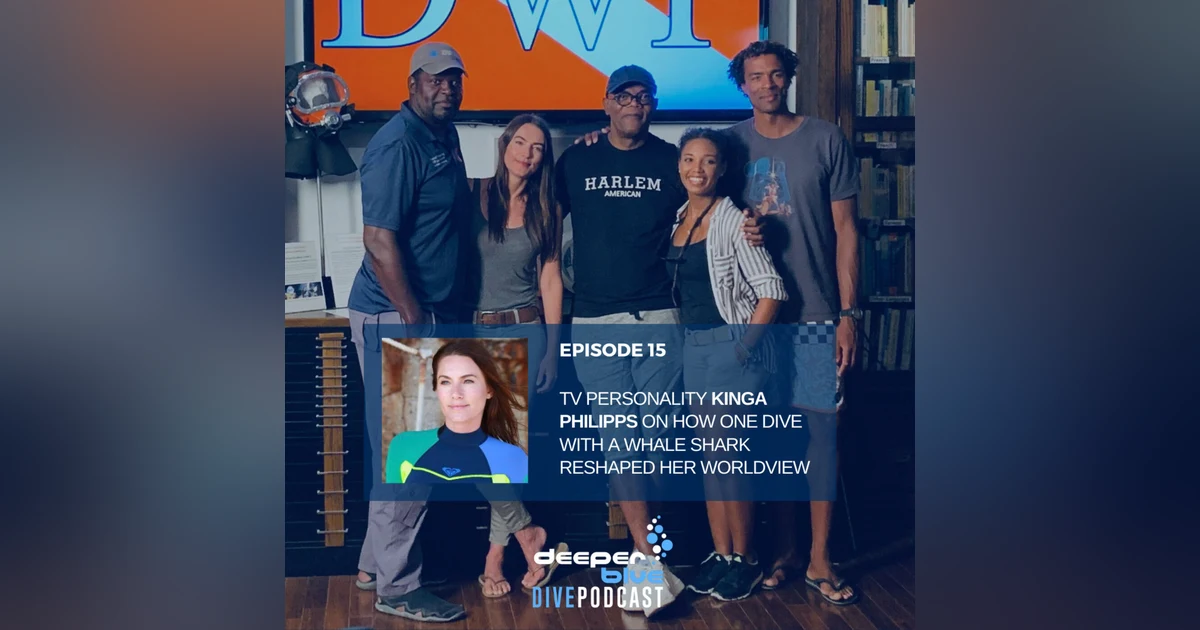
TV Personality and Journalist Kinga Philipps on How One Dive with a Whale Shark Reshaped Her Worldview, and More Convention Cancellations


 Apple Podcasts
 Spotify
 Amazon Music
 Overcast
 Castro
 iHeartRadio
 PocketCasts
 Podchaser
 TuneIn
 Deezer
 RSS Feed
 YouTube
 In Episode 15, you'll hear the latest news in the last week from around the world underwater including an update on AWARE week 2020 and several dive shows continuing the spate of cancellations and a new online dive show starting to hot up.
Then we welcome back co-host Linden Wolbert as she sits down with TV personality, avid Freediver & Scuba Diver, and ocean advocate Kinga Philipps. Kinga talks a little about her life in front of the camera, life as an ocean advocate, and how an eye-opening encounter with a whale shark gave her a much larger perspective on the world.
Our top tip this week comes from David Diley - Underwater Director/Videographer and director “Of Shark and Man” - who tells us his top tip about his perspective that if we want to be a good diver we need to start above the water.
And then finally we hear from Gary Chuven on his Best Dive Ever.
Don't forget to give us ★★★★★, leave a review, and tell your friends about us - every share and like really makes a difference!
Welcome to the Deeper Blue Podcast, your weekly guide to everything that is happening around the world underwater. My name is Stephen Wheeler. I'm the founder of Deeperblue.com, the world's most popular diving website. Every week, the Deeper Blue Podcast covers everything that's happening in the scuba diving, freediving, diving travel, and ocean advocates world. So join us as we explore the Deeper Blue. Hi everyone. Episode 15 of the Deeper Blue Podcast. Coming up in this episode, as usual, we have the latest news from around the world underwater this last week. We then welcome back co-host Lyndon Walbert as she sits down with TV personality, avid freediver and scuba diver, and ocean advocate Kinga Phillips. Kinga talks a little about her life in front of the camera, life as an ocean advocate, and how an eye-opening encounter with a whale shark gave her a much larger perspective on the world. We then hear from David Diley, the underwater director and videographer and director of the shark film Of Shark and Man, who tells us his top tip. And then finally, we hear from Gary Chuvan on his best dive ever. Before we get to the news, I want to announce a major milestone that we passed this week. 300,000 likes on our Facebook page. I'll be honest, I'm always astounded and honored when I see how far deeperblue.com has come in the last 24 years. In fact, although the site doesn't have an official birthday, a version of the site went live in September 1996. For something that I started while I was at university all those years ago, I have to pinch myself whenever I hear some new major milestone has been reached. It is totally mind-blowing. What made me laugh though is when I post the announcement on Facebook and a lot of my friends in the industry got in touch to give their congratulations, which is obviously very fantastic, but one that really stuck out was one of my fellow Brits, Dean Martin, who works with Aqualung, who said he listens to the podcast every Sunday as he gets in the car to go diving and was chuckling, but apparently my voice is very soothing. Something he didn't expect to be the case at all. And as I think most of my friends would agree, getting to the point where they were listening to me in their ear every week was not something that they would ever expect. So a big thank you to those who know me and keep coming back for more. And an especially big thank you, Dean. This is ones for you this week as you get in your car and go diving on Sunday. So on to this week's Diving and Ocean News. The dive show world continues to be shaken up. This week we've heard of two US-based shows deciding to cancel upcoming shows. Firstly, we have the Blue Wild Show. This is a fantastic show. We've attended a number of times over the past few years and been both attendees and exhibitors. It's one of the few global shows that has a strong free diving spearfishing focus. And this year they had changed their date from the more traditional April timeframe to November, which was going to be just after the DEMA Trade show, which we all know has now been cancelled for this year. We got an email last week confirming that it just isn't possible to run the show with the continuing challenges of COVID-19. And Sherry, who runs the show, has decided they'll come back in 2021. Similarly, the DC Dive Show had originally decided to go virtual for their February 2021 show, but have now decides to cancel all their 2021 shows, citing the impact the pandemic has had on both exhibitors and attendees for the show. On a positive front, though, there is a new online digital show called Scuba Digital that really is trying hard to move the concept of a dive show into a digital format. They are an online earning event being held over the 23rd to 26th of October this year. And as a visitor, you'll be able to interact with the exhibiting brands and speakers, as well as listen to both live and pre-recorded sessions. They're starting to gather a decent list of exhibitors across resorts, travel companies, equipment companies, and dive agencies. And we'll be watching closely to see how the show takes off this year. In the meantime, if you want to grab a ticket, they're currently priced at $10, but are set to rise to $15 or $20 as we get nearer the date. And you can head to scuba.digital to go and pick up your tickets. I'm so pleased to see my friends over at Volivolley Beach Resort in Fiji that they've been awarded Fiji's only Blue Oceans Dive Centre accreditation. Blue Oceans is a global environmental awareness project focused heavily on the oceans and waterways, however, also addresses many land and humour-related environmental impacts. I was lucky to spend a few days with the team at the resort and go diving when I was in Fiji back in 2018, and I could really see their personal approach, commitment to the environment, and responsible use of resources around the resort and dive centre. So massive congratulations to the team there on itching to go back and stay with you and go diving on those amazing reefs when it's safe to do so. The third annual Airware Week, organised by Paddy and Project Aware, took place last week as a way to empower people everywhere to carry the torch for ocean protection. Project Aware is a charity working to encourage divers to support the oceans primarily through shark conservation and removing marine litter. It's closely affiliated to Paddy as it originally started as a foundation in 1989, and Paddy itself helps provide offices and infrastructure to the organization. The annual AWARE Week is meant to encourage the global dive community to lead or take part in conservation activities and courses for a clean and healthy ocean. The event provides opportunities to support the ocean health, whether you're in the water or out of it, and in a variety of ways anyone can get involved, whatever capacity they have during these times. The week saw hundreds of beach and underwater cleanup activities, as well as dive centres, offering divers new and old the opportunity to learn some of the project to wear specialty courses, such as Dive Against Debris Speciality and the Shark Conservation Speciality. We have a long-standing partnership with Cunto, and this week Erin, who is one of our associate editors, published an article looking at the in-depth process that goes into the idea, design, construction, and testing of new dive computer. In this case, it was a two-year journey to bring the Cunto D5 wristwatch computer to life and included dozens of people's take it from concept through development and then the final launch that we were at at the Dema Show back in 2018. It's truly a fascinating journey that I don't think any of us really appreciate when we strap that dive computer onto our wrist before a dive. And I've pretty much always dived a Cento, even if it was a backup computer. So to get a peek behind the curtains, so to speak, is really quite amazing. I was also fascinated to find out that Cento had started over 80 years ago by a Finnish adventurer who invented a liquid-filled compass to keep him safe wandering around knee deep in snow and Arctic darkness. Just imagine what he'd be thinking these days about these magical computers that sit on our wrists to keep us safe as we go diving today. So take a look on deeperblue.com. The article is How It's Made, Sunto D5. Finally, and before we get to the main interview this week that our friend and co-host Lyndon Wahlberg has with our TV host and adventurer Kinga Phillips. It's worth checking out another one of the articles our very, very busy associate editor Erin has done this week. So Kinga recently appeared in a docu-series called Enslaved that features film superstar Samuel L. Jackson as he and the team explore over 400 years of human trafficking from Africa to the New World. Erin was very lucky. She sat down with Kinger and a dive team from Diving with a Purpose, who supported the series and really dug into the fascinating facts and detail behind the series. It included a fascinating exploration into tracing down the sunken slave ships around the world, including three different continents, which included a 100-meter, 330-foot dive into the English Channel. Although an original edit of the article said it was a hundred meter dive in the Thames, the river through London, which being a Londoner myself, we did look at and go, that's probably not right. 100 metres is definitely not the depth of the Thames, although it is going to be pretty murky down there. And they also did things like diving off the coast of Florida to locate the wreck of the Spanish slave ship, the Guerrero. So another one really worthy of adding to your reading list. And if you head to deepbulu.com after you listen to the podcast, you can get the full article there. So that's it for the news this week. I hope you're really enjoying these podcasts. We are loving putting them together. Please do tell your friends about it. Drop them an email, send them a link. We post a lot of stuff on Facebook, Instagram, and Twitter. Share those as well. Really, honestly, all these things really help in getting the word out about this podcast. And of course, if you like this episode, head to wherever you're listening to it, click on the subscribe button, hit the like, provide a comment or a review if you can, wherever you're hearing your podcasts. Everything really does make a huge difference.
SPEAKER_01Hi, this is Tanya Streeter, free diver, mom, environmentalist, and just general ocean lover. And you are listening to the Deeper Blue Podcast.
SPEAKER_00Hi, it's Jason Elias, producer of the Deeper Blue Podcast. Today we welcome back Lyndon Walbert as she chats with TV personality, avid freediver and scuba diver, and ocean advocate Kinga Phillips. Kinga talks a little bit about her life in front of the camera, her life as an ocean advocate, and the realization of how one day with a whale shark gave her a much larger perspective on the world.
SPEAKER_03I'm Lyndon Walbert, and I am here with Kinga Phillips, a wonderful ocean advocate, a host on many different television shows, and an avid diver, free diving and scuba diving both. Kinga, welcome to the Deeper Blue Podcast. Thank you, Lyndon, so much for having me. I'd love to know a little bit more about you and what you do.
SPEAKER_04Well, I am, as you said, a journalist and I am a TV host. And I have also had the pleasure of being an ocean advocate, in particular with the group shark allies that I work with that conserves sharks as apex predators and also the oceans as a whole, because they are so incredibly important.
SPEAKER_03And what draws you to the ocean as an element you like to immerse yourself in?
SPEAKER_04Salt water in particular has some kind of a property that has always been not only a draw, but this cleansing of all. And to me, getting into the ocean, whether it is for a scuba dive or a free dive or a surf or a swim or just wading around, has some kind of a magic to it that I've never experienced anywhere else.
SPEAKER_03I know that you've done some incredible filming recently for several shows, one of them particularly called Enslaved. And can you share a little bit about that with us?
SPEAKER_04I can. So Enslaved is a six-part series that will air on Epic starting in September. And the premise of the series is to take a look at the transatlantic slave trade, the history of through the lens of diving shipwrecks associated with the slave trade all over the world. So we got to go to some of the most spectacular, exotic, beautiful, harrowing areas from the English Channel that was so dynamic from an ocean perspective, to the coast of Costa Rica that was beautiful and warm and relaxed and tell these profound stories.
SPEAKER_03Wow. And what was it like to be on those shipwrecks, knowing the history of some of those spaces that were now submerged?
SPEAKER_04There's a duality when you're doing a show like that, because from one sense, you have this incredible camaraderie with your team, and you are filming in some of the most beautiful locations in the world. And we are also all the biggest fans of the ocean. So there's this immense joy of getting to do what we do and do these dives and experience these things and see the shipwrecks and see the area and being in these like dynamic, beautiful, colorful environments. And then as soon as you just feel your excitement growing about how lucky you are to be there, you layer in the feeling and the realization of what we are actually doing there and the story that we are telling, which is harrowing and dark and awful and truly the bottom of the barrel of human history and how humans treated each other. So there is very much a double-edged sword of the magic and the beauty of the locations and the people and the places and the ocean environments and also the history of what we're discussing.
SPEAKER_03And when you're on these dives, whether you're doing something for natural history, whether you're doing something for human history, what is a moment that you can recall that was just definitive of your connection to the sea?
SPEAKER_04You know, I have had so much pleasure in the shows for National Geographic and Travel Channel and Sci-Fi and all the shows that I've done over the years. So there's always been a water element and an ocean element because I think the producers know that I gravitate towards that and it's just a fun visual space. So I've had that pleasure of getting to speak to the ocean environment and its predators and how spectacular it is on TV, even if the particular show isn't about that. But to me, some of the most incredible moments that I've had have truly been on a personal scale. And one of the most magnificent ones is going out to find whale sharks. And I went to Islam with Harris by myself once because I wanted to see them so badly. And it was a spectacular experience. And they have the massive gatherings of them there. A 450 large, I think, was the largest one recorded, and it was wonderful. But it was also tourists crawling all over each other. And you can't blame them for that. It's an incredible spectacle. You want people to see it, but there's that balance of experiencing our ocean in a responsible way. Two years later, I went back with my sister and two of my best girlfriends, and we went to ease the hallbosh this time. And they also take you out to see the whale sharks to the same area, in fact. And somehow we ended up on this boat. We ended up in this beautiful blue water, and the four of us girls swam with honestly 10 plus massive whale sharks for two hours, and it was just us. And it in that moment, it occurred to me that on this planet of almost 8 billion people, here are four of us tiny little humanoids having this incredible experience with these wonderful, spectacular, Disney-like animatronic creatures, and it was just us. And that is why the ocean is so profound to me, that it is so vast and so incredible, and there are so many magical moments that you can experience like that, and it just be you.
SPEAKER_06You almost want to be able to dive without thinking about it because a lot of the time you're going to be invested in what's happening on the screen of your camera. And you need to be in a position where your diving is strong enough and good enough that that's not going to cause you any problems. And I'll split that into a second part, which is if you really, really want to get into that, maybe you're a diver at the moment, and you could be a professional diver. You could be a very, very experienced diver. Or you're just starting out on your diving journey, is film topside first. Get good with a camera on land because you don't have all the other stuff to think about. You get the fundamentals right, focus, exposure, composition, storytelling, get them right, learn your camera, know what you're doing, so that then when you combine the two, your diving is so good that you're it comes second nature, you don't really need to think about it so much. And the camera side of it is so good it comes second nature that you don't really need to think about it so much. When you get to the point where you've got both of those together, when you're underwater, you'll be able to capture much, much better quality footage.
SPEAKER_05My name is Gary. I currently live in Chicago. My best dive was my daughter's first post-certification dive. She was just turned 13. We were in Florida, and we dove the Sea Ember a barge that was sunk some years ago. Holes are cut in the hull. It's upside down. There are concrete culprits around. It's a great place to see marine life. Goliath groupers, murray eels, sharks now and then. It's 72 feet to the sand, 45 feet or so to the keel. So I told the dive off that I was taking her to the keel, circle around at 45 feet. And if she was comfortable, we were going to touch the sand, and that's what we did. The best part about the whole thing? She got cold. Didn't listen to her father, didn't listen to the instructor. She chose a shorty wetsuit. But we had a great time, and we've dove since, but that was the best one, at least with her.
SPEAKER_07We'd love to hear your story about diving. So at the end of the show, you'll find out all the info you need to submit your best dive ever. Thanks for listening to the Deeperblue Podcast. Find out more on all the stories you've heard this week, plus connect to the world's largest online dive community at deeperblue.com. And if you like what you've heard, please subscribe, like, and comment wherever you hear your podcasts. These comments and subscribes really make a difference. Before we go, I want to give a big shout out to Jason Elias, our producer. In case you didn't know, he has an amazing podcast about people who have a deep connection to our world's oceans. Connections strong enough that they've dedicated some part of their lives to being in or working on behalf of the water. Take a listen when you get a moment to Jason's show, the Big Deep Podcast. Every week, we want to hear your stories and share them with the world. So please record and send in your short story of your best dive ever. Keep it brief, no longer than two minutes, please. And in it, tell us your name and location, where you were on the dive, what happened that make it so great, and why it's meant so much to you. You can get that over to us at best dive ever at deeper blue dot com. Or head to our website podcast.deeperblue dot com forward slash best dive ever. Join us again next week and explore much more of the deeper blue.