Colombian Freediving Superstar Sofia Gomez on Rediscovering Her Love of Competition, and David Attenborough's "A Life On Our Planet" Documentary


 Apple Podcasts
 Spotify
 Amazon Music
 Overcast
 Castro
 iHeartRadio
 PocketCasts
 Podchaser
 TuneIn
 Deezer
 RSS Feed
 YouTube
 In Episode 17, you'll hear the latest news in the last week from around the world underwater including some thoughts on the new David Attenborough Netflix documentary “A Life On Our Planet” and the new Oceans.io S1 Dive Computer that features a unique underwater messaging option.
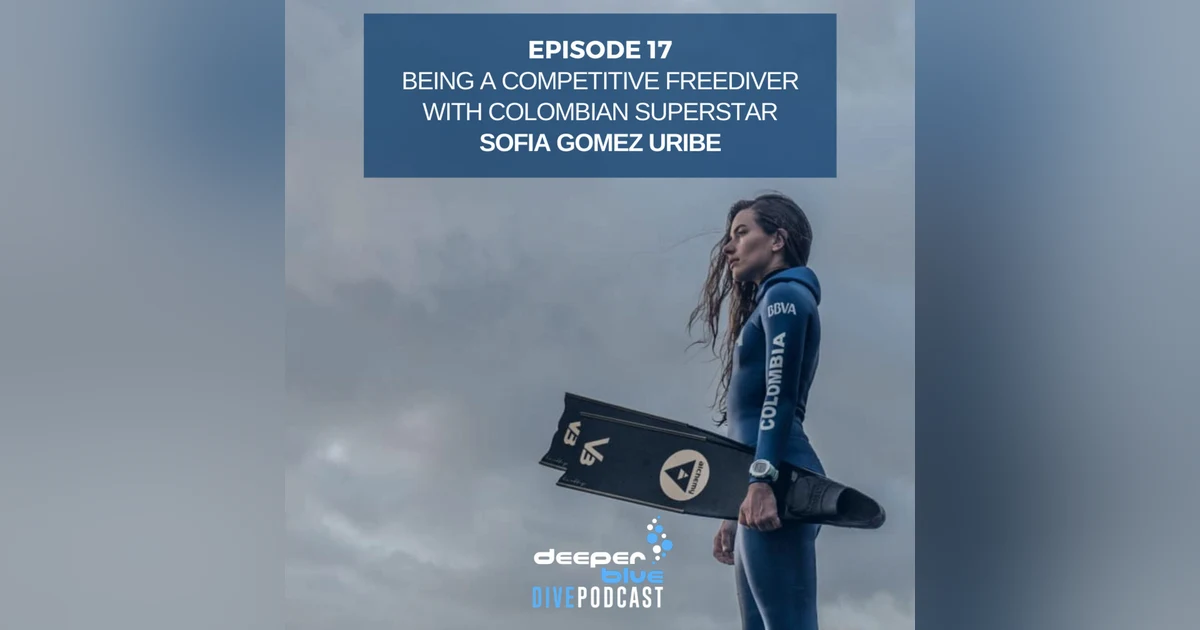
Then co-host Linden Wolbert talks with Colombian freediving star Sofia Gomez about what it means to be a competitive freediver and reconnecting with the passion that got her there.
We then hear from Captain Bobbie Scholley - legendary navy diver and salvage expert - who talks us through her top tip about setting goals to make your dive a success!
And then finally we hear from John Griffith on his Best Dive Ever.
Don't forget to give us ★★★★★, leave a review, and tell your friends about us - every share and like really makes a difference!
Welcome to the Deeper Blue Podcast, your weekly guides to everything that is happening around the world underwater. My name is Stephen Whelan. I'm the founder of DeeperBlue.com, the world's most popular diving website. Every week, the Deeper Blue Podcast covers everything that's happening in the scuba diving, freediving, diving travel, and ocean advocates world. So join us as we explore the Deeper Blue. Welcome to episode 17 of the Deeper Blue Podcast. Carp today, in this episode, as always, we've got the latest news in the last week from around the world underwater. Then co-host Lyndon Walbert talks to Colombian freediving star Sophia Gomez about what it means to be a competitive freediver and reconnecting with the passion that got her there. We then hear from Captain Bobby Scholey, that legendary Navy diver and salvage expert from a few weeks ago, who talks us through her top tip about setting goals to make your dive success. And then finally, we hear from John Griffith on his best dive ever. Before we get started this week, I want to talk about another milestone achievement that has happened this week. The DeeperBlue Instagram page has hit 70,000 followers this week. It's another mind-blowing number that comes right on the heels of that 300,000 likes that we got on our Facebook page just a couple of weeks ago. I really am so humbled and honored that so many people are taking the time to watch, like and share our posts. The Instagram page actually is a little different to our other social media as we feature stunning daily photos from amateur and professional photographers alike. I have to say, when I look at it on a daily basis, there really are some truly epic photos that appear. So if you don't already give us a follow, why don't you go and check out Deeper Bluegram on Instagram? And I'm pretty sure you won't be disappointed. Really, some truly inspirational stuff on there. So, onto this week's diving and ocean news. There's no one on earth who has had a life quite like David Attenborough. The BBC broadcaster has been the soothing voice of nature documentary narration since the beginning well of nature documentaries. Ansborough set off to explore the globe in his twenties and has been broadcasting the wonders of the natural world to the public ever since. He's now 94, unbelievably, and throughout his long life has watched the natural world wither before his eyes. And it really does seem that he's tired of keeping quiet about it. I've seen a lot of social media posts recently about his new Netflix documentary, A Life on Our Planet, which was released last week. And I decided to give it a watch. Actually, it was funny enough, the same day that my oldest daughter came home from school and she showed me some homework that was about Sir David Attenborough. And it really did give me some hope that schools are taking an interest in educating our up-and-coming ocean advocates and divers about the state of this planet. The scale of the problem is so overwhelming, so gargantuan, that it can be very difficult to absorb and to communicate through a single documentary. But by framing environmental destruction through Attenborough's eyes and his absolutely unique career, A Life on Our Planet manages to humanize an issue that can often seem distant and somewhat abstract. The documentary is bleak viewing for anyone that cares about this planet, whether you are above or below the water. It's depressing but utterly important viewing. Thankfully, the documentary does take a more optimistic turn as major environmental victories are highlighted and the film begins to focus not on a scorch apocalyptic future, but on a world restored. Well, it isn't a documentary about diving, it is incredibly important to watch, and there's a lot of ocean-related content in there. And as I've said before, we as divers are the ambassadors of the oceans. So we need to take on board what you can do to help every inch of this beautiful planet. It's not someone else's problem. It's yours, it's mine, it's ours, and every single person makes a difference. So I really highly recommend going to check out the documentary on Netflix. And Sir David actually now has an Instagram account that you can follow on Instagram, so go and check that out as well. So have you ever wondered how top photographers captured that perfect image to convey the wonders of the underwater world? What kind of technique, experience, and yes, luck yields the perfect, beautiful picture that transports us to faraway atolls and underwater seascapes? Well, the National Marine Sanctuary Foundation is hosting a series of virtual seminars and intimate discussions with world-class photographers on October the 20th, 27th, and November the 10th this year to celebrate the launch of America's Marine Sanctuaries, a photographic exploration that's being published on October the 20th from Smithsonian Books. And it's also the upcoming 50th anniversary of the National Marine Sanctuary System in the US. Each of these three sessions will feature an underwater expert who is sharing their stories about getting that perfect shot, finding their inspiration, and answering their photography questions. And tickets will be limited for each session. The schedule speakers include Keith Ellenbong, Melody Bence, and Stephen Frink. They can be purchased tickets for individual sessions or a package for all of them. And if you head to deeperblue.com, you can find out the links of where to get more information and buy your tickets. Now, we're all looking for some good news these days. Luckily, the newly released Positive Oceans Index gives us a glimmer of hope. The index ranks the best countries around the world for protecting their oceans, and Australia takes the top spot. The brand new study released by sustainable travel company Positive Travel analyses how countries protect their ocean and marine life, examining four key elements marine biodiversity, coastal development and infrastructure, leisure activities, and conservation and regeneration. The Eco Travel Enterprise works alongside 30 organizations, including global institutions, boards, ministries of environment, local NGOs, universities, and research centres to compile the study. Australia's neighbor, New Zealand, was ranked in second place, followed by Canada and Malaysia tied for third, with Papua New Guinea taking the fifth spot. The USA was the 15th on the list, but came in seventh place tied with Costa Rica, Seychelles, and Ecuador. The researchers took into account various factors surrounding marine life and conservation and tourism. And Australia got the first place after ranking highest marine biodiversity, second for coastal development and infrastructure, and seventh for conservation and regeneration. Really interesting research. Go and check it out at positive.travel. I mentioned last week that it was recently Aware Week 2020, the weekly initiative that was run in its third year by Project Aware. So the team at Project Aware got in touch during the week and very much are heralding the event as a tremendous success. The event itself took place between September the 19th and 27th and featured events aimed at protecting the environment across the globe. They highlighted a couple of events to us. The Bann's Diving Resort in Kotau and Thailand conducted dive against debris presentations as well as hosting a shark conservation seminar. And Key Dives in the Florida Keys hosted both beach cleanup and a dive against debris event. Also in the Keys, Rainbow Reef Dive Center removed 100 pounds or 48 kilos of debris from their local inland dive sites after hosting a dive against debris event. You can find out more details and links to some fantastic photos from the events around the world at projectaware.org or head to the news item on deeperblue.com. So this week's very much a conservation theme, and keeping up with that, we've heard that the S1 computer from oceans.io is now shipping to customers. The computer is really quite unique. It's a wrist-mounted dive computer that has the ability to send and receive messages to each other underwater. Yes, even underwater you can't be safe from texting either. The whole venture is backed by Fabian Custeau and is designed to help us all be citizen scientists by including features to log environmental reports and observations, as well as storing details captured by the computer that will enable visual projections on the health and state of marine habitats. So, really interesting computer, really interesting app. Head over to oceans.io to check out the details and find out more. Finally, you may remember about the huge number of Chinese fishing vessels that were reported near the Galapagos Islands that we told you about only a few episodes ago. Well, Oceana, an NGO, has recently released a report that has found that the vessels purposely disabled their tracking devices to mass their positions. Its analysis found that nearly 300 Chinese vessels pillaged the waters of the Galapagos Marine Reserve primarily for squids, which are essentially the diet of the iconic local species such as fur seals and hammered sharks, as well as for many commercial and recreational fish species such as tuna and billfish that contribute to the local economy. Oceana used the Global Fishing Watch mapping tool and they analyzed the data from the fishing vessels found to be near the Galapagos Islands for a one-month period between July the 13th to August 13th, 2020. During this one month period, Oceana documented that the Chinese fleet logged more than 73,000 total hours of apparent fishing. In fact, 99% of the visible fishing activity off the Galapagos Islands during this period was from the Chinese flagged vessels. Overfishing is the biggest problem we have around the state of the oceans today. I know we in the media always focus on plastic pollution, but events like this fishing fleet are examples of how we are truly pillaging the oceans. We need to find ways of stopping this overfishing, and I talked about the David Atborough documentary on Netflix earlier. This is also something that's tackled in there. If you're involved in this sort of conservation or have ideas about how to help, we really would love to hear from you about what can be done. Drop us a line at hello at deeperblue.com and we look forward to hearing from you. So that's it for the news this week. Hopefully I've not made you a little bit too depressed this week. Remember you can catch up on all the latest news and happenings from around the world underwater, including a lot of good news, by heading to deeperblue.com and checking us out on our social media pages on Facebook, Instagram, Twitter. And finally, as I ask every week, please subscribe, like and comment wherever you hear your podcasts. These really do make a huge difference.
SPEAKER_05Oh yeah, I I actually forgot. Okay, uh, let's see. Uh hi, I'm Aaron Arngrim, prolific wreck junkie that can talk to you about all things warrex, and you're listening to the best 30 minutes about diving, the Deeper Blue Podcast.
SPEAKER_04Hi, this is Jason Elias, producer of the Deeper Blue Podcast. Today, a chat hosted by one of our co-hosts here at the podcast, Lyndon Wolbert. Lyndon, as many of you know, is probably the world's most famous mermaid, known as Mermaid Linden, and today she talks with Colombian freediving star Sophia Gomez Uribi about the intensity of what it means to be a competitive freediver and reconnecting with the passion that originally got her there.
SPEAKER_03I'm here with Sofia Gomez, champion freediver from Colombia, and just a very sweet soul. Sophia, welcome to the Deeper Blue podcast. Hi, Linden. How are you? I'm just happy to hear your voice. I would love to know a little bit more about you.
SPEAKER_01As you said, I am from Colombia. I actually grew up in the middle of the country, like right in the middle of the mountains, but my mom is from the coast. So I always had a connection with the water since I was little because my mom felt like if we went on vacations to my grandma's house and we went to the beach, she was afraid that my sister and I will drown because we would go in the water. So I learned to swim really young, and then I started swimming competitively when I was like 10 years old. So I've always had a connection with the water, whether it's the ocean or a pool. Um, I had a really big connection with the pool for more than 10 years because I was a competitive free diver swimmer for for more than 10 years. I've always loved the water, and that's what I love to do.
SPEAKER_03So being a competitive fin swimmer, how did that then translate into becoming a competitive freediver?
SPEAKER_01So in a fin swimming training, we actually learned how to do free diving. We learned some breathing techniques, and at the end of the training, our trainer asked us to do a maximum breath hold, a dynamic with the bi fins. And that day I did 100 meters with a pair of plastic fins, first time doing free diving, and I loved it. And I was like, oh, this is so cool. And I started competing as a hobby, you know. I was still a fin swimmer, and I don't know, two weeks before a competition, my trainer would tell me, there's a free diving competition, do you want to go? And I would be like, Okay. I went to my first competition in December 2010, and I actually did two Colombian national records in that competition. And if you look back, I was such a horrible free diver because I didn't know how to breathe or how to pack, I didn't use neck weight, I didn't use anything, and I still did a really good distance for being a newbie. And I started falling in love with free diving, and in 2014, I decided to quit pin swimming 100% and focus 100% in free diving, and I think that's the best decision I've taken.
SPEAKER_03So, Sophia, what do we have to look forward to? You've done so many things in your career so far. I have just been watching you skyrocket, I don't want to say up, but down, into the abyss in such a seemingly effortless way. And the levels of recognition you've received, athlete of the year in Colombia, and all these incredible commercial campaigns and magazine campaigns. What do we have to look forward to?
SPEAKER_01Well, I think last year I was a little bit overwhelmed with competitions, and then I had an injury, you know, I had a lung squeeze. And many many freedivers don't think that lung squeezes are important or or serious, but that long squeeze made me rethink what I wanted to do as a freediver. I wasn't enjoying competing, you know. I wasn't I wasn't looking forward to do records or go diving deeper. Every time I was trying to do a dive, I would get so stressed, you know, and I was like, oh, this is not what I love about freediving. So this whole year has let me reconnect with what I love. I've been out of the water for four months because of coronavirus, and I miss it so much. And that's what I wanted. Like I wanted to have that urge to go in the water and go deep. So I don't know. For now, I think it's go back to the water and start enjoying it, not put pressure on myself that I have to do a record or that I have to be the best, but to enjoy it and to fall in love again with going deep and with competing and with being okay with being stressed, because I don't know, competition is so bad. Like if you go to the ocean and you free dive for fun and you go to the reef and you see uh animals and you swim with whales and sharks, it's so nice. But when you go to a competition, it's so much stress, and I wasn't enjoying it. So yeah, I think right now my objective is to go again to the ocean and enjoy it. And if I can, of course, my dreams to go deeper than a hundred meters, and I know that the world record is going deeper and deeper, and I'm like not earning a hundred meters, but I'd love to do a hundred and and keep going deeper, but because I love it, not because I have to.
SPEAKER_03And being safe and listening to your body, your heart, and your soul. Sophia, what is an experience or a moment that you feel is definitive of your connection with the ocean?
SPEAKER_01I think the most beautiful moment I've had in the water is one day I was going out for training in Dominica, and I was swimming out. We can swim, it's five minutes, and we have 150 meters depth, and I I saw something floating in the water, and I thought, oh, there it's a plastic bag because it was a little black spot, and I was like, Oh, plastic bag, I'm gonna go and get it. And I kept swimming towards it, and I saw it was a little baby turtle. I was so excited because I always wanted to see a baby turtle, and it was the most amazing encounter I've had, and I I felt that deep connection with that little turtle, and I was like, I don't want to leave you because you know the odds of you surviving are so small, and it would come and rest in my shoulder, and I was like, I'm not gonna touch it because you know I can't touch it, and she would come here and lay on my shoulder, and I was like, I have to leave you. But I spent I think 10 minutes with that turtle. I didn't have a camera, I was alone, but I I think I recorded it in my mind. So for me, that's the most special moment I've had in the water, and the one that it means so much, and it means all the love that I have for the ocean and the animals in the water. I just I just loved it. I was like so excited. I cried. I was like, it's a turtle.
SPEAKER_06I'm Michael Minduno, diving journalist. And this is the Deeper Blue Podcast.
SPEAKER_04Today's top tip comes from Navy diver and member of multiple legendary salvage operations, Captain Bobby Scully.
SPEAKER_02My top tip is one that we use in Navy diving for our dives and our salvage operations, but it's also one that I use in my life for a lot of things. And that is you set your goal and then you make a plan for that goal, and then you follow through on that plan. But you always need to be agile along the way for all those opportunities and sometimes for all the problems that life might throw you so that you can move along towards those goals. This works for both your diving and your salvage operations, but also for those life goals that you might set. So I would tell those young people, and maybe some of those older people also, reach for those goals, whether those goals be to reach for the stars, or in some cases, to reach towards the depths.
SPEAKER_07Finally, every episode we share a story from you, the dive community, where we ask you to tell us about your best dive ever.
SPEAKER_00This is John Griffith, and I am speaking to you from Knoxville, Tennessee. So reflecting back on my best dive ever, I would have to say it was my first dive ever. It was the summer of 1979. My parents were stationed in Hawaii. We lived in Porsche After, which is on Waikiki Beach on Oahu. And I had wandered by the Armed Forces Recreation Center at the Holly Koa Hotel, and Lady was putting a sign out saying scuba lessons. I was a big fan of Jacques Cousteau's underwater world. I think I had read Eugenia Clark's Lady with a Spear by that point, and so I was fascinated by the underwater world and was hell of a beachcomber and I liked snorkeling and stuff, but I'd never dived before. So I'm ahead and took the class, and I gotta tell you, the the world, the fascinating world that was opened up, that very first dive, was absolutely amazing. Did our checkout dives in Huanama Bay. Just magical. And here, 40 years later, it's still magical every time we descend beneath the waves and get to see that magical, beautiful, strange, exotic, exciting, fascinating world that diving lets us be part of, if only for a short time.
SPEAKER_07We'd love to hear your story about diving. So at the end of the show, you'll find out all the info you need to submit your best dive ever. Thanks for listening to the Deeper Blue Podcast. Find out more on all the stories you've heard this week, plus connect to the world's largest online dive community at deeperblue.com. And if you like what you've heard, please subscribe, like, and comment wherever you hear your podcasts. These comments and subscribes really make a difference. Before we go, I want to give a big shout out to Jason Elias, our producer. In case you didn't know, he has an amazing podcast about people who have a deep connection to our world's oceans. Connections strong enough that they've dedicated some part of their lives to being in or working on behalf of the water. Take a listen when you get a moment to Jason's show, the Big Deep Podcast. Every week, we want to hear your stories and share them with the world. So please record and send in your short story of your best dive ever. Keep it brief, no longer than two minutes, please. And in it, tell us your name and location, where you were on the dive, what happened that make it so great, and why it's meant so much to you. You can get that over to us at best dive ever at deeper blue dot com or head to our website podcast.deeperblue dot com forward slash best dive ever. Join us again next week and explore much more of the deeper blue.