Dr Mauricio Hoyos-Padilla on that time he got DEEP with sharks, and Mark Evans on not giving in to peer pressure


 Apple Podcasts
 Spotify
 Amazon Music
 Overcast
 Castro
 iHeartRadio
 PocketCasts
 Podchaser
 TuneIn
 Deezer
 RSS Feed
 YouTube
 Welcome to Season 4 of the DeeperBlue Podcast! In episode 5 you can look forward to:
- The latest scuba diving, freediving, ocean, and diving travel news that has happened in the last week from around the world underwater with producer Jason Elias and co-host Mehgan Heany-Grier .
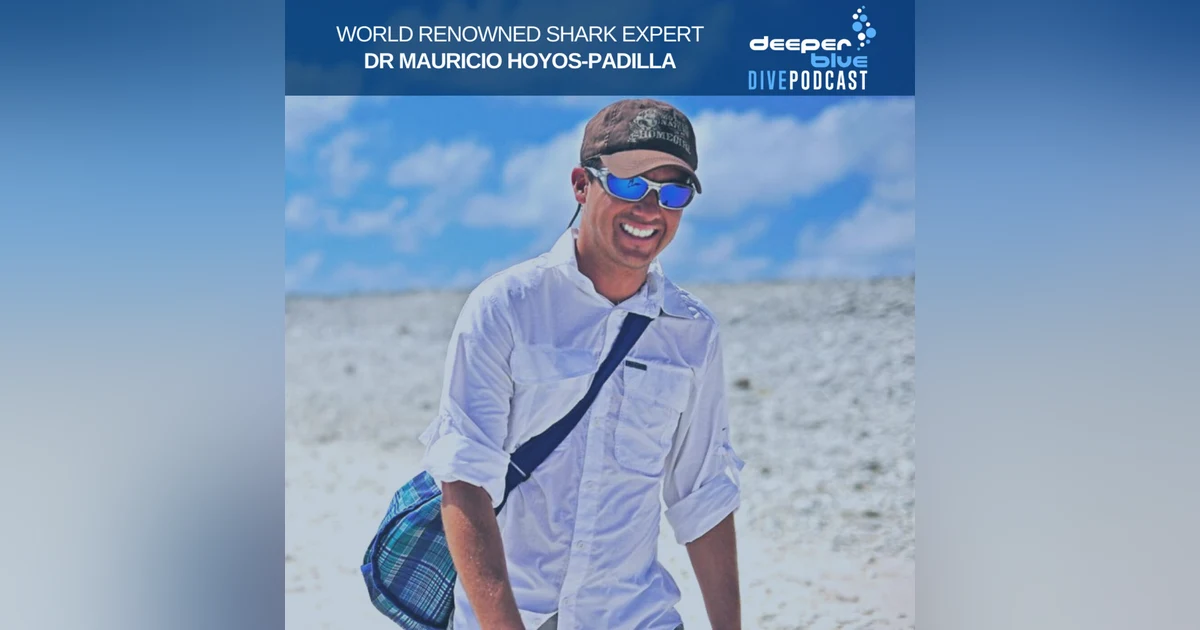
- Then co-host Linden Wolbert speaks with Dr. Mauricio Hoyos Padilla is a world-renowned shark expert. Linden finds out which shark is his favorite, what drives his passion and that time he got DEEP with sharks.
- We then hear a top tip from journalist and Scuba Diver Magazine publisher Mark Evans.
- And then finally we hear a listener-submitted Best Dive Ever from Sammy Kildegaard on diving with whales.
If you’d like to be notified when new shows air, please subscribe to the show in your favorite podcast app or head to deeperblue.com/podcast to signup for the newsletter.
Season 4 of the DeeperBlue Podcast is brought to you by Suunto. Finnish engineering pioneering adventure from mountain top to ocean floor since 1936.
Don't forget to give us ★★★★★, leave a review, and tell your friends about us - every share and like really makes a difference.
Season four of the Deeper Blue Podcast is brought to you by Sunto. Finnish engineering, piloting adventure from mountaintop to ocean floor since 1936. Sunto.
SPEAKER_06Welcome to the Deeper Blue Podcast, your weekly guide to everything that is happening around the world underwater. My name is Lyndon Walbert, and I'm a professional mermaid and co-host of the Deeper Blue Podcast. The podcast for DeeperBlue.com, the world's most popular diving website. Every week, the Deeper Blue Podcast covers everything that is happening in the scuba: free diving, dive travel, and ocean advocacy world. So join us as we explore the Deeper Blue.
SPEAKER_08Hi everyone, welcome back. It's Jason Lee as producer of the Deeper Blue Podcast. And today, instead of the grand fromage, Steven Whelan, we have a much better person to come along. Co-host, Megan Haney Greer.
SPEAKER_07What's up, Jason? So good to be here chatting with you. And that leaves me with some pretty big fins to fill, you know.
SPEAKER_08That's true. Yes, that's true. Well, so so glad you could be here for what is the last episode of the year. Just as a notice to everyone, we are going to be taking a break after this episode comes out until January 11th, just a couple of weeks off for Christmas and the holidays, so we can all relax just a bit. But I'm so glad you're here to finish out the year. It kind of feels like we're finishing out on a high note with you here. We're actually going to start off the news today with a few good stories. So I think our first one, great news from the environmental world. Fish are returning to a restored Indonesian reefs. So scientists from the University of Exeter have been studying Indonesian reefs and reseeding them over the last decade, have found that fish are returning to the reef and the reef is coming back to life. Now, how do they do this? They have been using sound recordings, underwater microphones, to record at the resite and say that the sounds, some of which we have never been recorded before, provide an audible measure of the health of the coral reef.
SPEAKER_07That's such a magical thing, too. And for any free divers out there, and maybe Jason, when you've gone free diving, that's something that uh I always talk about whenever I do any public speaking or anything and sharing about free diving. It's like you get down there to the silence, but it's not silent at all. A healthy, thriving reef and ocean is so noisy, even when you're free diving. So minus any bubbles, right? But like just the crunching and cracking and snapping and the communications going on between the species is really incredible. So I can imagine what these recordings are sounding like. It's really cool.
SPEAKER_08They were saying that the backing track to the reef was created primarily by snapping shrimp that sounds a bit like, and this is my favorite, frying bacon. So that's if there's not if there's a reason to go to the reef.
SPEAKER_07Indeed. I love the good news.
SPEAKER_08And this also comes on the heel of how they've been reseeding the reef.
SPEAKER_07Yes, this is a little bit of a such a cool story. And I think actually, I'm gonna I I think you should take this one too, because you have kind of a cool correlation, no pun intended. Well, no pun intended. I'm trying to keep up with Lyndon's C Puns, but I always thin short.
SPEAKER_08Well, so the reseeding of the Indonesian reefs has happened in part due to coral IVF. And the reason Megan says that this is a story I should take is because I have a three-year-old who was directly from IVF and it's in a magical process. So for people that are not familiar with IVF, IVF is in vitro fertilization, which essentially taking the zygotes of both the male and the female, putting them in a petri dish, letting them grow in the lab before releasing them back, implanting them into a womb of a woman, or reseeding them on the reef. The idea is that you grow it strong enough that it can survive, and then you implant it on the reef. And they've had tremendous success with this in Indonesia.
SPEAKER_07It's really amazing. I mean, and really, you know, the ocean is this not the womb of the earth, right? Where like all this life is just rooted there. And so it's so cool. Like how fascinating science just continually blows my mind.
SPEAKER_08Yeah, I think one of the things that's very interesting about this as well, you know, I get very hesitant to say there's a lot of people I know who are very smart and say, I'm not worried about climate change because human beings are so ingenious, they're going to figure something out before we get to the tipping point. And so I hesitate to ever take that argument because what it does is it reinforces that we don't necessarily have to do what we can now.
SPEAKER_07Yeah. No, I think we're at a point where we need to where everybody should be worried and be doing doing something, not just sitting there, you know, toiling and worrying, right? Like that doesn't do uh uh do us any good, but the action where we're worried enough to go, yes, okay, I can do something and I need to bounce forward. So I 100% re agree with that.
SPEAKER_08Right, right. But it is also I it's also nice to celebrate the times where we see the ingenuity of human beings put to good use. And the idea here of actually finding ways to restore the reefs in a scientific lab and then reseed them. That's just an amazing story. So we wanted to bring that up. Talk about people doing things. That takes us to our next great environmental story. And this is something you should do because I think you have a connection here as well.
SPEAKER_07So, yes, this one is an awesome story. Costa Rica implements green fins environmental standards. And this is the first place to do this in the Americas. GreenFins, for anybody out there that maybe isn't familiar, you should definitely look it up because they're doing a lot of amazing things. They have different courses you can take, all of this. And it's an environmental organization. I've collaborated with them, some at Dima, which is our industry trade show. They are the fins on the ground, so to speak. So they are really implementing these ocean-positive, beneficial environmental standards for dive shops, dive operators, uh, divers themselves to become more educated and be better stewards as we can be for the underwater world. Uh, they're the first country in the Americas that are adopting these environmental standards put together by green fins to reduce the threats associated with diving and snorkeling on the marine environment. And so, way to go, Costa Rica, for adopting these standards and putting it forward to help raise aware awareness with divers there. It's really amazing. I love this story. I love this good news stuff.
SPEAKER_08This is just great news again to see these kind of industry standards being put into place and for Costa Rica being so progressive to actually start implementing the first country in the Americas to do it. And hopefully this is an inspiring to other countries that they can do the same. So that's great.
SPEAKER_07Yeah, is doable. If Costa Rica's doing it, my goodness, we can we can jump in and and turn the tide there.
SPEAKER_08I love it. Okay, onto our next story, which is actually, I could say, in a way, is also positive news. But this one is the the best part about this is it comes from a guy named Nug. There's a guy named Nug who's at the center of this story.
SPEAKER_07So who is not surprisingly from Tennessee, because that's where, you know, down down in the south here, that's where you have those cool cool nicknames, right? Nug Nug.
SPEAKER_08Exactly. Nug is a scuba YouTuber. It's actually called Exploring with Nug. Would that be the Scootuber? A scoot tuber? Oh, good. Oh boy. Linda Linda, Lyndon's guy.
SPEAKER_07That was the mom version of a dad joke. Sorry, guys.
SPEAKER_08True, although I think Linden would be proud. Yeah, I think so. So Exploring with Nug, he is a YouTuber that does scuba videos, and he has done something incredible. He has taken a cold case from April 2000, where two teenagers went missing using the cold case clues and doing a lot of research on his own and then taking some video down to go search. He actually found the car from these two missing kids. Now, unfortunately, he also found the remains of the kids in the car. But what it has done is given some closure to the family. It's also helped the police close a cold case, but it's also he did it all in his video, which is absolutely incredible.
SPEAKER_07I love when divers, you know, where we use whether it's scuba diving or free diving as a tool to better things, right? So finding this, helping close the case. I think it's so cool that that he was able to do this and to to flex his scuba diving in a really positive way to help bring closure.
SPEAKER_08So he used sonar equipped raft to probe multiple uh local rivers. He found the 1998 Pontiac Gran M submerged in the calf killer river. That's a great um with human remions and a license plate matching the car the pair went missing in. And in the video, he actually comes down to the license plate and clears that out. It's pretty incredible. Now, the investigators haven't ruled out foul play, but they believe it's likely the pair lost control of the vehicle accidentally and went into the river. And one of the kids' fathers, Cecil, told the news that the family had never created a memorial for their daughter as they didn't want to do so without knowing for certain she wouldn't be coming back. And now he feels that he has some sort of closure around that, which is it's heartbreaking, but also it's wonderful that the family has that. Plus, it's just an amazing video watch. So I would highly recommend that. We just wanted to call attention to that. People doing amazing things underwater all around the world is kind of what we're about here. So indeed, indeed. Speaking about being above water, this is I've decided this is where I'm gonna go live. So I wanted to bring this story to attention. Do you wanna do you wanna talk a little bit about it?
SPEAKER_07That's so cool because I want to go there too. Okay, so this is amazing, and you must go look at the pictures. This is the world's first floating city that it's not built yet, but it will be built off the coast of South Korea by 2025. I mean, that's like right around the corner. Not really. I mean, this is a uh a way for humanity to survive rising sea levels. This is what the project leaders have announced. And so it's really interesting. Like that part is a bummer. It's really cool though, just looking at the technology and the different sustainable elements they have built in here. So this is a self-sufficient city, and it'll generate electricity from solar panels on top and produce its own food and fresh water. They're gonna be able to ferry inhabitants between the island uh and these futuristic, they're calling them boat pods, and they're in like an octagon shape. And there were a couple really fascinating things about this. They have underneath, they're gonna be able to grow shellfish on these cages that they're putting together. And right. I thought it was really crazy too. The floating material basically is a type of limestone that's it says it's two or three times harder than concrete, but it's still buoyant. So it's just fascinating. You have to see the pictures.
SPEAKER_08Pictures are very cool. And what's interesting about it, it's kind of like uh dissolving the boundaries between above water and a below water living in a way. All of the housing, which can hold up to 10,000 people, they're predicting that these cities will be 10,000 people at each one of these cities. Um, there's uh farming above ground and below water, which is amazing. Plus, also you could scuba dive to work. I mean, if your commute is getting in the water, no, and it said it's all organic farming too.
SPEAKER_07So everything would be farmed organically, which is really important. And then I'm wondering what they're gonna do with their black water. How are they pro- I wonder if they have like composting toilets? More research. In the new year, we'll have the MHG Blackwater Report. That's what we'll have. So we'll we'll know. Sweet.
SPEAKER_08I'm gonna see how I can uh put down a deposit and learn Korean. So next, this is gonna confirm what we've kind of all known. Anyone that gets in the ocean on a regular basis, really, their fear of sharks starts to lessen once you spend time with them because you see that they are just animals like the rest of us, and they're not the Jaws man-eaters that are portrayed in media. But we've always wondered why they attack humans, divers, surfers, all of those kind of things. And now it is official. There's been a study done at Sydney's Toronga Zoo that sharks bite humans because they confuse them with natural plays, such as seals. It's a mistaken identity theory, and it has been confirmed. And how did they do this? They built a virtual great white shark visual system to understand how the apex predators see the world because they have much lower visual acuity than us, meaning they cannot see fine details on that color vision. In these experiments, we were able to see the eyes of a great white shark and humans look like seals. Confirmed.
SPEAKER_07That is totally nuts. Like everything that you just relayed from this incredible study. I mean, think about that. They're seeing the world through the perspective of a shark and able to figure this out, which I love because there was a so a dear friend of mine, uh, the executive director of Ocean First Institute, Dr. Mickey McComb Cobza, she was doing a talk with some students I was working with. And she said at the beginning, she was doing a shark talk. Best line, which I also want on a shirt, is that uh, no, sharks don't want to eat humans. We're too crunchy. So humans are just too crunchy. This confirms that, right? Like it's just mistaken identity. They take one bite and they're like, yeah.
SPEAKER_08The story that we always kind of knew, which is that it's they're really not attacking human beings. They're just they're just confusing us with the prey that they want. It's been confirmed. Love it. And then talking about prey and and just in the world.
SPEAKER_07This is Stephen, this is for you. This is the real heavy duty.
SPEAKER_08This is heavy duty news you could use. Now, this is we're talking about here. Stephen, we're talking about football, American football, and we're talking about the biggest shark in American football, Tom Brady. So I just found this story very interesting.
SPEAKER_07So do you follow football?
SPEAKER_08I don't. I followed I don't really either. Yeah, I don't die.
SPEAKER_07My son is diehard, though. My son's a diehard football fan. And and what I've gathered is that most people don't like Tom Brady. And then I'm always like, why? You know, like I hear it's really good. And they're like, he's just like too good. He's just what everybody always says. And I can't wrap my head around this. Like, why do why do we hate Tom Brady?
SPEAKER_08He's too good, and he's married to like the world's biggest supermodel. So you're like, what kind of like so jealous? Yeah, exactly. But uh, so this is an interesting story that just as a last note. So, particularly as we're in the winter now and things are getting cold. So, Tom Brady apparently sometimes wears a dive suit while he's playing football on super cold days. Now, this is back when he was playing for, I don't know who he plays for now, but he used to play for the Patriots, right? Which is the Boston team.
SPEAKER_07Yes, and I can't remember who he plays for either myself.
SPEAKER_08We shouldn't know, but yeah, I'm sure we'll get no letters about this. But but he sometimes on snowy wintry days would wear a wetsuit. Now, of course, Megan, her first question was like, Well, who made the wetsuit?
SPEAKER_07I hope it was a recyclable green one, right?
SPEAKER_08Like I think it so it looks like here it's XPS. That's do you know who that is?
SPEAKER_07I feel like I should, Jason.
SPEAKER_08But I don't. I don't.
SPEAKER_07I was hoping it was like fourth element, you know? Come on.
SPEAKER_08Right, exactly. Exactly. That's what we'd love, right?
SPEAKER_07Or, or yeah, or I don't know, green pren or whatever, whatever other cool things are going on out there.
SPEAKER_08But I really, yeah, the This is the thing I'm thinking is that maybe now just people, if you live in a cold climate, why not just wear them all the time? Like, why not just wear scoot? Like, you this is a great way where during the winter months, if you're not diving, just take it out, wear it out.
SPEAKER_07Isn't he a vegan and he's he's very into I think he's into the environment and like taking care of the environment and things. I think that's an opportunity for uh one of the dive manufacturers to send him a very good environmentally friendly.
SPEAKER_08News you can use. News you can use. That's that's exactly right. Well, thank you, Megan, for coming and helping close out the year. Very much appreciated. Always great to talk to you.
SPEAKER_06Yeah, likewise, Jason.
SPEAKER_08Just a reminder to everyone that we are going to be taking a couple weeks off and we'll be back on January 11th. But Megan, have a Merry Christmas and happy holidays, and we'll see you in the new year.
SPEAKER_07Happy holidays to all of you to you, Jason, and to all of you out there as well. On with the show.
SPEAKER_08Thanks, Megan. On with the show.
SPEAKER_05Hi, I'm Kirk Kroc of Performance Free Diving International, and you're listening to the Best 30 Minutes About Dive, the Deeper Blue Podcast.
SPEAKER_06Dr. Mauricio Oyos Padilla is a shark researcher based in La Paz, Mexico. Since 1998, Dr. Oyos has made it his life's passion to uncover the mysteries of the most feared predators on our planet, sharks. I caught up with Mauricio just before he embarked on an expedition to Cocos Island, the island of sharks, to find out which shark is his favorite, what drives his passion for this type of research, and to learn about an unusual set of behaviors he witnessed in white sharks while in a submarine deep off the waters of Isla Guadalupe. So, Mauricio, I had heard about you for a very long time. Wonderful things about Dr. Mauricio, who was going to be coming up on a boat to the boat I was on to cage dive with white sharks in Guadalupe off the coast of Mexico. Tell us how you got to this point in your life. What got you excited about the oceans and about sharks?
SPEAKER_02No one believes this, but when I saw the movie Jos, I fell in love with the white shark. And that's when I decided that I wanted to be a marine biologist. And that's why I became a biologist, and then I moved to La Paz to study my master's and my PhD, which was focused on the behavior of the white shark in Balupe.
SPEAKER_06And so what was it that just drew you to these animals?
SPEAKER_02When I saw that movie, I mean, uh, that animal for me was like perfect. I thought that the nature was using Photoshop. Uh when I saw the the pectoral thing, the teeth, the eyes, everything became like for me, it was the most perfect creation of nature right in front of me.
SPEAKER_06Do you have a favorite kind of shark?
SPEAKER_02Yeah, definitely the white shark. I mean, that's why I fell in love with sharks because of Jaws. And I don't know why everybody is afraid. Well, I know why, but in me, it was the opposite reaction. I I fell in love with this animal. They have been here for 400 million years. And if you get to see them underwater, you will realize how perfect they are.
SPEAKER_06You have done extensive research in different parts of the world on several species of sharks. But for you, the white shark is sort of your baby. When I think of great white sharks, I think of, of course, when I was there diving with some of your resident sharks that you have done a lot of research on. Do you feel in some way a relationship with individual sharks that you dive with or research?
SPEAKER_02No, yeah, totally. Actually, in Guadalupe, we have identified uh more than 300 animals. And some most of them they have names. And I have seen these sharks for years and years. One of them is Bruce. I have seen Bruce since 2003, when I was there at the beginning of my career in Guadalupe, and I have seen that shark every year since then.
SPEAKER_06And do you believe that these sharks have any recognition of you? I'm just curious.
SPEAKER_02Well, you know what? Sometimes when I am trying to take a biopsy, I have like a pole spear, which is like a golden spear, and you have to take a little piece of tissue. Sometimes you cannot take it, but as soon as the shark, the same shark sees you again trying to do the same, they go away. They immediately they know that, oh no, no, he he wants to take a biopsy, I better go. So I'm sure that they can relate certain things.
SPEAKER_06I'm curious, Mauricio. The experiences that you've had have to be in the hundreds and thousands of dives and submarine explorations and observations that you've made over the years with these animals. Is there a moment in your history of whether it was diving or something you saw or experienced with these sharks that was just unforgettable for you? Take us on a dive with you.
SPEAKER_02Well, actually, for me, the best experience was when I was in a submersible. I always wanted to be in a submersible. And in 2008, we were able to do it for the first time. And I have this hypothesis for my PhD that the watchers were looking for prey in deep water in Guadalupe, and this is the only place on earth that they do that. We were using this special device that is called Automatic Underwater Vehicle, and it has six cameras, and this device was attacked several times when it was from 96 meters to 267 meters, because we think that the sharks thought that it was a fish and they were attacking this device, and we have footage of nine different attacks, and these attacks were coming from underneath. I mean, I think that the sharks saw a silhouette of something at the surface and they thought that it was a fish, and all the attacks were to the propeller of this automatic underwater vehicle. So we have found that they attack different animals according to how they move. If it is a northern elephant seal, they attack the lower part of the body because they move with that. If it is a California sea lion, they can attack the four flippers, you know? If it's a fish, they attack the tail. And in this case, they were attacking the tail of this device. And we were right at the edge, we were really deep, like 200 meters, and we were just waiting. I thought that the white shirts were staying in that area, right at the edge, waiting for the Northern Elephant Seals to come to Guadalupe. And then we saw this beautiful, huge female right in front of us, and you cannot see her. Actually, when I saw something, I asked the pilot, Could you please turn on the lights? And when he turned on the lights, we were able to see this huge female patrolling exactly how I thought that it was. And I almost cried when I saw this because imagine that you have a hypothesis for years. And then you are in a submersible at 300 meters, and you get to see that actually the big sharks are waiting for the seals right at the edge in deep water.
SPEAKER_01You are listening to the world's only weekly podcast for scuba diving: free diving, dive travel, and ocean advocacy. I'm Ken Stewart of Diving with a Purpose, and this is the Deeper Blue Podcast.
SPEAKER_08Season four of the Deeper Blue Podcast is brought to you by Sunto. I just want to say a big thanks to Sunto for being the first sponsor of this show. They've really shown their commitment to what we're doing. They believe in the podcast, but also about what we represent, which is a way for the community, the ocean and dive community, to hear from each other, connect with each other, and share their passion and love for the ocean. I also want to say personally that I use a Sunto dive computer, and it's fantastic. But I'll also say that before I knew what Sunto was, I would have taken any dive computer that my dive shop was selling. But now that I've had an interaction with Sunto, now that I've actually spent time talking with them about what they represent, who they are, and understand the people that work there, I might be a Sunto fan for life. And I just want to say thank you to Sunto for sponsoring us. I don't have a tagline for you. I don't have anything to say beyond that. I just want to say thank you to Sunto for sponsoring us in this season of the Deep Reboot Podcast.
SPEAKER_00So we're joined by Mark Evans, publisher and editor-in-chief of Scuba Dive magazine with his top tip.
SPEAKER_04And I'm back. Thank you for having me again. Um, yes, what I'd like to talk about today is peer pressure and why you shouldn't give in to it. This is a personal bugbear of mine. Obviously, I've travelled around the world a lot. I've been in a lot of places diving. Number of times I see people on the boat being berated by their buddy, or if there's a group, the group leader, telling, you know, the person's obviously nervous for whatever reason. And instead of giving them support, asking what's making them nervous or anything, they're giving them that you'll be fine. You know, it's like just getting a water, you know, and various other things and just really pushing them. And that I hate that because if you go into the water and you're already on edge and something goes wrong, then you're gonna end up in that spiral down into, you know, something really going wrong. Because you're already, you know, you're not in the right frame of mind to deal with stuff properly. Yeah, it's just a real personal thing of mine that I just hate seeing it. So my advice is do not give in to peer pressure. If you don't want to do something, don't do it. I don't care if you're a newly qualified open water diver and it's some course director who's telling you to get in the water and do something. If you are not happy about getting in the water, stand your ground. I've always said it's better to be sitting on the boat and wishing you're in the water than being in the water and wishing that you were back on the boat or on land. So, yeah, that's my big thing. Peer pressure shouldn't have any place in diving.
SPEAKER_07Where we ask you to tell us about your best dive ever.
SPEAKER_03Hey there, this is Sammy from Free Dive with Me, recording from the Texan Cecos Islands. So, my best dive ever, or one that I can recall very vividly, as if it was yesterday, was a whaling counter. So, me and some friends decided to do a trip to a spot that is located between Bahamas and the Texan Cecos Islands. It is basically in the middle of nowhere. And after a two-hour trip, we hit a spot and there he was. We could even hear the song from the boat. So we shut off the engine, drifted slowly, and once we decided that it was okay to interact with him, then we slowly slipped into the water. He was stationary and singing and singing nonstop. His frequency was so spectacular that I could hear all my my body vibrating. It was like flowing, all the frequencies are flowing all over my my body. He will come up to the surface for breathing and then come back down to around 15 meters and stay there. I remembered his eyes were closed and I I could just go down there and just enjoy this gentle giant. It was so humbling and so special. I can say that I had never experienced anything like that before. I felt so humble and to be in front of these gentle creatures. And even the you see, their size is huge, yet they are very, very graceful in the water. So yeah, it was it was something something special, really.
SPEAKER_07We'd love to hear about your best dive ever. So please head over to deeperblue.com slash best dive ever to share your story about your best dive ever.
SPEAKER_06Thanks for listening to the Deeper Blue Podcast. Find out more about all the stories you've heard, plus connect with the world's largest dive community at deeperblue.com. If you like what you've heard, please share, like, and rate our show wherever you get your podcasts. As those shares and likes really make a difference. Thanks so much, and see you next week.