Filmmaker Inka Cresswell On How It Felt Seeing Her First Footage Play On TV, and Bethy Scuba "The Dive Nanny" On What She Is Humming Underwater These Days


 Apple Podcasts
 Spotify
 Amazon Music
 Overcast
 Castro
 iHeartRadio
 PocketCasts
 Podchaser
 TuneIn
 Deezer
 RSS Feed
 YouTube
 Welcome to episode 10 of season 2. This is the last episode of this season but we'll be back after a short break with some more amazing news, interviews, top tips, and best dive ever stories.
In this episode:
- The latest scuba diving, freediving, ocean, and diving travel news that has happened in the last week from around the world underwater with Host Stephan Whelan and producer Jason Elias.
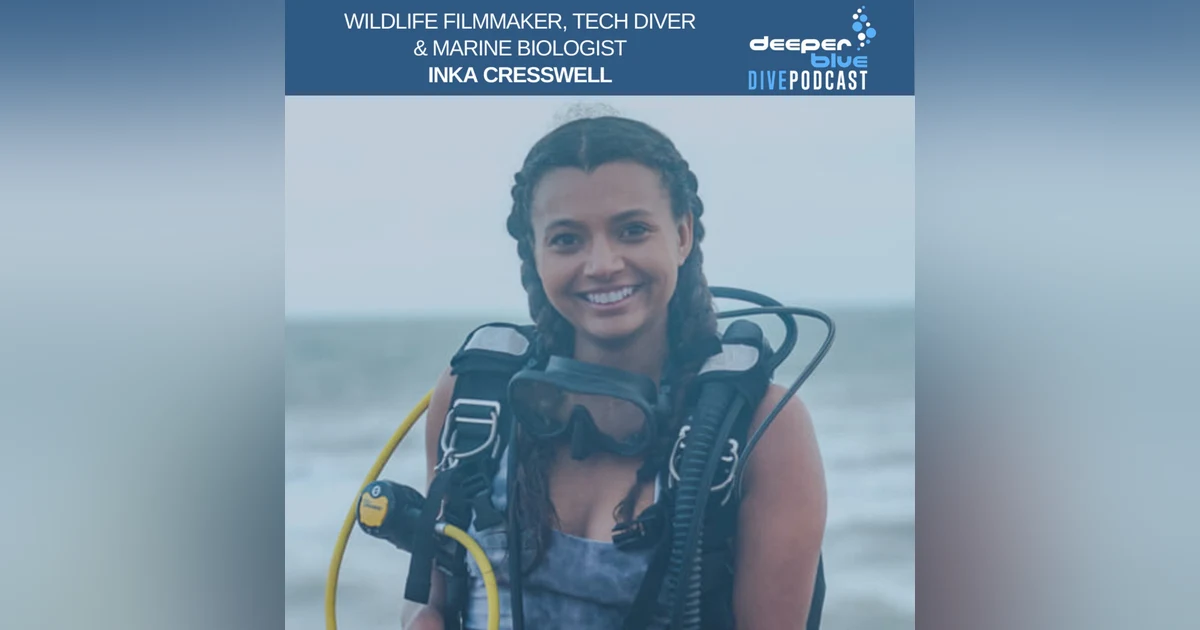
- Then co-host Sarah Richards speaks with Inka Cresswell, filmmaker, and marine biologist. They have a fascinating discussion on the biases inherent in the diving industry before Inka shares her incredible story of getting her big break shooting for the BBC.
- We then hear a top tip from Beth Scuba "The Dive Nanny" on why it pays to hum underwater and what Bethy is humming these days.
- And then finally we hear yet another incredible listener-submitted Best Dive Ever from freediver shares a great late-night dive with Dolphins.
The DeeperBlue Podcast is brought to you by Suunto. Finnish engineering pioneering adventure from mountain top to ocean floor since 1936.
Don't forget to give us ★★★★★, leave a review, and tell your friends about us - every share and like really makes a difference!
Season two of the Deep Blue Podcast is brought to you by Sunto. Finnish engineering, pirating adventure from mountaintop to ocean floor since 1936. Sunto. Welcome to the Deeper Blue Podcast, your weekly guide to everything that is happening around the world underwater. My name is Stephen Whelan. I'm the founder of DeeperBlue.com, the world's most popular diving website. Every week, the Deeper Blue Podcast covers everything that's happening in the scuba diving, free diving, diving travel, and ocean advocates world. So join us as we explore the Deeper Blue.
SPEAKER_01Hi, welcome to the Deeper Blue Podcast. I'm Jason Leas, producer of the podcast. In today's episode, we start off with the news of the week underwater with Deeper Blue founder Steven Whelan and me. Then Deeper Blue co-host and founder of the incredible Girls at Scuba community, Sarah Richards, speaks with filmmaker and marine biologist Inca Cresswell. Inca and Sarah have a fascinating discussion about the hidden biases inherent in the dive industry before Inca shares her incredible story of getting her big break shooting for the BBC. Then co-host Lyndon Wahlberg gets a tremendous top tip from Bethie Scuba, the dive nanny, on why it pays to hum underwater and what Bethy is humming these days. Finally, we hear yet another incredible listener-submitted best dive ever as free diver Emma Farrell shares a great late night dive with dolphins. Also, this is the final episode of season two, so we'll be taking a brief hiatus as we work on bringing you season three of the Deeper Blue podcast. But first, this week's news. News of the week underwater with Steven Wheeland and Jason Lewis.
SPEAKER_02Welcome to this week's news with Deeper Blue and some tabloid stuff from Jason.
SPEAKER_01I had to get it in because this is our last episode of the season two, so it's going to take a little break, so I had to get as much fun stuff in.
SPEAKER_02I'm a bit sad, Jason. I have to say, this is the end of season two. It is. Ten shows of season two. What a fantastic run we've had.
SPEAKER_01We really had a lot of fun. It's a lot of work to put this show together, but it's we say it all the time, it's a labor of love. We really enjoy doing it.
SPEAKER_02And importantly, depending on when you listen to this episode, if you're listening it to the day it comes out, the next day we find out whether we have won the best sports podcast of the year award in the lead story is that this podcast has been nominated for best sports podcast in the podcast publishers awards, and we will be finding out if it wins or not.
SPEAKER_01The thing that's interesting is that we submitted before Steven and I started to read the news together. So they haven't heard any of you and I together. So I don't know if it's a plus or a minus, but we'll see.
SPEAKER_02Well, there's some other awards that were in contention for carry up later in the year, and they have heard us talking together. So who knows, Jason? Who knows?
SPEAKER_01So let's get to the news. Where do we start off, Steve?
SPEAKER_02So our friends over at Dan have issued quite a bit of info this week, actually. So the first one is they have issued some advice that divers should consider waiting at least seven days after each dose of any coronavirus vaccine for engaging in scuba or free diving activities. It's probably because the microchip that they install in you. Bill Gates tracks us when we're underwater. That's exactly right. It's probably needs a bit of time to get it.
SPEAKER_01Good advice, just be cautious.
SPEAKER_02So there were three bits of advice that they've issued. So what you should know about diving after COVID-19, there's a physician's field experience about diving after COVID-19, and then there's one about some guidelines around what to do. That's just really interesting as you read some of these things because they're also tackling people who have had COVID and how do you get back in the water safely if you have had COVID or long COVID. Basically, we just don't know what long-term effects COVID has had.
SPEAKER_01It's all good information, it's cautious information, but good. And that, of course, it comes from an insurance agency. So of course they're they're going to side on the side of caution, which is a good thing. They're also having a webinar coming up, which I thought was interesting about environmental considerations of disinfecting during the COVID age, because as we're all going to be heading back into the water, hopefully sooner rather than later, and we're also going to be going to places that maybe are in different COVID situations than where we came from. We might want to be paying more attention to how we sanitize things. And they're having a webinar talking about how we sanitize things in a way that is healthy for the reefs that we're going to see. So that's great information to have.
SPEAKER_02There's gonna be a load more disinfecting going on because everyone's much more cautious and just about what impacts that can have environmental. So I'm really interested in watching this webinar.
SPEAKER_01There was some other news that came out this week. The scuba show 2021 has been cancelled, and this is deeply impacts me because I live in Los Angeles and that show is in Los Angeles, and it's my main show that I go to every year besides Dima. So I'm a little bit bummed about that, particularly because it's just a great way to kind of connect with people again.
SPEAKER_02It's hard because people are itching to get back and connect with people and see the brands and touch and feel equipment, talking to the manufacturers and retailers and so on, really important. Yeah, I know loads of stuff. Later in the summer, I think it's just that it's that a little bit too early.
SPEAKER_01It's a little bit too early, and that's what they were just saying. They just couldn't do it with the precautions in place, even though I told them I've been fully vaccinated. Didn't seem to really matter. So Dima.
SPEAKER_02Let's let's let's hope for Dima, right?
SPEAKER_01Dima, that's exactly right. So what's next?
SPEAKER_02Another product announcement's come out. There is something called EarPro, which is just launched. It is a preventative remedy against ear problems caused by trapped water in your ears.
SPEAKER_01The reason I put this in there is because now we don't know yet, we haven't done the research in terms of like how well this actually works, but I just really like the idea of this because you know, water is actually something that I've struggled with a few times while diving. Plus, I also like to go swim in the pool, and sometimes that's actually where it's even more of a problem. Apparently, this stuff is you spray it in your ear in advance of going in the water, and it helps prevent swimmer's ear. It uses a liquid paraffin oil and oregano oil, so it means it's also safe for the environment. Very interesting to follow up to see how well this actually works.
SPEAKER_02The only disadvantage is you don't get to do that really silly dance when you get out and you stick your finger in and jiggle it around a lot and throwing your head side to side up and down, trying to get the water.
SPEAKER_01You know, there's all this stuff about boxing punch drunk, and I think about that every time I go to the pool and I get out and I start shaking my head around like a dog. I think that my brain shouldn't be moving around like that. That doesn't seem right. I have very little intelligence to give. So anything that can help me get around those kind of things, I think is interesting to talk about. Okay, what's next?
SPEAKER_02Bit of free diving news now, still over in the United States of America. So your side of the pond, Jason. Yes. For those that don't know, freediving, there's several agencies that will certify records and competitions in there. So a bit like boxing, you can be a world record holder in the same thing, just in different agencies. So the two biggest ones, which is Ada and CMAS, they are teaming up together as federations to judge the competition that's going to be in Tampa Bay, Saturday, May the 8th to Sunday, May the 9th. It's first time that a pool competition has done this. So they've done it on depth competition where they're going as deep as possible, but an actual pool competition, first time they're doing it, which is fantastic, I think, because it just means that there's a bit less confusion about, well, didn't someone just break a record in exactly the same thing?
SPEAKER_01So I think one of the things that they can really do to reduce confusion is since it's in the United States, we can talk about the depth in feet. So we can really talk about the real way to talk about depth, which is in feet, and stop confusing everyone with meters, because you really always have to just convert it. How many meters? How many feet actually is that? So we sh now that it's in Tampa Bay, we can actually just talk feet.
SPEAKER_02Yeah, but you see, what you can do is just learn to do measurements properly.
SPEAKER_01The other thing I was gonna say, uh, I don't know if this is true in the free diving world or not. You know, there's competing agencies like in boxing. There's some that are more legitimate than others. If you ever go get a diamond ring, I got a diamond ring for my wife and I went to a gem show to get it. I don't I there are some very legitimate agencies that certify diamond rings, and then there's the fly by night ones that kind of I think they certified the diamond ring I got for my wife because when I bought the ring, the guy behind the counter actually called his buddy over and said, I just sold that diamond. So that wasn't a good sign that I all right. So well, that's great that this competition has happened, things are coming back.
SPEAKER_02It's good to see free diving competitions coming back, and and the competitive aspect of free diving is really important. It's how the sport has grown, and I'm really looking forward to seeing some more competitions going on. So that's fantastic.
SPEAKER_01Great, great. What's next?
SPEAKER_02Next one. So this is one that I think you you really like, Jason. There's a poacher. Oh yes. So the California Fish and Game Commission recently managed to catch a poacher, a guy called David W. Hornbaker. David W. Hornbaker. He was unlawfully taking some marine species.
SPEAKER_01Catalina Island, yes. I love any story that shows people just bumbling through life like we all do. And I, you know, we all try our best and we're all so confused. This guy, he's an underwater poacher. Already we know he's made some poor life decisions, right? But then he went out to Catalina Island, which is where I've been diving many times, and he anchored his boat and went down diving. So the patrol boat, some uh officer wildlife officers Spencer Gilbert and Rob Rohas on the boat Thresher, skippered by Lieutenant Eric Cord, noticed a small sailboat, and they recognized that sailboat as this dude's sailboat, and they so they knew something was up. So they drove over to his sailboat, he wasn't on board. So then they looked around and they saw bubbles coming to the surface, and they just followed the bubbles like a dive boat until the dude came up. He came up and he had a bucket full of blue bandied gobies with him. Then they actually dove back in the water and went down to the bottom, and the dude had had another bucket of blue bandied gobies down at the bottom of the water. So I just these stories of the bumbles and the people fumbling through life and trying to make it at the margins. I just, I mean, I don't I'm not happy that he's a poacher for sure, but I just it gives me so much compassion for how confused people are.
SPEAKER_02The lesson here is if you're gonna be a poacher, you might as well use a rebreather so you don't get any bubbles out. So you can get caused I was thinking freediving Jason, to be honest, but you have to come up and then go down again on a regular basis. But also the other thing for me, Jason, on this one is he must have heard the boat coming and markup. So it's like saying, Oh, who's that up there?
SPEAKER_01He could have left his bucket down there and come up with nothing on him. Again, a confused guy. David W. Hornbacker deserves what he gets for sure. Yeah. But uh it sounds like a Cohen Brothers movie. It's like someone from a Cohen Brothers movie, right? So okay, what's next?
SPEAKER_02So talking about poachers. So interestingly, uh, eight fishermen who are operating out of Isla San Esteban in Mexico have illegally caught and killed as many as 14 great white sharks. Terrible, that's terrible. Which is awful as so, right. But interestingly, what's come out of this is they've discovered that this actually might mean that the Gulf of California has more great white sharks than they expected and realized in there. So out of a tragedy, scientists are starting to understand perhaps a bit more about the Gulf of California being an area of more activity for great white sharks.
SPEAKER_01Not only that, as we all know, great whites are one of the great mysteries of the ocean, and figuring out how they breed, where they breed, those kind of things are still kind of unknown. Those are still being researched, and they think that because of the large number of females captured, combined with the timing of the entry of tagged females into the Gulf, that this may be a great white shark pupping ground, which is super cool for us as ocean advocates, but also as divers, knowing that there's a place now that this is kind of happening. Cocos Island, I think, is in this region as well, right? So it's not uh it's not outside the realm of possibility that that might be something, but it's just exciting to discover this, especially on the heels of the idea that they were caught by poachers. Like, you know, something good came out of what these people were doing. So very interesting story.
SPEAKER_02Oh, I just come back to one thing you said though, Jason. So one of the great mysteries of the ocean. I thought that was you when you go diving, is one of the great mysteries of the ocean because you just mean people like how does he continue to survive? How does he survive? Exactly.
SPEAKER_01One of the great mysteries. How does he continue to get in and not die? Yes, it's amazing.
SPEAKER_02He looks just like a bit of flotsum in the water. I don't understand, but it's can't touch him.
SPEAKER_01Is he dead? Is it gold or poke him? Is he is he he was thrashing around for a while and now he stopped moving. I don't know what it is. So what's next?
SPEAKER_02So the next one is we saw an article that came out this week, which is around 14 cities that are underwater now. Yes. Um, that you can go and explore. So these are basically real-life versions of Atlantis. That's right. Or the legend of Atlantis, should I say. Absolutely amazing. It's it's really hard to describe on a podcast how beautiful some of these images are and how you just want to go and jump in the water immediately.
SPEAKER_01Well, it's interesting because this certainly, like when we start compiling stories for the week's news, I tend to follow more clickbaity kind of stuff just because that's where my simple mind takes me. So I end up following this article, which said, forget Atlantis, 14 cities that are actually underwater. Now that's definitely a clickbaity article, but the truth is, once you get into the article, it's on fodors.com, the travel guide company. It really is about 14 different cities that are submersed. And so some of them are naturally submersed. They went underwater thousands of years ago, and some of them were submersed because of dams being put into place. But the upshot is that there's actually these places you can go dive these cities underwater, which is fascinating. Some of them are simple walls or ancient mounds, those kind of things, but some of them actually have much more infrastructure underwater, which is absolutely fascinating. And I actually saved this article as a place like over the course of my life, I'd like to go to some of these places and dive these seas, particularly because the history connection to that. The idea of you swimming through places that people used to walk. That's pretty fascinating.
SPEAKER_02The one that I've always wanted to go and do is Yonaguni Jima, which is basically Japan's Atlantis. And it's these like step, it looks almost alien, looks a bit like alien spaceship has flown in and landed. So these really sort of straight block almost lines around stuff. And actually, if you've ever watched Guillaume Neary, the world champion freediver, Long Breath Around the World, he actually dives, and one of the scenes is him walking along, swimming along.
SPEAKER_01Yeah, so this article that's the number one place that they recommend because it is stunning. But there's uh 13 other places which were interesting, and I'm sure we'll have a link on deepenblue.com.
SPEAKER_02Well, and then I think we got the final little piece of news for this week. Right. Which you were very surprised about, uh Jason, because this is This is a Jason story, not a Stephen's story. This is a Jason story, and I put it forward. So this one is great. So this is about science has done some research. It's a small study in Brazil that takes a look at octopi. Octopus. Octopuses. Octopuses.cephalopods, really, is what we should be saying. And interestingly, they have a very similar sleep cycle to humans. The scientists have observed that octopuses pulse their skin with a dazzling array of colours when snoozing away on the seafloor. And the phase of sleep that they realize is very similar to when we do rem, so the rapid eye movement part of sleep in humans.
SPEAKER_01Which is when our deepest dreaming happens.
SPEAKER_02And then they have another part of the cycle which is called quiet sleep, which is when the octopus remains very still and turns a pale white colour, which again is very much like a deep regenerative sleep for us. So it's uh it's really interesting.
SPEAKER_01I wonder what I mean, that just brings up the question what are they dreaming about? I assume if it's anything like me, they're coming into class, they haven't done their homework, they're not wearing pants, something like that.
SPEAKER_02Well, they're probably th I think what they're dreaming about is what is a super cool podcast we could be listening to to learn all about.
SPEAKER_01If I had ears, I guess they do have ears. They do have ears, right? I think do I have to have ears? Yeah, I don't know.
SPEAKER_02I might have to Google that. That might be a follow-up story.
SPEAKER_01What is a podcast? And if it was a podcast, what would I listen to? And I'm sure it would be listening to us.
SPEAKER_02Absolutely.
SPEAKER_01I think on a deeper level, what it really speaks back to is the way human beings can feel we have a monopoly on this experience of life in a way that is unique to us, and it's a great reminder that perhaps the shared communal experience that we have is much greater than our simple species. And it's amazing to think that these sentient beings underwater are having dreams that allow them to process information that they brought into their world. It speaks about the life experience that they're having, and that's just a great reminder for all of us as divers, as human beings, about how we connect to the world.
SPEAKER_02So, Jason, I do love it, mate, because for someone who loves clickbait, you're actually quite a deep thinker.
SPEAKER_01So uh I run the gamut.
SPEAKER_02That's the news of the week. This is our final episode of season two. We're gonna have a little short break and we will be back later in the year.
SPEAKER_01We've already been doing interviews for the next season. We have some in the can. We've got more we're reaching out for. It's been a great ride, the season two. Stephen, thanks for doing this with me. We will see you all on the tail end of this break. We'll see you sometime early summer.
SPEAKER_02Thanks, Jason.
SPEAKER_01Oh, thanks, Stephen. Talk soon.
SPEAKER_00The world underwater. Every week. I'm Dr. Steve Giddings, Chief Scientist of NOAA's National Marine Sanctuary, and garage engineer building the next generation lionfish trap. And you're listening to the Deeper Blue Podcast.
SPEAKER_05It's Sarah Richard, the co-host of the Deeper Blue podcast. And today I am talking to Inka Cresswell. She is a wildlife filmmaker, a marine biologist. She's one of our girls at Scuba Ambassadors, and she is a great role model for females, for UK divers, for anybody looking to get into conservation and diving. I'm super excited to talk to one of my friends, Inca, and I think you guys are gonna love her.
SPEAKER_03Hi everybody, I'm Inca Creswell. I'm a wildlife filmmaker and underwater photographer and have a background in marine biology.
SPEAKER_05So Inca and I know each other because Inca is one of our girls at Scuba Ambassadors. You are definitely somebody that women and young girls can look up to in terms of career and in terms of breaking boundaries in diving. And I'm really interested to talk more about your background. I watched your film and there was talk about Jamaica and your dad, and that really interested me about where your diving story came from and what inspired you to dive.
SPEAKER_03So I am half Jamaican, half British, and where I grew up in the UK, I have always felt like I was drastically missing out, and I am much more suited for a warm climate with beautiful, crystal clear waters. Um I've always just absolutely adored the Caribbean. That's where obviously where my family are from. So I've just always had this love of the ocean, just felt really connected to our oceans. And even in the UK, I grew up in Brighton. So for me, my love of the underwater world started off on my British coastline here in the UK, rock pooling on the beaches. It wasn't that crystal clear, beautiful water that I imagined, but it is an incredible place to start kind of building that natural curiosity for our oceans. And over time, I started snorkeling, I was in the sea constantly. And when I actually was able to go back out to the Caribbean and see some of these reefs for the first time myself, I fell in love. And I think I was probably about five or six years old by the time I said, Yep, I'm gonna be a marine biologist when I grew up. I think I actually told my dad that I was gonna be a dolphin trainer, and he is the one who told me that the correct word for dolphin trainer is marine biologist. And then for the rest of my life said everyone, I'd be a marine biologist, and that's exactly what happened.
SPEAKER_05And it's good that you didn't turn out to be a dolphin trainer.
SPEAKER_03It's a very good thing that I didn't turn out to be a dolphin trainer. I think in that six-year-old mind, I was just like, I want to play with dolphins, this is all I want.
SPEAKER_05So, would you say that growing up with your dad who was diving, did you start to see that it was maybe a lot of males in diving? Did you have that experience? Or, you know, what was your experience with kind of the gender diversity in diving?
SPEAKER_03So I started diving really young. I was about 11 or 12 years old, and it was because my dad used to have a dive club in Brighton. So I used to hang out there after school all the time. And those first dives, I was always budded with my dad, and we would be on a boat surrounded by adult men. And I was just this like tiny little girl with wide eyes, just like with my giant scuba tank. And I was never worried because I was always with my dad at that age. But when I got a little bit older and I hit those teenage years, and my dad maybe couldn't come away with us because he was working and I had to start going on those dive boats on my own. I was absolutely nervous. And it was that, oh, but who am I going to buddy with? Is there going to be somebody who's looking out for me? What if I can't actually lift the gear because I was 13 and everything was brilliant? So I definitely did deal with that. And I think as I've got older though, I've watched that gender shift, which has been amazing. And by the time I did my instructor course, I actually ended up with like there were more girls on my course than boys, which was amazing. And I did my DMT with five awesome girls, and we just had the best time. And I was just like, Yeah, I've finally found my people. This is awesome.
SPEAKER_05I think that hopefully that last generation that maybe we had stories before about how diving was very male dominated. But as we grew and as it came into this time we're at now, there are so many more females in diving. However, when we talk about diversity in diving, I do still think that people only think of gender. They think male and female. Then that's where diversity stops. However, it very much still is, let's be honest, it is a white man's sport. Why do you think that is first up? And how do you think that we can change that and encourage more diversity into diving?
SPEAKER_03It's a really difficult one. And absolutely, as a black diver, and normally the only black diver in a lot of the dive shops that I'm in, it is something that I've noticed over the years that we do hugely lack diversity in these industries. And I think a lot of it is to do with the way that the clubs in the UK are based. A lot of UK divers all come through BSAC, they come through university. We also have a much smaller amount of minorities enrolled in universities that would be have the financial ability to take part in these clubs that are often expensive. The gear is expensive. A lot of people who dive in the UK, they're also diving abroad because they love the tropical waters, and that requires a disposable income to take up what is a very expensive hobby. But in addition to that, there's also these things that we have to look at historically, which is where you've got black people who are excluded from public swimming pools and never learn to swim. So if you've got parents that never learn to swim, they're not teaching their kids how to swim. So then you've got an entire generation of kids from ethnic minority backgrounds who have never had the chance to kind of fall in love with the ocean and feel comfortable in the ocean the way that we have. And I think the thing that I find really heartbreaking about that is that for me, scuba diving wasn't just this fun luxury holiday. It's a skill, it's an essential skill for the work I do. And it has allowed me to have so many jobs open up to me. So I think it's really important that we make scuba diving much more accessible so that it can be a tool that people from all different backgrounds can utilize for doing marine research, for doing conservation work, and for generating an income.
SPEAKER_05And do you know of any nonprofits that focus on that you can tell our listeners about?
SPEAKER_03Yeah, there's some really fantastic organizations doing brilliant work to increase diversity in scuba diving. The Black Girl Dive Foundation, based out in the US, are doing amazing stuff to get more black girls into scuba diving and into STEM careers that focus around the ocean. There's a brilliant little organization called Fish and Fins that teaches ocean literacy out in the Caribbean. And their entire goal is to teach kids about their local ecosystem and give them fins and masks so they can go and understand what amazing life is right there on their own doorstep, which is essential if we're going to make them future ambassadors for their local coastlines. There's another fantastic organization called Diving with Purpose to have taken things even further, and they're actually training an entire group of black divers so they can go out and dive like historical slave shipwrecks that went down in the Atlantic Ocean, which is just fascinating. And it allows people to kind of gain access to that history that they've lost. So some really amazing organizations doing incredible things.
SPEAKER_05Let's kind of step back into why, why you do this and what it is that you love it. I mean, you're a wildlife filmmaker. You must have seen some incredible things, you must have had some incredible experiences. And I'd love to know one that sticks out, one that stays with you, a story that you want to tell.
SPEAKER_03I think a story I want to tell is one that's actually from early on in my career as a filmmaker and as a camera operator, because it kind of shows the opportunities can come from anywhere, and you never know where their next adventure is going to be. And sometimes it is just by getting that foot in the door. So I was working for free, of course, and doing bits of research where getting teas and coffees as you normally do. And there was a situation where the camera operator for a shark shoot failed. And I put my hand up and was like, I can do it. Of course, the immediate look was, What do you mean you can do it? You're the intern that's just like this girl that showed up out of nowhere. I showed my portfolio and they all agreed, and they're like, Yeah, I think she can do it. The next day, I was down in Cornwall, miles offshore, surrounded by choppy waves, and I spent four hours sitting on this boat, rocking backs and forwards. The director got so sick that she was just throwing up over the side of the boat the entire day. And I was just crossing my fingers, going, please let these sharks turn up. About three hours in, finally, we saw our first fin. A few hours later, I was able to get in the water once they'd got used to us, and it was the most outstanding experience. It was just off the coast of Penzance, and I had blue sharks surrounding me, about 30 of them. And they're just stunning. And it's like when the sun hits them just right, they almost glow purple. Their skin is just magical. Visibility was amazing, like mind-blowingly beautiful for UK waters. There were just sharks bumping my camera, ramming into the back of me, circling me constantly. And I was able to get the most amazing footage of these sharks, mouth open, chewing on my dome port at times. And a few weeks later, I got a call from the director saying, we absolutely love the footage, which of course just made my heart soar because I was like, not only did I do it, but like it was good. Someone thinks it's good. And then a few weeks after that, I got to watch it play on the BBC. And it was just the most surreal experience to go from just taking your shot and going to a work experience position to literally seeing my footage play on BBC. It was amazing.
SPEAKER_06Hi, I'm Francesca Trotman. I'm a marine biologist and I'm the founder of Love the Oceans. And you're listening to the best 30 minutes about diving. The Deeper Blue Podcast.
SPEAKER_01The Deeper Blue Podcast is brought to you by Cindal. So, one of the things we're going to talk about today is how a lot of the Cinto Dive computers now have a PSI bar on the screen, making diving easier as all your information is on one screen. Now, for someone that floats through the water like I do, like a piece of dead seaweed.
SPEAKER_02You said floatsome last time, and I was on the top. It's an image that I like.
SPEAKER_01I float along, I float along a piece of seaweed tangled around a log. That's how I that's my diving skill set. I will have to say that I really do appreciate the idea of taking everything off of my plate because I'm basically just down there surviving. And so if I can have a watch like that that just tells me exactly what I need to know with a quick glance, that's pretty epic. I do like that. Now I know it goes to all kinds of professional level people, like people like you know, down to deadwood like me.
SPEAKER_02Deadwood. So look, this stuff is pretty cool. I remember starting my journey in diving where you had your tank pressure gauge that you you had to take a look at, and you know, I was always obsessively checking it, and then as I started becoming dive master and then instructor, and so on, I started checking obsessively all the people who are around me and then Sunto also has w watches for the dive masters so that they can actually see what other people are doing.
SPEAKER_01So if it's someone like you, dive master, that has someone like me, dead wood on the trip, plotsum piece of seaweed drifting in the in the surge, then you can also be watching out for me. Basically, I just want to make sure that I'm safe. So I need you to say make sure I'm safe by looking at your watch, which that's pretty awesome.
SPEAKER_02It is, and I think if I remember correctly, some of them connect up to 20 of these little they've got what they call a pod, which attaches to your cylinder and and it can connect to up to so like the Sinto Ian core and the in steel can connect to you know 20 of these things.
SPEAKER_01So you can't I also like I like the old names that Sunto's chosen copper, steel. Like I like these names, they're they're exciting to me. I'm obviously very easily influenced by marketing language.
SPEAKER_02Well we'll let since we'll let Sunto know that you're easily persuaded around it. So uh they should target some messaging to you.
SPEAKER_01That's exactly right. Well, thank you for sponsoring the podcast, Sunto.
SPEAKER_02Thank you.
SPEAKER_08We're here with Bethie Miller, also known as Bethie Scuba and the Dive Nanny. Bethy, what is your top tip for new scuba divers?
SPEAKER_07My top tip for scuba divers would be to pick a sanctuary song. And what that means is pick a song that you like to sing by yourself in the shower or hanging around that calms you down and really brings you to your calm, happy place. So if you ever find yourself underwater and you're feeling scared or stressed, you can just start singing that sweet little song and to help slow you down. That's amazing. I have heard recordings of you humming, singing underwater. Is that what you're doing when you're doing that? Exactly. And so most of the time, people are like, yeah, you always hear Beth just singing. And I'm like, no, actually, when I start feeling myself getting a little bit overworked or I'm feeling uptight, I just start singing my slow song. And it just starts slowing my heart rate down, and I just start getting into my fishy tune. You're done because come along. And honestly, I feel like the mana rays, when I start singing that low tune, it attracts them and they come over and they're like, What you sing, doll? That is awesome.
SPEAKER_08Bethy, thank you for sharing that top tip with us. That is awesome.
SPEAKER_02Finally, every episode we share a story from you, the dive community, where we ask you to tell us about your best dive ever.
SPEAKER_04So my name is Emma Farrell, and I'm currently in Bath in the UK. And I was in the Red Sea when I had the most amazing free dive of my life. It was the night before my 40th birthday. We were on, I think, the Mistral, which is part of a tornado fleet, and we were moored over the Thistle Gaum wreck, which is an incredible dive site in and of itself, in the middle of the ocean. So we're out in the middle of the ocean, some of us are about to go to bed, and then the call goes up that there are dolphins, there are dolphins. So we rushed to the side of the boat, and from the boat, there are these amazing lights shining down into the water, and we can see these two dolphins. Everyone's like, quick, quick, quick, get in, get in, get in. So we got in, I put my monofin on. I didn't even bother putting wetsuit socks on because I was in such a hurry, I was like, I can't miss this. And we had the most incredible dive session with these two dolphins. They were playing, they were having sex with each other a lot, they were fishing, they were blowing bubbles. It was I've never had an experience with dolphins quite like that. It was absolutely magical. And it was so overwhelming. We had two divers, one was in the special forces, he started crying. We had another male Italian doctor free diver, he started crying because I hadn't put my wetsuit socks on and I was thrashing up and down underwater, you know, diving with them and playing with them. I took all of the skin off the tops of my toes, which was excruciatingly painful. But it was the most incredible experience because you are diving and it is pitch black. However, you've got these shards of light from the lights on the boat shining down into the water, and then suddenly out of nowhere will come this dolphin and it will be circling you and it will be blowing bubbles at you, and then and then they're they're fishing and then they're playing with each other, and it was absolute carnage and it was incredible. And the only thing that stopped us was the fact that we were all absolutely knackered, and everyone who had not put on wetsuits, such as myself, had managed to take the skin off their feet. So that was the most incredible free dive of my life. It will stay with me forever. And it when we went back to the Thistle Gaum the next year on another one of our free diving trips, I was so desperate to recreate this that I actually went to sleep in my wetsuit, which was the most insane and uncomfortable thing I think I've ever done. But I was so desperate that if the dolphins came back, I would be ready. And then about like two o'clock in the morning, I realized that they weren't coming and I had to take it off. But it's one of those experiences which will stay with me forever, and it was just magical.
SPEAKER_02We'd love to hear your story about diving. Uh so at the end of the show, you'll find out all the info you need to submit your best dive ever. Thanks for listening to the Deeperblue podcast. Find out more on all the stories you've heard this week, plus connect to the world's largest online dive community at deeperblue.com. And if you like what you've heard, please subscribe, like, and comment wherever you hear your podcasts. These comments and subscribes really make a difference. The Deeperblue Podcast is brought to you by Sunto, Finnish Engineering, a pioneering adventure from mountaintop to ocean floor since 1936. Sunto. Before we go, I want to give a big shout out to Jason Elias, our producer. In case you didn't know, he has an amazing podcast about people who have a deep connection to our world's oceans. Connections strong enough that they have dedicated some part of their lives to being in or working on behalf of the water. Take a listen when you get a moment to Jason's show, the Big Deep Podcast. Every week, we want to hear your stories and share them with the world. So please record and send in your short story of your best dive ever. Keep it brief, no longer than two minutes, please. And in it, tell us your name and location, where you were on the dive, what happened that make it so great, and why it's meant so much to you. You can get that over to us at bestdiveever at deeperblue.com or head to our website podcast.deeperblue.com forward slash best dive ever. Join us again next week and explore much more of the Deeper Blue.