Francesca Trottman on the Humpbacks of Mozambique, and Dr. Mauricio Hoyos Padilla on why you should leave your camera at home


 Apple Podcasts
 Spotify
 Amazon Music
 Overcast
 Castro
 iHeartRadio
 PocketCasts
 Podchaser
 TuneIn
 Deezer
 RSS Feed
 YouTube
 Welcome to season 3 of the DeeperBlue Podcast! In episode 8:
- The latest scuba diving, freediving, ocean, and diving travel news that has happened in the last week from around the world underwater with co-host Mehgan Heany-Grier and producer Jason Elias
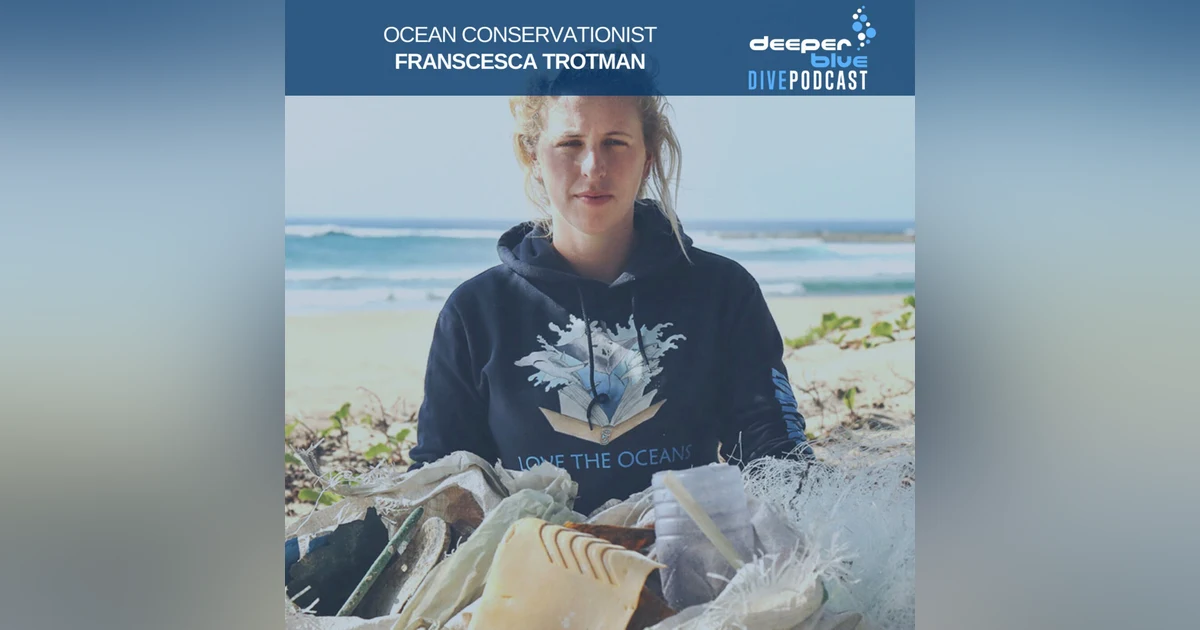
- Then co-host Sarah Richard speaks with Francesca Trotman, the founder and managing director of the ocean conservation organization Love Your Oceans based in Mozambique.
- We then hear a top tip from shark expert, Dr. Mauricio Hoyos Padilla, on why you should leave your camera at home
- And then finally we hear another listener-submitted Best Dive Ever from Dano Krahling who tells us about diving in Deans Blue Hole in the Bahamas
If you’d like to be notified when new shows air, please subscribe to the show in your favorite podcast app or head to deeperblue.com/podcast to signup for the newsletter.
Season 3 of the DeeperBlue Podcast is brought to you by Suunto. Finnish engineering pioneering adventure from mountain top to ocean floor since 1936.
Don't forget to give us ★★★★★, leave a review, and tell your friends about us - every share and like really makes a difference!
Season three of the Deeper Blue Podcast is brought to you by Sunto. Finnish engineering, piloting adventure from mountaintop to ocean floor since 1936. Sunto.
SPEAKER_06Welcome to the Deeper Blue Podcast, your weekly guide to everything that is happening around the world underwater. My name is Lyndon Walbert, and I'm a professional mermaid and co-host of the Deeper Blue Podcast. The podcast for DeeperBlue.com, the world's most popular diving website. Every week, the Deeper Blue Podcast covers everything that is happening in the scuba, free diving, dive travel, and ocean advocacy world. So join us as we explore the Deeper Blue.
SPEAKER_04Hi, everyone. Welcome back to the Deeper Blue Podcast. This is Jason Elias, producer of the show, and today we have a super fantastic person to read the news with, co-host, Megan Hane Greer. Hi, Megan. Hello. Wonderful to be here again today.
SPEAKER_07How are you today? I'm good. It's my birthday today, Jason. Hey, happy birthday.
SPEAKER_04Thank you. 2023, right?
SPEAKER_07Exactly. All over again.
SPEAKER_04No, man. I'm 44 and proud. Happy birthday. Congratulations. Well, let's get to the news. We have a little bit of news today. Steven is. I don't know where he is. Who knows where that guy is? I don't know.
SPEAKER_07He's got his feet kicked up on a beach somewhere.
SPEAKER_04Exactly, right?
SPEAKER_07With a, you know, compostable umbrella in his drink.
SPEAKER_04Well, let's get to the news. So we're going to start by taking us around the world. We're going to start with some travel news, like we do every show, just kind of keeping you updated. And unfortunately, these days, the travel news tends to always be around COVID-related stuff and it's about the what's open, what's closed. And the travel news we have today is that Tahiti has gone into a revised lockdown. International tourists in Tahiti may go anywhere in their lodging as long as they stay within their property. Which basically means that if you you can still go to Tahiti, anywhere in French Polynesia, but what ends up happening is that you have to go to your hotel and stay there. You really can't go do anything. You can still dive, but there's also a curfew from 8 p.m. to 4 a.m. I don't know what people would be doing. This is coming from a parent. So like, what do you do after 8 p.m.?
SPEAKER_07What happens out in the world after 8 p.m.?
SPEAKER_04Yeah, it's like I've been asleep for half an hour.
SPEAKER_07Yeah. I'm reading Harry Potter and Crashing Out, man. That's what we do. Yeah. So it's kind of it's it's a little bit like Hotel California, but maybe better because you can go diving.
SPEAKER_04So that's right. That's right. You still can't. You still and activities in designated areas in lagoons in front of tourist accommodations, snorkeling, swimming, paddle boarding, and then also diving are still available. So you can still go. It's just a little bit limited in terms of what you can do, but still you can still go. So if you have plans to go, just make sure you read, as always, what the local conditions are and what the local requirements are. But that's the only chapel news we have. So what do we have next?
SPEAKER_07Well, next we have a really interesting story about that divers are making a digital map of this 17th century warship that mysteriously exploded. This is called the London. And it just mysteriously exploded back in 1665. 300 souls perished. I think only like 24 people survived. And it's really interesting. They have recovered some incredible artifacts off of this time capsule that went down. They had a lot of guns, like 76. It was a gunship for the Navy. And anyway, it's really interesting because they're making this digital map of it. And they have some of the images from that on this article, which I'm sure are going to be on deeperblue.com, right, Jason?
SPEAKER_04That's exactly all information ocean-related in the world ends up on DeeperBlue. That's where you can find it.
SPEAKER_07But anyway, it's really incredible. And I just uh I love this kind of story because it really can kind of transport you not just underwater, which I'm Jonesing to be right now, but also just way back in time, you know, with all of the artifacts that they have pictured here. And then also just seeing this vessel sitting on the bottom with this digital map. It's really incredible. It is absolutely incredible.
SPEAKER_04The London was sunk in the Thames River. So it's an estuary of the Thames near Essex. There is some incredible things that they're bringing up. What I one of the things I read in here that I thought was fascinating, they said that the divers that do this kind of stuff, they're using all kinds of this mapping technology with lidar and that kind of stuff. But they they're saying that because they're wrecked divers working in these kind of conditions, the murky waters which have a 20-inch or 50 centimeter visibility is considered good by the diving team. So that shows you what kind of thing. Isn't that crazy?
SPEAKER_07I dove in that kind of water and like where it's even been worse. And it is, I just keep thinking I'm gonna find like a like a dead body. Yeah, right. Have you dove in that kind of water, Jason?
SPEAKER_04Um, not going down thinking, I mean, I've definitely been in a cave where my wife kicked up dirt as I was following her, so I couldn't see. Yeah. But beyond beyond that, no, I have not dived in it. This, I don't know how much this appeals to me. I mean, the idea of going down a historical wreck is super appealing to me, but the idea of diving in extremely limited visibility really kind of spooks me a bit.
SPEAKER_07Yeah, I hear you. Not top of the list. Fair enough. I don't I don't think you're alone and and uh with most divers, I'm with you.
SPEAKER_04I will say though, the things that they are finding are pretty incredible. And so I'm sure there'll be a link to this in the in ondeeperblue.com, the world's best source for underwater ocean news. But there are some very cool things on there. Well, that's great. So what do we go to next?
SPEAKER_07Well, let's see. We are talking about a sad story. And even more than sad, Jason, is this is really a tragedy about the orca, um, Amaya, who died recently at SeaWorld's San Diego's uh park. And the reason I consider this a tragedy is just because these animals do not belong in captivity. If any of us can do anything for the ocean and these animals and things like that, is just to not support SeaWorld and similar parks and just really educate yourself onto the reasons why. And this is really sad. They don't belong. She was only six years old. And Orca have such an incredible family dynamic and and just tapestry of community that to take these animals away from their pods is just mind-blowing.
SPEAKER_04It is so yeah, I think one of the things about this is that they're unsure why Amaya died. And I think that for me, I I was always I felt uncomfortable being in a sea world environment, particularly because you have these very sentient beings uh performing, right, in uh tanks that are super small for their size and what they're used to. But then, of course, if anyone has seen Blackfish, the documentary, it really kind of highlights the specifics of why this should not be supported. So they're getting a lot of there's a lot of controversy around SeaWorld in general. And now with this mysterious death of Amaya, there's really getting slammed in the news right now, and it's kind of reinvigorating people to say, why do we keep these parks open? So just keeping that on the radar as in terms of um something that's happening within the ocean conservation world, and also, I mean, I understand the idea of why a sea world sounds appealing in the beginning because you're like, oh, it's a great place to interact with wildlife, but these are not the conditions that really are best for the animals. And that's something that we that should be at the forefront of the conversation.
SPEAKER_07And I I think it's important to say too that shaming anybody really doesn't motivate, you know, ever. But I I feel like it's really important to just do what we can to educate ourselves on what is really happening, and then when we know better, we can do better. And that once you know, chances are if you're a diver and you're a water person, all this stuff, you're you're not gonna want to support it because now you you can't unknow those things. Yeah, good to have on the radar to be aware of what you're supporting with your your money.
SPEAKER_04For sure. Let's go on to some really good news, which is Thailand has so we recently on the show, we had Autumn Blum on the show from Stream2C, whose entire company is focused on creating sunscreens or was formed on the idea of creating sunscreens that are actually not damaging to cars. They are fabulous, and they are fabulous, and she's very cool as well. Uh Thailand has now banned all coral-harming sunscreens. This actually came around during the pandemic because um they saw the revitalization of the reefs and they took that opportunity with a lack of tourists to actually place these laws in effect that it ban these coral harming sunscreens, and it's really great.
SPEAKER_07Yes, it is for sure. There have been some other places that have uh blocked and banned these harmful chemicals as well. But I like in here that they say that they're actually going to be fining anybody who breaks this law and up to it sounded like $3,000. And, you know, a lot of this type of thing comes through in the enforcement. So it'll be interesting to see how that plays out. But yeah, it is, it's such a simple step that we can take as conservation, as imperfect conservationists and as divers of just a, you know, a swap out basically in your gear bag. And they list on here a handful of sunscreens, which are said to be less harmful to sea life. But I do know with Stream2C, as we mentioned, and Badger sunscreen, I know that they have a very hard-to-get rating uh from the, I think it's called the Protect Land and Sea certification. And in particular, they have to really go through the ringer and and prove time and time again with the tests that their products are safe. And Stream2C has passed those and has that rating. So super cool swap out. Easy thing to do as the imperfect conservationists we are.
SPEAKER_04That's right. So good on Thailand. That's some good news. Very cool. Now maybe a little bit less good news. People who listen to this show, people who create this show, we are all connected to the ocean in some way. We have a deep affinity for it. And with the ocean under duress environmentally, that's at the forefront of the conversation. There's a there's a big article in The Guardian recently about Exxons drilling off Guyana, posing a major environmental risk to the ocean environment there. And we just wanted to highlight this story.
SPEAKER_07Absolutely. So this is a situation of big fossil fuel coming in. They're going to be there for 20 to 25 years. And then when they pull out of that area, then the local community is be basically left holding the bag to clean up the mess. And the problem with this is that, especially this one in particular, where there's a lot of concern that there is going to be some sort of environmental disaster. And this will have a huge impact, of course, on the indigenous communities that rely heavily on fishing in that area.
SPEAKER_04I think the what one of the reasons that we're highlighting this in this podcast, there's some major offshore drilling that they're planning. And the concern around this is that Guyana, which is one of the lowest income countries in South America, just doesn't have the resources or necessary oversight to make sure that it's all done within the parameters of what they're allowed to do. And a lot of concern from the environmental world that the company's safety plans are inadequate and dangerous already. Nothing bad has happened yet, but the idea is that we're putting this on the radar in terms of like a place that doesn't have the necessary oversight to make sure that some sort of environmental disaster doesn't happen. And the idea being that really, particularly that this can deeply impact the fisheries there, the uh ocean environment there. And so that's why we're highlighting it here. And of course, what that ends up being is like, well, what can we do? How can we what can we do about that? And of course, that's like, as as Steven says a lot, we can use our voice as consumers. And as Megan says, there's also something we can do as imperfect conservationists.
SPEAKER_07As imperfect conservationists. So one of my episodes, I covered this really simple habit change that we all can do. So if you ever drive a car, there probably has been a time where you are not in traffic, not at a stoplight, you just have pulled off, or you're waiting for kids to come out of soccer practice or school or something. You have sat with your car idle. It's called puffing when you're sitting there in your car just idle. And there's a 10-second rule. So this is a really easy thing that we can do. If you're going to be sitting idle for more than 10 seconds, you can shut your car off because it takes less fuel to start it back up than it does to sit for 10 seconds.
SPEAKER_04And so I think one of the things, again, we've talked about on the show is we do have a lot of environmental awareness on the show. And you might argue, well, for an a dive show, why do you have so much? Well, it's because we actually connect with the world's oceans and the oceans are being deeply impacted by the environmental climate change that is happening right now. And so one of the things we really do try to emphasize here is how our personal choices can impact the place that we love. So even the idea of turning off your car instead of idling, those kind of small changes can really lead to large consequences for the fragile marine environments that we all care about. So thank you for that.
SPEAKER_07Absolutely, especially because they catch on. We like to build on each other's good stuff.
SPEAKER_04That's right. Okay, moving on now to something very cool, which is this is very brief, but this comes directly off deeperblue.com, which is that there is a new expedition to go find Shackledon's endurance, which is so interesting. Their Explorers Club has partnered with Falkland's Maritime Heritage Trust to go find Sir Ernest Shackledon's ship the endurance. They're gonna film it and survey it, which is so cool. That's very, very cool. Yes. I wonder how I wonder how deep they think this is. Yeah, I don't know.
SPEAKER_07It really is fascinating, though. It's endurance 22 and is what they're calling this expedition. And yeah, I mean, polar exploration, it's the explorers club presidents, Richard Garriott, and I think some other Explorers Club fellow fellows of mine over there at the Explorers Club. I just think it's such a neat thing. They're gonna take the flag. I would love to just, you know, I don't know, be the be the fly on the wall and and see things go down with us. That would be pretty amazing.
SPEAKER_04Yeah, very cool. Okay, taking us on to our last story, which is you know, Steven's the one that always chooses these kinds of things. Oh, yeah, that's Steven.
SPEAKER_07He's just not into that like solid news, you know?
SPEAKER_04No, I'm always arguing, let's just hit hard-hitting news, and then he always puts these kinds of things. This has been all over the internet this week, and so that's why we've really this is hard-hitting news that we need to talk about. Sexually frustrated sea snakes mistakes scuba divers for potential mates. So the story that's coming out is that uh a few scientists have discovered that a lot of the sea snake attacks, I mean, I don't think there's that many to begin with, anyways, but the aggressive qualities that sea snakes show underwater sometimes are really not them just being aggressive snakes. It's really because they're frustrated and looking for mates. So this is news you can use. Really, it's really so I okay.
SPEAKER_07So I just I'm gonna just play devil's advocate here for a second. So how do we know they're frustrated? I think there might be a little anth anthropromorphorizing. How do you say thank you? Morphorizing, yeah. I just like I chewed on that one and it didn't work. Pretty funny. So, how do we know they're frustrated, Jason?
SPEAKER_04I don't know. You know, I living in Hollywood, you can always tell who's a frustrated dude at the bar because the ones walking around with the glassy eyes looking to see what woman is sitting by herself. So I don't know that that's the same here with sea snakes. So I don't know what I don't know how they determine that. If you've done dived in any areas that have sea snakes, every time you go down for a dive, people say, if you see a sea snake, be careful.
SPEAKER_07Well, so they're talking, they did some interesting study where they were documenting the encounters, and it said that 74 out of 158 encounters where he was approached by a sea snake overlapped with mating season. So they're we're they're seeing like this funny behavior, which I kind of call it funny. So they call it aggressive, which I think that term's misused a lot, right? Like it's the animal just being the animal, but we are like freaked out because we don't understand what's happening. So we're like, ah, I was attacked. Right. The sea snake is like wrapping around divers and like doing this licking motion.
SPEAKER_04Again, like a this is like a bar of the bigger. Yeah, so I mean, this, yeah, you can't make this up.
SPEAKER_07This happens in Hollywood. So they're like doing this licking behavior, but apparently, you know, they're sensing what's in the water. Just, I mean, just like, you know, land snakes do with their tongues, they're sensing different things in the air, right? And so the sea snakes were doing that, but I mean, you can imagine if you weren't really expecting to be snuggled by a snake, this could kind of surprise you a little bit. What I do like in this article is that they cover some of their potential reasons why that they don't have very good eyesight, so maybe it's mistaken identity and they can't really distinguish shapes, but they're just looking for a mate. These male snakes are just like, they're like, where are the ladies at? And they just find people's fins, parent.
SPEAKER_04That's right. There's a whole incel community of sea snakes that are very frustrated right now. So, well, that's again, Steven, we put that fluff in for you. I don't know why. But that's yes. All right, well, that's our news for the week. Uh Megan, thank you so much for doing this this week. It's always a pleasure to talk to you. Likewise. And I guess on with the show.
SPEAKER_07On with the show.
SPEAKER_02Hi, I'm Freediver William Trueridge. And you are listening to the best 30 Minutes About Diving. The Deeper Blue podcast.
SPEAKER_04In today's episode, co-host Sarah Richards speaks with Francesca Trotman, who is based in Mozambique.
SPEAKER_09My name is Francesca Trotman, and I'm the founder and managing director of the marine conservation organization Love the Oceans. We work in Mozambique, and our mission is to establish a marine protected area. So we do a lot of different areas of research, which I help head up, and we do a bunch of community outreach projects as well with alternative livelihoods, education, and swimming. So we take quite a holistic approach to conservation, and obviously, diving is a large part of that as well. So I'm happy to be here and thank you for having me on the podcast.
SPEAKER_08Let's start from the beginning. I mean, A, how do you even start up an organization like that, which has got so many sides to it and is so instrumental to conservation? And why did you do it?
SPEAKER_09I'd always been obsessed with sharks from quite a young age. So I went to like the London Aquarium when I was eight years old and then learnt to stewardive when I was 13. And so then I just kind of when it came to choosing university courses, I did marine biology. And at the end of my second year, I took an internship in Mozambique in photography. And while I was there, I saw my first shark killing. And obviously I'd read about it, but seeing it in real life is something quite different. So it was quite emotional. And I decided that I wanted to find out why the sharks were being killed, which was for the shark fin trade. And so I went back the following year and collected data for my master's research on the shark fisheries in Mesin Beach. And then I went back to university and was writing up my master's thesis and was getting the exact results we would think in terms of the shark fin trade and its sustainability. But I didn't have enough data to publish to lobby for legislation change or to take any action off the back of the research. So I started Love the Oceans just to continue that research and to try and stop the shark fin trade in our area. But the more I read into it, the more I realized that education is absolutely a crucial tool in changing people's minds and the way that they live and work. And now we're slowly expanding very slowly with sort of micro-organisations, but that's how it all came about.
SPEAKER_08I looked into Love of the Oceans and I've looked at your research trips that you offer, which look amazing and look so fun. It's obviously like a vital part of funding for you and for research. Tell me more about these trips.
SPEAKER_09So we have a few different expeditions that we run. Our main ones are probably our two, our three, and our five-week ones. People can come out and learn to dive and then they get involved in all of the areas that we work in. Um, so it's really yeah, open to anyone who wants to kind of get involved in our work. We're very lucky. We have some incredible animals. So our humpback whales, our seasons June to November, and there are so many whales. Like legit, sometimes it's hard to move the boat because there's too many whales. We obviously have a bunch of turtles and sharks and whale sharks and mandarins too, which are always the big ones that divers love to go and see. The whales obviously you see a heat from the boat as well, and sometimes they'll join you on dives too, which is really lovely as well. And then I've recently started stand-up had a warding in our area too, which is so cool because it's non-motorized. So the whales will just come right up to the board to be like, what is this? Who are you, human? And because we're so rural as well, we're in a very rural part of Mozambique, there's no load traffic, so you're the only people in the water, which means the whales are super inquisitive.
SPEAKER_08Sounds like a dream. Uh, tell us more about any in-water experience you've had, any standout moments that you've had dive in with these whales.
SPEAKER_09The noise that we get diving. The mums and the calves communicate through drumming. So your whole rib cage can vibrate with the drumming calls from mother to calf. You know, when they're really close, it's so loud. It's like yelling at the top of their lungs. But it's so incredible to feel like a whale call as well. But I was on a dive a couple years ago, and I think it will always stay with me. I was at the back of the dive group, and staff member was at the front. And my other staff member is pretty into corals. So she was like looking at this coral really close, like her face is really in the coral. And I looked to my left, and there was a baby humpback well just chilling there. And I had that moment of like so cool to see these amazing animals so up close and personal. And the interaction is totally on their terms, which just makes it so amazing to interact with these amazing animals. Yeah, that's probably one of my favorite moments underwater, definitely.
SPEAKER_05I'm journalist and ocean advocate King of Phillips, and this is the Deeper Blue Podcast.
SPEAKER_04Season three of the Deeper Blue Podcast is brought to you by Cunto.
SPEAKER_03Oh, I've missed doing this, Jason. So yeah, listen, you know, it's absolutely amazing. We had the conversation with Cunto when we were off on a break, obviously selling ourselves on beaches somewhere, smoking cigars, drinking mimosas in between podcast seasons. And Cunto so grateful for this, and I know you are too, Jason, that they believe so much in what we're doing that they came back and they are sponsoring this season, and actually they're sponsoring next season as well. Huge, huge thanks to all the team at Cunto for all the faith and belief they have in what we're doing.
SPEAKER_04Yeah, in a time that the entire world shut down and the dive industry in particular was hit very, very hard. So there was not a lot of incoming coming in. Sunto sponsored us, carried this podcast through those times. So we just want to say a very heartfelt thanks. It's a company that we actually very much believe in, and I think that's indicative of where they put their money. Very much appreciated. And we just want to say a big heartfelt thanks to Cunto. And if you're fans of the show, then support the show by supporting Cinto. So thank you, Cinto.
SPEAKER_03Thanks, Cinto.
SPEAKER_06Dr. Mauricio Oyos Padilla is a shark researcher based in La Paz, Mexico. And this is Mauricio's top tip.
SPEAKER_01Okay, for all the divers that would like to see the white shark for the first time. My top tip is your first dive, first of all, you have to ask for permission to the place. In this case, if it is Guadalupe Island, which is the best place on earth to do it, please ask for permission first. Like this is what I always do like Guadalupe, please let me go into your waters and watch these amazing animals. And then if you are going to do your first dive, do not take any cameras with you. Because this moment is unique and you have to enjoy it. And believe me, this is going to be with you for the rest of your life.
SPEAKER_06That was an awesome top tip.
SPEAKER_00I was on a diving for a cause trip, which is a charitable organization comprised of free divers founded by California free diver Colleen Gallagher. The trip was to raise money and awareness for people affected by cystic fibrosis. At the time of the dive, those affected by the disease did not live past the age of 40. We were joined by Chris, a California native tragically affected by cystic fibrosis. The purpose of his visit was to share his story and for the first time to free dive. I was skipping while Chris and his girlfriend, Melina, entered the water with the other divers. From that moment on, it was pure excitement. Instantly they were met by a lone Atlantic bottlenose dolphin that stayed right next to Chris and his girlfriend. It could not have been a more perfect dive. Later we went to a shallow reef and the excitement continued. Look, look, a barracuda, Chris would shout. Did you see the teeth on that thing? The excitement and sheer gratitude for God's creation was in full display and continued throughout his dive. And to think that the night before he was telling a room full of free divers that he wouldn't be alive much longer. Since that day, not one time have I entered the water without thinking about Chris and his gratitude for each and every day and his search appreciation for all things that are often overlooked. Also, I am stoked to share an email I received from Chris recently. The email reads in part, Hey Daniel, life is good here. Ironically, the past year has been the healthiest I can remember, not even a single cold. With the new Vertex drugs, my life course has changed considerably. Now my plan of living until 40 has been extended to 50 or 60 at least. I'm completing my PhD this spring and I plan to be a professor. Because I never expected to live very long, I never saved any money and never sought jobs that paid well. Now that I'm going to be around for a little while, I've realized that I might be able to have a career and own a home. This past year was the first year that I've started to save money. I also had a revelation that I could live in Puerto Rico because as part of the U.S., it would allow me to keep my health insurance. Now that my health is more stable, I'm dreaming of owning some property near the ocean where it could host a community of friends. Lots of good wishes to you and the family, Chris. Well, thanks guys for allowing me to share this story with you. In closing, I want to thank Colleen Gallagher with DeFact, Stephen Whalen, and Deeper Blue for such a great form. And of course, thank you, Chris, for my most bitching dive ever. I love you, man.
SPEAKER_07We'd love to hear about your best dive ever. So please head over to deeperblue.com slash best dive ever to share your story about your best dive ever.
SPEAKER_06Three, two. Thanks for listening to the Deeper Blue Podcast. Find out more about all the stories you've heard, plus connect with the world's largest dive community at deeperblue.com. If you like what you've heard, please share, like, and rate our show wherever you get your podcasts. And those shares and likes really make a difference. Thanks so much, and see you next week.