Legendary Underwater Photographer Stephen Frink On How Dolphins May Have Saved His Life, and New Jellyfish Discovered!

 Apple Podcasts
 Spotify
 Amazon Music
 Overcast
 Castro
 iHeartRadio
 PocketCasts
 Podchaser
 TuneIn
 Deezer
 RSS Feed
 YouTube
 In Episode 25, we've got the latest diving and ocean news including some awesome new freediving and scuba kit, as well as a brand new species of Jellyfish discovered.
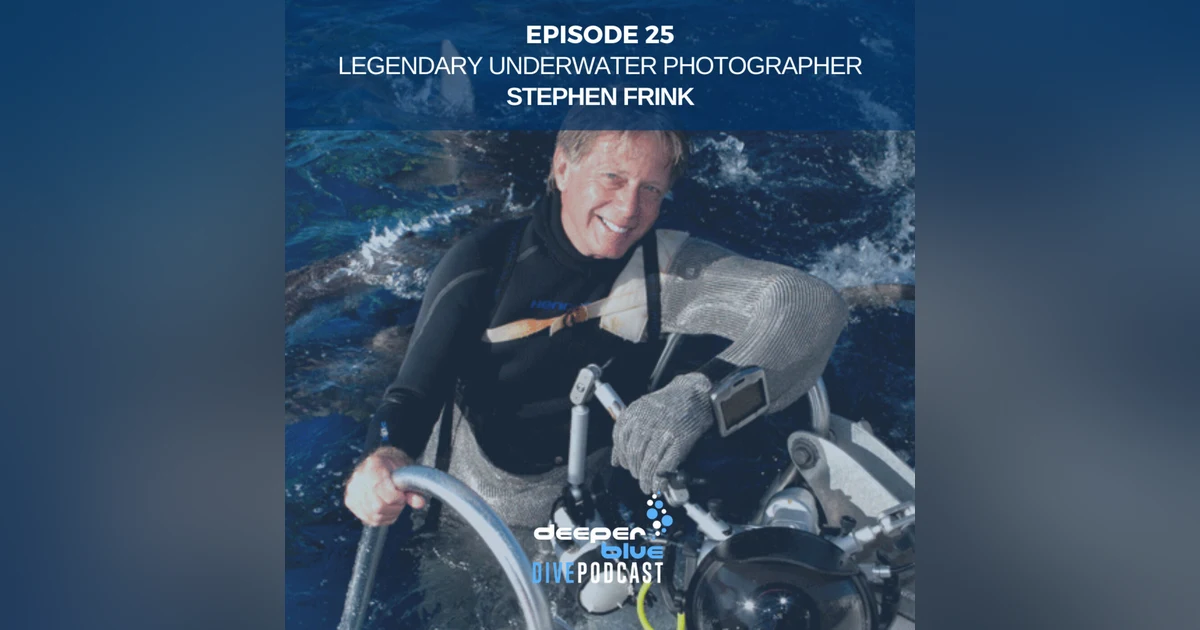
Then co-host Mehgan Heany-Grier talks to the legendary underwater photographer Stephen Frink, who is also the publisher of the Divers Alert Network’s beautiful magazine Alert Diver.
We then hear from Margo Peyton, founder of Kids Sea Camp with a Top Tip on how to trust your instinct when starting out to dive.
And then finally we hear from Ralph Graves on his Best Dive Ever.
Don't forget to give us ★★★★★, leave a review, and tell your friends about us - every share and like really makes a difference!
Welcome to the Deeper Blue Podcast, your weekly guide to everything that is happening around the world underwater. My name is Stephen Whelan. I'm the founder of DeeperBlue.com, the world's most popular diving website. Every week, the Deeper Blue Podcast covers everything that's happening in the scuba diving, freediving, diving travel, and ocean advocates world. So join us as we explore the Deeper Blue. Hi everyone, welcome to episode 25 of the Deeper Blue Podcast. Coming up, we've got all the latest news in the last week from around the world underwater. Then our fabulous co-host, Megan Heaney Greer, talks to legendary underwater photographer Stephen Frink, who also happens to be the publisher of Divers Alert Network's beautiful magazine, Alert Diver. We then get to hear from Margot Payton, the founder of Kids Sea Camp, with a top tip on how to trust your instinct when starting out to dive. And then finally, we hear from Ralph Graves on his best dive ever. Before we get started this week, I want to update you on what is going on, as this is going to be the penultimate episode of series one of this podcast. When Jason Elias and I started the podcast back in June, we were at the height of the first wave of the pandemic. And when we kicked this off, we wanted to see how everyone responded to it and how more importantly we kind of gone to this rhythm of doing the podcast. I'm pleased to say that everyone seems to absolutely love podcasts, certainly everyone who gets in contact with us. So thank you for your support over the last seven months. What we probably hadn't accounted for was the immense amount of time and money that it takes to produce a podcast, the quality that we believe in. But to make sure that we can continue that level of quality, we do need to build in some breaks to the schedule to allow us to do things like recharge our batteries, do some planning, work with the co-hosts and guests to make sure that every episode ends up as epic as we can make it. In 2021, we're now going to be moving to a four series of 10 episodes each, with a little break in between each series. So what does that mean for episodes this year? Well, our last episode of this series, which will now become series one, will be episode 26, which is next week. And we'll release that Tuesday, the 15th of December. And then we're going to take a well-earned break through to early February next year, 2021. And to be honest, although it seems like a long way away, it will only be a short time, and then we'll return. And honestly, we can't wait to return and continue to bring you the latest news from the underwater world. Talk to the most interesting people in the dive world. We certainly have had many of them on this series. And of course, we get to hear top dive tips from those interesting people, and of course, your best dives ever. One final thing before we get into the news. If you've liked or even if you've disliked anything on the podcast, perhaps you have a guest that you think we should interview, or just want to get in touch to talk about all things diving, then please do get in touch, we'd love to hear from you. You can drop us a line over email at podcast at deeperblue.com, or if you fire up your browser and go to deeperblue.com slash contact us, you can get us there as well. Right, let's dive straight into this week's diving and ocean news. Kicking off this week, we'll have some new product news. Italian diving equipment manufacturer CIAC has introduced its latest dive computer, the CIAC screen. The computer seems to buck the trend towards full colour screens with a more traditional dot matrix display and backlight. And it looks like a really solid, feature-rich computer that can be worn on your risk or as a console-mounted computer. And looking at all the features, it should appeal to both a technical diver needing something more advanced as well as the beginner diver just looking for something affordable and simple. As with a lot of computers these days, it has scuba, freediving, and gauge modes, so should be a versatile little computer. More product news. It's always something that is wanted by professional freedivers, and this is usually to show off their name, country, sponsors, those sorts of things. And now Alchemy allows any customer to easily customize their fins by filling out a simple form that can be downloaded from their website and then emailed in. When they get the form through, they will send you a cost estimate back from the team. And if you are happy with those fins and quotes that you get back, you can then proceed to getting those fins you always wanted with around about a three-week lead time. If you head to deeperblue.com, you can find out more on how to get started on those beautiful new custom fins. If you're a pro diver who prefers high-end gear and love being able to talk to your dive buddy as well as look at them underwater, or perhaps you're just a bond villain looking for the best kit setup for your underwater assault teams, then Ocean Technology Systems have just released two new underwater COM systems that you might be interested in. These systems are specifically designed rechargeable lithium-ion battery that boasts more power for a greater range and up to a 14-hour runtime with a significantly improved battery lifespan, which will really allow that unit to keep you connected when you need it. There is also some new added communication security features with an all-new scrambler mode to avoid being listened into. All in all, these features don't come cheap as the base model, the PowerCom 3000D, retails at 1599 US dollars, that's around 1,300 euros. And the more powerful models, you can't even get any pricing unless you're a member of the military. Or perhaps even that Bond villain. So if you're interested in this sort of stuff, go ahead and take a look at deeperblue.com to find out more. On the travel news front now, operator Master Liverboards has announced it's returning to its regular scheduled operations across multiple destinations worldwide. These destinations that are now back in operation include the Red Sea with Egyptian itineraries, the Galapagos Islands, Thailand and the Maldives. Needs to say, Mars Liverboards has not been resting on their laurels during the lockdowns. Boat crews have been busy across the board implementing the latest COVID-19 guidelines and getting the boat certified and compliant with all the latest regulations. The new measures ensure the safety of the crews and guests on future sailings. You can find out more details on deeperblue.com. A new technical diving book called Close Calls is now available to pre-order. The book is the work of Stratus Cash and has Eduardo Pavia and Michael Menduno, who you've heard of this podcast before. The book's premise is simple, it's a compilation of 68 personal stories from some of the world's leading technical divers and features incidents that nearly cost them their lives. By acknowledging that some of the legends of the community can make mistakes that nearly cost them dearly, any diver can make these mistakes. By acknowledging this, normal divers become even safer, since if it can happen to a legend, it can definitely happen to them. You can get the order, the book on pre-order, it's 35 euros, which is about 40 US dollars, and it will then retail at a normal price of 40 euros, which is about 47 dollars, from December 2020, and that'll be on most online platforms. The best bit about this is half the book's net profits will be donated to the Divers Alert Network Europe's Cloudyus Opermayer fund, which is used to help fund people who are in dire need in case of emergency. Scientists have confirmed the discovery of a new species of comb jellyfish off the coast of Puerto Rico. According to the US National Oceanic and Atmospheric Administration, or NOAA, a research team was conducting an underwater expedition five years ago when operating a remotely piloted underwater drone and came across a mysterious-looking blob swimming past the drone's high-def camera lens. The underwater drone, the ROV, captured the high-def video of the new species during a 2015 dive. And the scientists Mike Ford and Alan Collins, working from Shore, spotted it and recognised it as something that no one else had seen before. Discovery is the first time new species was described and annotated exclusively via high definition video. And that video had to be rigorously analysed before any scientific paper could be published, which recently came out. If you actually head to deepblue.com and look at the news article, there is an absolutely fantastic video of these critters from the high def video, and that's been published by NOAA. Finally, Dima has announced that it's opposing moves by the Florida Fish and Wildlife Commission to ban the feeding of sharks in the Federal waters of the Florida Keys National Marine Sanctuary. While this move seems initially well intended and aims to ban fishermen from using chum to attract sharks and capture them, a closer look reveals other considerations. DIMA argues that by imposing a blanket ban on all shark feeding activities, tour operators who use chum to attract sharks recreational divers to photograph would suffer a severe economic impact. As part of his argument, DEMA submitted research highlighting the minimal environmental and safety impacts that provisioning ecotourism has on the species, and DIMA cited several research sources as well as highlighted the paper offering a better and more sustainable solution. Lots of detail on Dema.org if you want to go ahead there and find out more and understand how you can get involved in the petition. So that's it for the news this week. Remember you can catch up on all the latest news and happenings around the world underwater by heading to dwell.com or by checking us out on Facebook, Instagram, or Twitter. And finally, like always, if you like what you've heard, please take a moment and tell one friend who loves diving about the podcast. We really do rely on you, our passion listeners, to spread the word about this podcast.
SPEAKER_03Hi, this is Margon with Kids Sea Camp and Family Dive Adventures. And you are listening to the Deeper Blue Podcast.
SPEAKER_01Hi, this is Jason Leus, producer of the Deeper Blue Podcast. For today's interview, one of our co-hosts, our free diving specialist, Megan Haney Greer, speaks with Stephen Frink, the world-renowned photographer and publisher of Alert Diver magazine.
SPEAKER_04Today I'm thrilled to be catching up with legendary underwater photographer Steven Frank, who is also the publisher of the Diver Alert Network's beautiful magazine, Alert Diver. Steven is a fixture in the dive industry, the underwater world, and far beyond, having had many high-profile clients over the years for his underwater photography, such as Victoria's Secret, Rolex, American Express, Canon, Nikon, and so many more. We're in for a real treat today as Steven shares some of his theory on pixels and proximity, as well as a close call experience he had while free diving and photographing a pot of dolphins in the Bahamas. So can you give us just a brief history of your diving and career, how you found it and got into it?
SPEAKER_05I went to graduate school in California. I was I actually got a master's degree in experimental psychology, but that's where I took my first photo classes. And I lived in a little beach community called Seal Beach, and I went to Long Beach State. Every day when I drove by, there was Long Beach Marina and there was a place in there called Scuba Duba. And I needed a job. So I knocked on the door and I said, I don't know what you guys do, but I'd like to have a job. And they said, We send people out and they clean boats and we pay 25 cents a linear foot. I said, So if I clean a 40-foot boat, you're gonna give me 10 bucks. Yeah, how's that sound? That sounds pretty good. He said, You can't start until you're certified. So I went and got a scuba certification, but I wasn't a photographer yet. When I had finished up my coursework and I was still working on my thesis, I took photo classes for fun. And I found that to be far more compelling. And so I never did work in psychology. So by the time I came to Key Largo, I knew how to process film. I had a camera. And for the first few years, I just rented cameras and processed film. Then one day one of the dive magazines got blown out. And so they called me and they said, Look, we know you're in the keys. We don't want to send somebody. Can you go cover that for me? And I did, and it worked well. I'd never shot wide angle and I'd never shot a model, and I'd never done editorial photography. So I did all of that in one day, and and uh they said, Man, these are pretty good. What are you doing next week? We'd like to send you to Cayman. So it was, I guess, being unwilling to tell them how little I knew. And I got lucky.
SPEAKER_04Stephen, I'm really familiar with your amazing career, but for our listeners who may not know, can you explain a little bit about what you do and your history in diving as far as your career now?
SPEAKER_05I did get started in photojournalism. I I discovered early on that without being able to contribute words and photos to a magazine, I wasn't going to get anything published. So, like my passion was photography, but the heavy lifting was words. So I had to learn to be a writer as well. So there was a magazine called Sport Diver magazine in the old days, and that's who I wrote for it. And then they folded, and I was without a job, and so I called Bonnie Cardone at Skin Diver Magazine and said, This is what I've been doing for the competition. I was, you know, writing a column on underwater photography and traveling. And she said, come and do it for us. And so for 17 years, that's what I did. I traveled extensively for Skindiver magazine, and my beat was the Bahamas, the Caribbean, the Florida Keys. And in so doing, I created this archive of underwater images. And I was recruited by a stock photo agency in New York. And so I did that with them. And then I was not only getting the modest money that I got for traveling and writing an article, but I got these images that I could then syndicate. And of course, you remember there was a program called the Nikona Shootout. And Frank Finnell, my buddy from Nikon, ran that. And they needed a travel company because they were booking these groups of 40 and 50 people to various destinations. And so they asked my wife and I, would you guys be our travel coordinator for these programs? And we did. So we created waterhouse photo tours. And I began running not only the Nikona shootout, but live aboard trips worldwide. So there was that. At a certain point, I was hired by the Austrian Trade Commission to do an analysis on this beautiful housing that was made in Austria called Seacamp. And they were going to pay me a thousand dollars to say whether this had marketability in the United States. And so I used it, I loved it, and I wrote the guy back, I don't want your thousand bucks, but I don't want to send the housing back. He said, Yeah, but if you're passionate about it, how would you like to be a distributor? So I must have done that for about 20 years, maybe.
SPEAKER_04So after you got into the process of getting certified and being certified, what is it about diving that really got you hooked?
SPEAKER_05I grew up in the Midwest and there was no ocean, but there was a 25-yard pool. And getting to the other end of it as fast as I could was the most important thing I did. Seeing sea hunt and not to a lesser extent, Jacques Cousteau, I was more of a sea hunt guy. But seeing those just people breathing underwater, it just seemed so exotic to me. And then I certainly found in the keys there was something more exotic than cleaning boat holes. So I could I could relate to that. The marine life was very compelling, but I would have dropped out if it were not for underwater photography because every dive is a little different, even if it's molasses reef for the 2050th time. It's a different Queen Angel, it's a different lens. It's it's just a different challenge. And that's what keeps me engaged even now. If the wind had laid down today and I went out on molasses, there'd be stuff to shoot that I never shot before.
SPEAKER_04It really is. Looking through the lens, it sounds like is the thing that got you hooked.
SPEAKER_05That's the only reason I do it. On the rare occasions, like I'll be teaching a class, and the first day of a class, I don't take my camera in the water. Man, those are long dives. I can't, I can hardly do 60 minutes in the water without a camera.
SPEAKER_04Thinking back over all of your dive career and time you spent working underwater, is there one dive that's really pivotal for you in some way, really special or a touchstone dive experience?
SPEAKER_05Yeah, but it's not a dive. It's oddly a snorkel. So I was off West End Grand Bahama working the spotted dolphins there. And I'd been a few times, so I had in mind what it took to get a good picture of the spotted dolphins. You have to be athletic and engaging. And if you're just a slug on the surface, they don't pay any attention to you. So I had in mind that this time I wanted to extend my time pre-diving because I'm not as good as you are at it. So I had got from U.S. diversopter bailout bottle from their military unit. And so it was like this tiny little two-inch diameter tank. It had a dedicated regulator. And so my plan was I would go down and I would swim with the dolphins as long as I could. And then I'd take a couple hits from the compressed air and go a little bit further. And then I would just do a free ascent on the way up because obviously by then it was compressed air. It wasn't just a breath hold dive anymore. So it was the end of the day, and the dolphins, at the end of the day, they head off the bank into deeper water for the night. And so they weren't really into playing. They were going where they were going. And I was swimming alongside a pot of maybe 18 or 20 dolphins. And I was getting really good stuff. Bam, bam, and you got to get closer. And so nice light, beautiful action, good proximity. And I was out of breath hold, so I took the compressed air. So I took all there was. And then it was time to go up after I got a few more shots. By the time I was done on the bottom, I was pretty spent. And I still had to do a free ascent. I was going up and of course exhaling, and there wasn't much left. And I thought this is the first time I'm not 100% sure that I'm going to make it to the surface. I had that thought and a long way to go. And I had to keep exhaling, and all of these dolphins were headed off to the bank, always swimming horizontally away from me. And the moment I had that thought, they stopped swimming horizontally and they all circled around me vertically. And they followed me until I hit the surface and then they left. And that was the last I ever saw of them. I couldn't take a picture because I was fighting for my life. But it was that moment that I was really aware of the conscious interspecies communication between marine mammals and people. I knew it. I knew it intuitively, but I had never experienced it personally. I don't know. I think it was transformational for me, feeling that I was a guest in their world. And at that moment they were accepting and willing to help. That's how I feel about fish too. I don't eat fish for that same reason. I feel like I've been a guest in their realm. And it's my job to have a benign presence. And if I can communicate something to our species relevant to their species, maybe that's a good thing for me.
SPEAKER_02Hi, I'm Michael Linguto, diving journalist, and you're listening to the best 30 minutes of Updiving, the Deeper Blue Podcast.
SPEAKER_03We're here with Margot Payton to learn her top tip for new divers. Margo, what's your top tip for divers? My top tip for divers is probably a little bit on the serious side because I want divers to have fun and be safe. So I always encourage new divers to trust their gut, their conscience, and their comfort level. And just because you're learning from someone that's an instructor, no question is too dumb to ask. Ask those questions that you have. Make sure you feel comfortable in every part of what you're learning to do as a diver. And make sure that when you start diving, you dive within your comfort level, you dive with someone you feel safe with, and that you feel confident about where you're going and what you're doing. And once you feel that, then you can really enjoy and just have fun with the sport because it is one of the most amazing, awesome sports in the world. So I would just say manage your comfort and your trust and go with that.
SPEAKER_00Finally, every episode, we share a story from you at the dive community, where we ask you to tell us about your best dive ever.
SPEAKER_06Hi Deeper Blue, my name is Ralph Graves, I'm living in True Core UK. My most memorable dive was on the P31 wreck, Camino Goto Alta. And it was a day where there was a lot of users at the site, there were boats tied onto the wreck itself, there was conflict at the surface, and my dive took me away from all this, and as he approached the entry hatch in the bow dive, a scuba diver emerged. And then there was two scuba divers, three scuba divers, four scuba divers, and I as they left. I I went into the wreck and on my journey through the wreck, uh pulling myself along through hatches, up and down ladders, past more scuba divers, moving quite freely to the stern of the wreck, and wriggling out of a small hulk up to the surface and giving my protocol to somebody who was not my body, but my body was waiting at the front of the wreck. Everybody was really clean, I was happy, and I learned that life doesn't always go your way, it's unexpected.
SPEAKER_00We'd love to hear your story about diving. Uh to at the end of the show, you'll find out all the info you need to submit your best dive ever. Thanks for listening to the Deeper Blue Podcast. Find out more on all the stories you've heard this week, plus connect to the world's largest online dive community at deeperblue.com. And if you like what you've heard, please subscribe, like, and comment wherever you hear your podcasts. These comments and subscribes really make a difference. Before we go, I want to give a big shout out to Jason Elias, our producer. In case you didn't know, he has an amazing podcast about people who have a deep connection to our world's oceans. Connections strong enough that they have dedicated some part of their lives to being and or working on behalf of the water. Take a listen when you get a moment to Jason's show, the Big Deep Podcast. Every week, we want to hear your stories and share them with the world. So please record and send in your short story of your best dive ever. Keep it brief, no longer than two minutes, please. And in it, tell us your name and location, where you were on the dive, what happened that make it so great, and why it's meant so much to you. You can get that over to us at best dive ever at deeper blue dot com or head to our website podcast.deeperblue dot com forward slash best dive ever. Join us again next week and explore much more of the deeper blue.