Mark Evans on when his muck dive ended with some surprise ice cream, and Francesca Trottman on why coconut can be a lifesaver when diving

 Apple Podcasts
 Spotify
 Amazon Music
 Overcast
 Castro
 iHeartRadio
 PocketCasts
 Podchaser
 TuneIn
 Deezer
 RSS Feed
 YouTube
 Welcome to Season 4 of the DeeperBlue Podcast! In episode 7 you can look forward to:
- The latest scuba diving, freediving, ocean, and diving travel news that has happened in the last week from around the world underwater with host Stephan Whelan and producer Jason Elias.
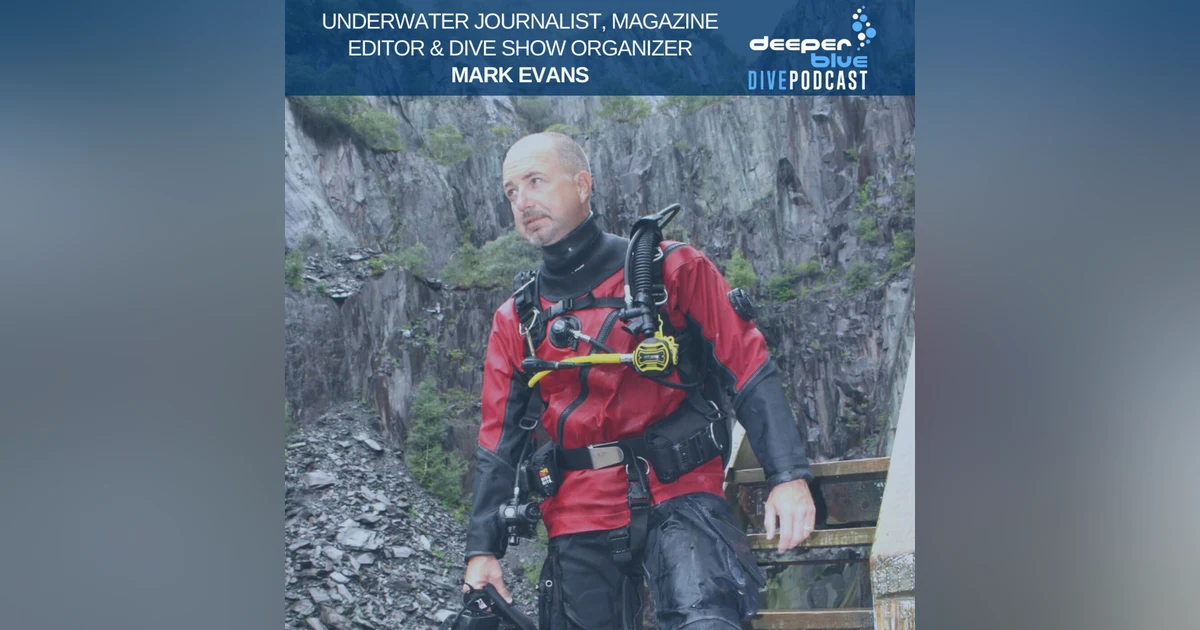
- Then host Stephan speaks with underwater journalist, magazine editor, and dive show organizer Mark Evans. They discuss how he became one a diving "media mogul" and one special muck dive that ended with some surprise ice cream.
- We then hear a top tip from marine biologist and conservationist Francesca Trotman on why coconut can be a lifesaver when diving.
- And then finally we hear a listener-submitted Best Dive Ever from Pauline Hsulpas on her best dive in the Netherlands with a beautiful school of herring.
If you’d like to be notified when new shows air, please subscribe to the show in your favorite podcast app or head to deeperblue.com/podcast to signup for the newsletter.
Season 4 of the DeeperBlue Podcast is brought to you by Suunto. Finnish engineering pioneering adventure from mountain top to ocean floor since 1936.
Don't forget to give us ★★★★★, leave a review, and tell your friends about us - every share and like really makes a difference.
Season four of the Deeper Blue Podcast is brought to you by Sunto. Finnish engineering pioneering adventure from mountaintop to ocean floor since 1936. Sunto.
SPEAKER_06Welcome to the Deeper Blue Podcast, your weekly guide to everything that's happening around the world underwater. My name is Megan Haney Greer. I'm a free diver, ocean explorer, and the imperfect conservationist. Also co-host of the Deeper Blue Podcast, the podcast for DeeperBlue.com, the world's most popular diving website. Every week, the Deeper Blue Podcast covers everything that is happening in the scuba, free diving, dive travel, and ocean advocacy world. So join us as we explore the Deeper Blue.
SPEAKER_05Hello, everyone.
SPEAKER_08This is Jason Leas, producer of the show, and Steven Whelan, founder and host of the podcast.
SPEAKER_05Or Elizabeth Holmes. I'm not sure which one it is just yet. Okay. Let's get to the news.
SPEAKER_08Right. Let's get straight into it this week, Jason. I think. So two episodes ago, we talked about these guys on YouTube who had solved this cold case based on going diving and sleuthing underwater and so on. And there's been a news story that in just two months, uh, people who've been inspired by this uh by the story. Obviously, they were listeners of the podcast and they listened to the podcast and they've been inspired by it. They were inspired by us.
SPEAKER_05That's right.
SPEAKER_08That's right. They've solved seven further cold cases involving missing people.
SPEAKER_05So it's uh in a group called Chaos Divers of Jacob Grubbs and Eric Busick, as well as Lindsay Busick, who's in charge of logistics, solved seven missing person cases in Illinois, Oregon, Kentucky, and Texas between October and December of last year. We thought we would bring this up because this is like the first time we'd heard about it was just a like maybe a month ago, and now we're finding all over the place that people are going in the water in solving cold cases, which makes me think what have I done underwater? I floated around like a broken stick and um maybe brought back a shell for my son. That's the extent of it.
SPEAKER_08So there's there's place in the universe for those people as well, Jason. Just the uh the karma doesn't quite work quite in the same level as helping solve a cold case.
SPEAKER_05That's true, that's true. But it is pretty interesting. They have some pictures here on the article of like they found a they found a car that had been missing for something like seven years with some people inside. And you know, as much as it sounds like a kind of a crazy story, it's also really wonderful to hear. It's also celebrating the diversity of experiences that you can have underwater. Everyone thinks that everyone that's not an ocean person thinks, oh, you go diving, you what? Is it like going in an aquarium? It's like, no, there's a whole world of things that you can do out there. So we're just kind of like celebrating that. Onto another story that's just as exciting. And I know that most people out here would say that this is something that Steven put in because it's uh your eyes glaze over. But actually, I put this in there, and it's because XDeep, who manufactures a lot of underwater products, had a safety recall for its NX700 first stage regulator. And the reason we put this in is because obviously there's some dives out that they probably use this and you should know it.
SPEAKER_08Now, Xdeep, fantastic products, by the way. I actually dive with an XDep wing. So yeah, it is of interest to me. So I was very, very pleased to see that you'd picked yourself up from your slumber being asleep on your did you fall asleep on your keyboard? And when you woke up, you'd accidentally gone on this page. So that might have been.
SPEAKER_05I'm not quite sure if my if what's happening is that I'm becoming more interested in the technical aspects of diving, or Steven has dumbed me down.
SPEAKER_08I'm not sure which one it is, but Yeah, it's safe to recall. This is a serious this is a serious topic, Jason. This is so no, it's it's really important. NX700s. So if you're an owner of an X700 first stage, you need to stop using it immediately, contact the data where you purchase the regulator, or contact Xdeep directly. Story and information is on deeperblue.com.
SPEAKER_05Speaking of more safety news, this one is something that I've paid a lot of attention to. I mean, the whole dive world has paid attention to it, but being living in Southern California, uh, the conception fire has been something that was much more in the ether here because, of course, it happened right off our coast. And the Coast Guard has just announced new regulations based on their research around the conception fire. And the reason we put this in is because it's important to know these go into effect on March 28th, and they are on all dive boats in the United States, will require the installation of fire detection and suppression equipment. But in addition, and this is the one that I found very interesting, owners of boats that carry passengers overnight must provide better skates from below deck, including at least two exits, and ensure a night watchman is alert and making frequent rounds, which is a big change, I think, because I remember the last time I was in an overnight dive boat here in California. I just remember the captain shouted over the intercom for me to stop talking in my bunk. That was the extent of my overwatch.
SPEAKER_08To be honest, I sometimes shout from my house here in the UK, uh, asking you to be quiet uh in your bunk in Los Angeles. I mean, it's a great victory for the victims' families who had actually banded together after the accident to push forward reforms. They had a group Advocacy34, and Maggie Strom, whose husband Ted had died in the conception, uh, had made a comment which was it was a uh really good thing for safety. I think it helps save lives, and this is what all the families want here.
SPEAKER_05March 28th, it goes into effect. So just be aware that when you go diving on boats here in the United States. Next.
SPEAKER_08Well, we've got a story which normally our lovely co-host Lyndon would be covering because it's a poop story, and she's always keen to cover these. Poop from meat eaters threatens coral reefs. So there's a growing awareness of what harm is coming from meat production. And in December, there was a study that was published about a new evil to do with meat eating. Apparently, when you eat meat, more nitrogen goes into your poop, apparently. And we excrete pretty much all that nitrogen. Uh, and then unfortunately, that of course he reaches our ocean via the rivers and sewer systems, and then ends up harming coastal uh ecosystems like coral reefs. I found this story really interesting because I am currently doing uh veganary, which is you know, take a month and be vegan for a month. I actually end up being vegan more than uh during the course of the year, but I take one month during the year to be fully vegan. And of course, one of the side effects, which I didn't know until I did this for the first time last year, is there's definitely more nitrogen in my bodily system than when I was a meat eater. So I found this quite interesting as a that's eating meat is causing nitrogen uh to go out. So I thought it was just an interesting thing.
SPEAKER_05So this was published in a very um prestigious journal, PLOS One. I am a meat eater myself, so I don't indict meat eaters for this, but really the arc of history is bending towards eating less meat. That's really what it's about. There's just too many repercussions from all of us eating meat at the same level that we do all the time. So this is just another one, particularly for ocean lovers, that we talk about the reefs being damaged by the runoff from our body waste. Again, another reason to maybe just at least start cutting down on your meat consumption. Now, to more interesting news from underwater. There was a video just came out on a PBS documentary called Octopus Making Contact. And the video shows an octopus asleep and changing colors while it is sleeping, which leads researchers to believe it is having REM dreams. You know, it's not surprising we have a dog that sleeps right next to our bed and sometimes it starts yipping in the middle of the night. So it's not, you know, if a dog can do it, you can assume that an octopus can do it. But what's interesting is that the video is really phenomenal because it the octopus goes through eight or nine different color changes during while it's sleeping. So it's really fascinating to see. Yeah, so you can go onto YouTube to uh Well, I might say this will probably be available on deeperblue.com.
SPEAKER_08It's really fascinating. I'd like to think that when I sleep, I change color in this way as well. So uh, you know.
SPEAKER_05I think your body does morph like the uh octopus does, but uh Yes, I'm incredibly svelte like uh like the octopus is as well.
SPEAKER_08Next story. This is a story about a study that had been published in the journal Nature Communications, which is a peer-reviewed publication, and it's talking about how the oceans and the planet generally finds ways of adapting over time. So obviously, plastic mass waste accumulating into the oceans is something that uh is a big problem, and lots of people are aware of that. But interestingly, the oceans seem to be adapting, and a lot of the plastic is now providing a unique habitat for coastal species that may evolve to adapt to a life on floating plastic, which which is fascinating. I mean sad but fascinating at the same time. A decade ago, marine researchers believed that coastal organisms that live along sheltered shorelines cannot survive inhospitable open ocean. Yet uh when the Japan's 2011 tsunami hit, uh it sent some 300 forms of marine life out into the ocean, and they were riding durable and buoyant plastic garbage into the North American waters, which is pretty much disproved that these creatures can't survive and they're adapting by using plastic.
SPEAKER_05Yeah, this is one of those classic times where you can hold opposite feelings in your heart at the same time, because there is something heartbreaking about the fact that marine life has to adapt to plastic islands floating in our waters. And yet, what it does, it is fascinating to hear about that life perseveres, and no matter what is thrown at it, it somehow learns to adapt, which is terrible but also fascinating.
SPEAKER_08Talking about terrible yet fascinating, I've got another environmental story. Apparently, a new study has been published last week in the journal Advances in Atmospheric Sciences. Again, I've said it before. I'm fascinated by the number of journals there are and things that's amazing. It's authored by scientists from China, Italy, and the USA. And unfortunately, its finding is that the world oceans in 2021 were the hottest ever recorded by humans, and the 2021 annual value is even higher than last year's record value. So this is you know, it's not just a one-off, it's uh you know, continually rising, and it's now year on year breaking records as being really, really hot. So a lot of scientists are ringing emergency alarms about the state of the oceans, coral bleaching, plastic in the oceans, rising temperatures, all sorts of things. It's oceans are in a pretty sorry state, unfortunately. And as divers, we are ambassadors to the underwater world, and we see a lot of this happening quite sadly.
SPEAKER_05Yeah, it's not surprising. Anyone who does believe in science knows that the world is warming. Uh the climate change is real. And this is just yet another data point to show us it's true. And it's a terrible data point because obviously a place that we love is is the reason we love it primarily is because of the flora and fauna that we see in there, and that is directly impacted by these kind of things. So bit of depressing news, not much to say beyond we've got to work on this.
SPEAKER_08Yeah, I gotta work on it. How about a bit of travel news? Should we do some travel?
SPEAKER_05Yes, it's always my favorite part of the show besides the mega mansions.
SPEAKER_08So the mega mansions. Well, we've got a special one coming up for you later later in this segment. So a couple of bits of news, so a little bit of travel news around the Cayman Islands. So we talked previously about the Global Citizen Concierge Program, which was for people who had proven annual income over $100,000 and health insurance were invited to live and work remotely in the Cayman Islands. So they have actually extended that offer to two years. So it continues to be open to people uh in the current climate.
SPEAKER_05We actually know a few people that did make these kind of choices during lockdown and have stayed in the places that they've done uh that they went to. Um, for us, that window is passed. But there's an idea like if you could go and live in the Cayman Islands, that's just something fun to do.
SPEAKER_08I'll tell you where I'd live, Jason, just as an aside is I would go and live in La Paz in Mexico, because I just went there in November and it is a beautiful place. And it's full of very cool divers as well, and it's a cool city.
SPEAKER_05Well, I think you could do that. Your job is, I mean, besides the continuous cocktails you have to have in downtown London, I think that uh you could do it.
SPEAKER_08Um they have cocktails there as well, by the way. They have cocktails in Mexico.
SPEAKER_05So here's another travel story. In Spain, archaeologists have identified the possible location of the lost temple of Hercules. Ancient accounts suggest that Roman leaders Caesar, Hannibal, and Scipio Africanus worshipped at the Temple of Hercules Gaditanus. Well, no one has ever known where that is, but now with new lidar imaging, they have found what they believe is the Temple of Hercules off of the coast of Spain in the Bay of Cadiz. The Lydar looks like there is all sorts of stuff underwater there, which is so interesting. And it all looks like it's relatively shallow as well. But I think what they're actually looking for now is what is left there. But I mean, this is a place of classic, classic historical significance. I mean, it's where Julius Caesar wept when he saw a depiction of Alexander the Great, and Hannibal offered tribute for victory in his military campaigns on the Italian peninsula. I mean, if that is not so fascinating to go dive, I don't know what else would be. This would be like my dream dive trip.
SPEAKER_08The only problem is there's probably really nothing down there. It's, you know, something that only radar and lasers can see, right?
SPEAKER_05I would nerd out on it. I've been to temples in jungles all over the place, and all you see is a stone sticking out of the ground, and you're like, oh my god, that's absolutely amazing. Because it's just the history that happened in that place. Did we want to talk about the free dive records?
SPEAKER_08Absolutely. Freediving is always a topic close to my heart. So there was a competition in December. It was a regional competition in Tampa Bay in Florida. Funnily enough, names the Tampa Bay Apnea Competition Christmas Edition.
SPEAKER_05That's like great British baking show Christmas edition.
SPEAKER_08Claire Parris and Evan Walfer have both set new women's and men's US national pool freediving records in a discipline which is called Dynamic with BIFIN. So this is hold your breath, swim horizontally under the water using normal fins that you would do. So one fin on each foot as opposed to the big monofins that freedivers use. Claire Paris had shattered and extended the record by 11 metres with a performance of 159 metres. That's 521 feet, which is her sixth uh national record. And Wolfer did uh the record twice actually in December. He swam 166 metres, 544 feet. And then the next day, because that wasn't good enough, he decided to do 175 metres or 574 feet in two minutes and 14 seconds. So always great to see records being broken. And in particular, this this competition in Tampa is always quite popular as a pool competition. Congratulations, Claire and Evan.
SPEAKER_05Not being involved in the free diving world as much as you are, uh, I always find it fascinating how many records are broken on a regular basis. And I know that's because there's all sorts of disciplines and there's also certifying agencies, but it also just speaks to the fact that it is a still a maturing uh sport, and that means that there's who knows where the limits will be. So that's really an exciting, it's an exciting time for free diving. So that's really cool. All right, on to the last story. I think you all know that I love these stories of lives that I will never live. But this story is not a mega mansion. This is actually maybe even one better. There's an ex-Russian Foxtrot class submarine for sale. This Foxtrot class submarine, as NATO designated, represents the dull mass of the Soviet and then Russian Navy from the late 1950s until less than a decade ago. It's 294 feet long. It has three diesel engines, and it has the there's some photos in here that show it's decked out kind of nicely, I guess, as far as submarines go. I mean, it looks like you could throw a hell of a party in here. You know, I think it's it's it's kind of blase. I live in Los Angeles, it's kind of blase to have a private jet. I mean, who doesn't? Uh, but to have your own private submarine I I don't just say I don't. To have your own private submarine. And the super cool thing is, is like, because it's Russian foxtrot from the 1950s, it's not super sleek inside. It looks like a studio set, like there's all these like grungy handles and dials that look like they measure I don't know what the hell they measure. Um, but I just thought maybe let's say you're single and you're trying to have some leg up on the competition. Hey, darling, come and see my submarine. So I just wanted to put that, it doesn't the only unfortunately is it doesn't really put a price tag on it.
SPEAKER_08So that's because pricing and I love this shipping information. So it's like, you know, FedEx and DHL and stuff are you know gonna you know say price shipping information is reserved for only the most serious prospective buyers. So you better have your paperwork and credit score in order if you're ready to spend your days as a Soviet submarine commander.
SPEAKER_05Well, that's very exciting. So, anyways, just wanted to put it on the radar of any oligarchs that listen. I mean, we have a lot of oligarchs, let's be honest, we have a lot of oligarchs that listen to the show. So all right. Well, that takes us to the end of the news. Stephen, thank you very much.
SPEAKER_08As always, Jason, thank you very much. And for everyone else, thank you for listening. Remember, you can get all your news uh that you heard today and more interesting diving news, even if you're Jason at deeperblue.com. And let's go on with the show.
SPEAKER_05On with the show.
SPEAKER_04You're listening to the world's only weekly podcast for scuba diving, free diving, dive travel, and ocean advocacy. I'm Tony Michlaev, also known as Tones of Blue. And this is the Deeper Blue Podcast.
SPEAKER_08Welcome back to the Deeper Blue Podcast. We have a very special guest joining us this week, Mark Evans, who not only is one of my dearest friends, Mark is also editor and publisher of Scuba Diver magazine and various other magazines around the world and you know, events, shows, and so on. You have a real long career in the diving industry. So, Mark, thank you for joining us on the podcast.
SPEAKER_07I'm very honoured to be here. Thank you for having me on the show.
SPEAKER_08So, Mark, first of all, we'd like to start off by just asking whereabouts in the world are you right now?
SPEAKER_07Right. Well, I am in a lovely little village called Gebowan. So Gebowan, it's a small village, northeast area of Wales, is we're about 30 minutes south of Manchester.
SPEAKER_08A little bit of uh a history upon history, you know, you you like myself, long career of journalism in the diving industry, but tell us a little bit about your career to date. So, what were you involved with? Because it's not just ScoobDive magazine you're doing right now. Tell us a little bit about your history.
SPEAKER_07Basically, when I started, I managed to link two things together. So diving was a hobby, and I was a newspaper journalist. The two kind of ran side by side. So I was diving in my free time and writing newspaper stories for local newspapers. And then it was in 1999, that's when I entered the diving industry as the editor of Sport Diver magazine. And then Sportdiver ceased to exist. ScubaDiver, which is our own magazine, me and my business partner Ross. And then that's grown. So we've now got Scuba Diver in the UK, we've got Scuba Diver in Australia and New Zealand, and we've got scuba diver destinations in North America. And as if that wasn't enough to do, we then decided we were going to launch a dive show as well. So we also run the go diving show. Because, you know, there's not enough hours in the day, really, to try and keep you occupied.
SPEAKER_08Three global magazines and a dive show. That's an incredible amount of work to have to do. Actually, to an ass, I probably should describe you as the media mogul of the diving world, you know.
SPEAKER_07Yeah, well, I did somebody did describe me, they said you're like the Rupert Murdoch of the diving world. I said, Yeah, but without the money. Why do they always say, How do you make a million in diving? Start with two. Start with two.
SPEAKER_08Exactly. Being a diving journalist, yeah, it's a fairly unique thing. It's not something people really understand very much about what we do. Get to travel around a lot. You must have been diving around the world and done quite a lot of travel and those sorts of things, right?
SPEAKER_07Yeah, I mean, that was the best thing. Like you say, we you you know, you're right. You say people don't really understand what we do. And I had so many of my friends outside of the diving industry who just thought I was on one continuous jolly around the world diving, and they all kept saying to me, When are you going to get a proper job? There was plenty of foreign travel, and we are getting back on track post-COVID, so we're going the right direction. But the difference when I'm travelling for work and when I'm travelling on holiday is that you've got to be on when you're out there for work. So I've got my you know, scuba diver hat on. So, yes, while I'm diving, it's just the same as if I was diving for fun. But then on an evening, you've got to be in work mode, you know, you've still got to be there. You might be sitting having a beer, but if you sat with the owner of the company or whatever, you've still got to be switched on and this, that, and the other. And you know, that's part and parcel of the job. But it you know, I can remember some trips where it did get a bit tiring where we were moving hotels every day, and every evening I had a meal with like Minister of Tourism one day, and the next morning, you know, it was with another minister. And some evenings you just wanted to have a beer and go to bed because you've been diving all day and you were tired, and it was like, I've had enough now, but you had to kind of get your glad rags on and and go out. But when I tell people that, they all just look at me and they go, But you were in Grenada, or you're in the Maldives, or you're in the Bahamas. Like, cry me a river. They're like, you know, I had to go to like you know, Grimsby for a an hour's meeting or something. You've got nothing. To complain about.
SPEAKER_08I know, I know. And you know, very lucky you get to go to lots of really nice destinations. And uh, you know, sitting, having to talk to the head of tourism for you know Grenada for a few hours, sitting on the beach watching the sun go down, I'm sure, is just like going to a meeting in Grimsby for an hour.
SPEAKER_07Exactly, it is. It's very similar viewpoints, I reckon.
SPEAKER_08Let's go back to what I like to describe as your origin story. I know for a fact that you and I have very similar starting points here, but tell our audience a little bit about how you got started in diving.
SPEAKER_07Basically, I've always loved the water. Used to go on family holidays to Anglesey, which is an island in North Wales. I remember snorkeling off the beach when I was a wee little. And that's where I actually had my first experience of diving. My uncle was a commercial diver and a hardcore British recreational rec diver. And he's the one who took me under his flipping wing and decided that I would like to have a go at diving. So he threw me off a boat in Anglesey when I was 10. And it really was sink or swim. Because I remember there's this strapping, you know, 19-year-old puts his entire kit on this tiny little 10-year-old and then pushed me off a boat. Um, and I just remember sinking to the bottom, laying there at six metres and thinking, oh, I'm not dead, I can breathe. And then crawling around on the bottom until he dragged me to the surface. And basically, from that moment, I was hooked, and my diving's just continued from there, really.
SPEAKER_08A lifetime of diving career. So, in all that time, you must have one story that is comes to mind when you talk about diving and really incredible. And you know, our audience would love to hear about. So, what what do you think you've got?
SPEAKER_07The problem is there are so many things that I've been and done. I think probably one of my favourite ones is when we did a drift dive in the Menhai Straits, which is a narrow body of water between Anglesey Island I mentioned earlier and the North Wales mainland. Now, the current through the Menhai Straits can seriously rip. So if you're dive in it, you need to get your timings right. We'd heard that you could do a dive where you would jump in underneath the bridge that crosses the straits, you go with the current down and you end up on a wreck site. And at that point, that says the tide, it's slack. So you can have a swim around the wreck site at slack, and then the tide changes and it goes screaming back up the straits the other direction. And then we get out where we got in. I mean, what could possibly go wrong? You know, we're dealing with like, you know, several not current. It'll be absolutely fine. Now, to be fair, we had done this two or three times and it had gone like clockwork. We literally got out 20 metres from where we got in. Not this time, though. I think we were maybe slightly earlier, got our timings wrong, but we just went flying down the Menhof Strait and realized that we completely missed where we're supposed to be and we were still drifting. So we eventually surfaced and found ourselves a long way down the Menhof Strait and still drifting. So we decided that we'd swim into shore and then we could just find someone with a phone and ring our surface crew who were sat having a cup of tea back on the beach where we got in to come and get us. So I was never forgetting the look on all these holidaymakers' faces when we climbed up the ladder out of Carnarvon Harbour, which is a big castle on the coast there. So we can climb up out of the water, they're all sat there with their ice creams and everything. We're fully kitted up in dry suits and everything, dump all our kit, ferry it around and try to find some coins between us in our undersuits, and get ourselves an ice cream, ask somebody for a phone, and then sit there having an ice cream waiting for our pickup. But it was just the look on people's faces. I think the thought that we've been invaded, they just had no idea where we'd come from. But there you go, it was all it was just good fun.
SPEAKER_01Hi, this is Paul DeGelda. Oh shit, dagger number one. Hi, I'm Paul DeGelder from Discovery Channel Shark Week. And you're listening to the best 30 Minutes About Diving, the Deeper Blue Podcast.
SPEAKER_05Today's top tip comes from Francesca Trapman, founder and director of Love of the Oceans, a marine conservation organization working in Mozambique.
SPEAKER_00My top tip would probably be to do with hair. As I spend so much time in the water, my hair turns to straw if I just don't look after it properly. So I would say plait your hair if you have long hair. Uh, that'll stop it dreadlocking, and then oil it. Coconut oil works wonders and loads of different other oils. You can Google it, but pretty much any oil you can put on your hair, even some cooking oils, and it will offer that little level of protection. So that would be my top tip.
SPEAKER_05And action.
SPEAKER_08Hey everyone. So the Deeper Blue podcast is brought to you by Sunto, the dive watch and dive computer manufacturer.
SPEAKER_05Sunto. Sunto has an app. Sunto has an app which logs your dives and other activities with Bluetooth connection to D5. I don't know what that is. Eon Core, I don't know what that is, and Eon Steel. Are those three of their dive computers?
SPEAKER_08It is three of their dive computers, and I know that as we've mentioned before on the podcast, you're a bit of a novice when it comes to this stuff.
SPEAKER_05Uh you're you're a bit of flotsam in the water when it comes to uh I like a log on the surface of the ocean that gets thrown around by the waves. But I love it, I love it.
SPEAKER_08Yeah, so the D5 is uh one of their wrists. Well, in fact, all three of them, the the Eon Core, Eon Steel, and D5 are all wrist dive computers from Sinto. And one looks like a watch, which is a D5, and the other two look like little square rectangular computers on your wrists.
SPEAKER_05That's pretty cool. That's pretty cool. I I think the thing I like about this, so it says here, the copy says it allows you to use a map to post and then share and show off. And so here's the deal. Here's something that I'm gonna say that is sacrilegious, at least for scuba divers. For the free divers out there, I don't know what they do because you're a free diver and I'm not. I don't log any of my dives ever. I've never been, I'm a big picture guy, so I don't care about the details. And people, I know this is sacrilege to say this.
SPEAKER_08That's true from doing this podcast with you for a while, uh Jason. You're a big picture guy. Someone has to do the details, though.
SPEAKER_05Someone does have to do the details. So I don't log any of my dives. I basically just remember what I just did. I mean, I've done hundreds of dives, but I still just I just kind of experience it. So the fact that this thing can actually log all the dives for me, put them on a map around the world, that's pretty cool. I do like that.
SPEAKER_08You know, there's a little bit of a narcissist in all of us, right? So we all like to see what goes on around the world, you know, what are we doing and stuff. And uh look, it's the it's the modern day thing. Yeah, we've got apps we that track us doing everything, whether we want to or not. And I think, you know, I love being able to, you know, show off where I've gone diving. I don't really log dives anymore. I've done God knows how many now, 1,500, 2,000, something like that over my career. So when I log a dive, I want to do it because I want to show off. So it's really cool in the Centro app. You know, you go and log it, look, connects to your computer, downloads everything, puts some extra information in. You can do it on the app or you can do it on the website. It's very, very cool.
SPEAKER_05Yeah, and that I actually I do like that. I don't know. I honestly still am confused why I need to have logs of my dives, because what do I need to like show people for? I mean, other than show off on Facebook, but I don't go there anymore.
SPEAKER_08It's because we don't trust you. So how do we know you've gone diving if you uh haven't looked at it?
SPEAKER_05As a as a piece of flotsam on the surface of the ocean, you actually would be right to question if I've actually done all of those dives. Uh okay, so the Sunto app. That's pretty cool. I like it.
SPEAKER_08Yeah, I like it. Very, very cool. Go go and check it out, guys. Sunto.
SPEAKER_03Finally, in every episode, we share a story from you, the dive community, where we ask you to tell us about your best dive ever.
SPEAKER_02Hi guys, this is Pauline from the Netherlands, and you probably will not believe me, but my best dive ever was in the Netherlands. It was one of those perfect times, beautiful sunshine, somewhere in the southwest of the Netherlands, and there is this brackish kind of lake with some face and with some muscles and those kind of things. Not too much. Anyway, I was there teaching a new student. It was her first open water dive. And we were there like for 15 minutes or something like that, and we were sitting on the sand, she had to do some exercises, and suddenly she already uh spotted some salmon trouts. Suddenly, we were uh surrounded by a whole school of herrings, and they were circling around us, just like you would imagine somewhere in very tropical waters where you you have these these barracudas coming around, and well, these were the herrings, and you really hardly see them. But in in in 50 dives, I think I've seen them only once. So we were sitting there and they were surrounding us for like minutes and minutes and minutes, and we were just looking and looking and looking, and this was great, especially with this beautiful sunshine and this girl that did make her first dive, and she was so so excited. And of course, she's still diving now, so although she is so this was my very best dive ever. I hope you're not too much disappointed because it was only a school of herrings, but uh I liked it very much. Have a nice day, bye-bye.
SPEAKER_03We'd love to hear about your best dive. So please head over to deeperblue.com slash best dive ever to share your story about your best dive ever.
SPEAKER_06Thanks for listening to the Deeper Blue Podcast. Find out more about all the stories you've heard today, plus connect with the world's largest dive community at deeperblue.com. If you like what you've heard, please share, like, and rate our show wherever you get your podcasts. These shares and likes really do make a difference. Thanks so much. We'll see you next week. MHG O
