RAID President Paul Toomer, and Wreck Expert Aron Arngrimsson

 Apple Podcasts
 Spotify
 Amazon Music
 Overcast
 Castro
 iHeartRadio
 PocketCasts
 Podchaser
 TuneIn
 Deezer
 RSS Feed
 YouTube
 In Episode Four, we kick off with host Stephan Whelan reflecting on the first month of the podcast, followed by our weekly news round-up
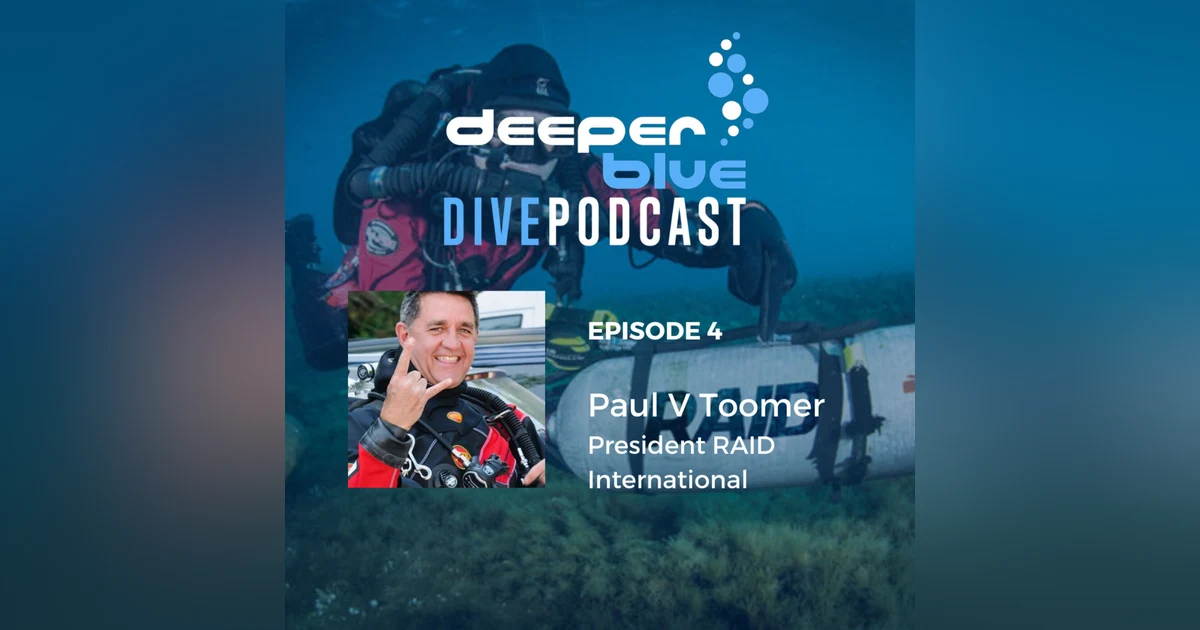
Then we have an interview with Paul Toomer - former band drummer, metalhead, tattoo fundamentalist, instructor trainer, and now president of diving agency RAID joins us to talk about what it is like to be a maverick in the diving industry from day 1.
Then we hear from Aron Arngrimsson - who dives some of the world's most spectacular and challenging wreck dives through his company Dirty Dozen Expeditions. He gives us some advice on planning your next trip.
And then finally we hear from Rannvá Jørmundsson on her Best Dive Ever.
Don't forget to give us ★★★★★, leave a review, and tell your friends about us - every share and like really makes a difference.
Welcome to the Deeper Blue Podcast, your weekly guide to everything that is happening around the world underwater. My name is Stephen Wheeler. I'm the founder of Deeperblue.com, the world's most popular diving website. Every week, the Deeper Blue Podcast covers everything that's happening in the scuba diving, freediving, diving travel, and ocean advocates world. So join us as we explore the Deeper Blue. Hi everyone, welcome to the Deeper Blue Podcast. We are at episode four. I have to say, reflecting a little bit back on the last month of this podcast, it's been a truly incredible ride. I think the response has been overwhelmingly positive. And I want to just take a moment to say thank you for all your listens, shares, reviews, ratings and emails that we've received over the last month that's been truly, truly heartwarming and amazing to see how great everyone's receiving this podcast. Well, that is apart from there was one email that we got from a guy in Europe somewhere who told us quite aggressively, there were a couple of swear words involved, to one of our email announcements, telling us to go away, that the army was at his door and he didn't have time to listen to a podcast. So but who am I to judge what was going on with him? So hopefully he's okay. Before we get on to some news, we'll do that in a moment. I wanted to talk a little bit about what's happened over the last month since the show debuted. So I think for Jason and I, Jason being the producer of this show, I think it's uh been honestly a lot more work than we expected and even anticipated. But it's been a hell of a lot of fun, I have to say. Doing uh doing this podcast has been an amazing ride. It's allowed us to connect to an incredible set of people all over the world. And that's continuing, to be honest, as the guests we have on the show are taking time to connect us with other people, uh, and uh people that uh some of you may have heard of, and and we're also highlighting uh shows and people uh who you may not have heard of. So that is is absolutely amazing. It's also reminded us as to why this is such an incredible community, uh the diving community and the deeper blue community. We've talked to so many people across the community uh who have such an incredible passion for the ocean. And it's uh it's uh great because that echoes our passion for the oceans. So thank you, thank you all, thank you to our guests, thank you to our community, and thank you to our listeners. So looking forward a little bit, we um we have an incredible lineup of people uh that we have over the next few months. And some of these people are uh the most iconic and important people in the diving and ocean worlds. We've got people who've dived the Titanic, there's pioneering free divers and scuba educators. We have uh technical divers who've explored some of the most phenomenal wrecks in the world. And we're also very lucky to be able to talk to some of the most legendary divers and ocean conservationists alive today. So uh some pretty, pretty epic stuff coming down the line. So please keep listening and showing your support uh through your shares, likes, ratings, and reviews. So thank you. At the same time, we also have loved hearing from you, the diving and free diving community. Uh, not only is the support being overwhelming, but also we have absolutely loved hearing your best dives ever. So there's a segment at the end of each episode where we get to hear the dive that was most important to you. So don't forget to keep sending your best dive overs in. You can find out more information and submit directly on the website at podcast.deeperblue.com forward slash best dive ever. Keep those submissions coming in. They're absolutely amazing. Jason, I want to thank you for making this such an incredible ride so far. So thank you so much. Uh now, thankfully, you won't just be hearing from me or Jason. There will be others involved as we grow and develop. We've uh put together a team of co-hosts that you'll be hearing from in the next few months. Um they are honestly uh the most wonderful group of beautiful people, and I'll be honest, slightly weird as well, but that reflects Jace myself at the same time. So let me uh let me take you through who some of these people are. Uh so first up we have Megan Heaney Greer, the iconic US free diver and discovery channel host. She'll be covering legendary divers, free diving in general, and the occasional uh conservation and environmental story. Next is Tech Clock. For those of you who don't know him, he's one of the foremost diving industry experts and is known as the scuba guru. Honestly, he uh he looks like one as well. He's got this amazing flowing hair recently and impressive beard uh over lockdown. So he definitely looks like a guru by my standards. Uh he'll be covering education and safety in diving as well as the industry at large. There's a fellow Brit on board, uh Sarah Richards. She is a force of nature that started the huge Girls at Scuba brand and community. Uh she'll be covering well, uh Girls at Scuba. So looking forward to hearing some of and highlighting some of the stories from that community. Uh Michael Menduno also joins us. He is the diving journalist. He's an award-winning editor of a number of different magazines, uh, staff writer here at deeperblue.com. His energy and gravelly voice will explore the latest in tech diving and the aspects of that world. Uh, and I think that's only fitting because he is uh credited, after all, with coining the term technical diving. And then lastly, of the co-hosts, we have mermaid Lyndon Walbert. She's perhaps the world's most famous entrepreneur mermaid as she describes herself. And she'll be covering women in diving, uh, Hollywood, and the media for us. So uh that's going to be super, super exciting. So they're the set of co-hosts, and of course, you still get Jason as the producer and myself free of charge. So uh I look forward to that. Let's go on to the news. So at the top of each episode, we'll highlight some of the news from the week. This week, it's been an interesting week, to be honest. As the world is opening up slowly, I think we've heard quite a lot about dive shows and organized events to do with diving have been cancelled, unfortunately, due to coronavirus. These include things like the Our World Underwater Show in Chicago in February, the Long Beach scuba show in California in May, the dive resort travel shows in Shanghai, Beijing, and the Philippines across July, August, and September. We're also hearing that the dive show in Birmingham in the UK quite possibly could be moved from October this year. And of course, the big news for most people in the industry is that Dima, the big international trade show held in the US in November, has been cancelled for this year. I think that in particular was quite disappointing for the industry, as it was the first time that it was going to be held in New Orleans for about 20 years. So I think there's a lot of uh disappointed people, including ourselves, about not being able to do that. But, you know, it's important to stay safe. We also have heard that the World Series of Free Diving, which was due to be in Greece and Camerata in September, has been cancelled for the year. Although there's some positivity around this because they are still hoping to host the vertical blue competition in the blue hole in the Bahamas towards the end of the year. And we also have some good news from our friends over at the Go Diving Show in the UK. They have just confirmed their dates in February 2021 to be returning to Coventry in the UK for their fantastic show. So uh looking forward to that. We've been keeping an eye on how things are opening up as well. Paddy have this fantastic coronavirus world map that kind of shows you where things are opening up across the world. So take a look at that. We're already planning uh and looking at destinations that are opening up. So places like uh Egypt, for example, some uh Dominican Republic, those sorts of places which are opening up, which is fantastic and complements the local diving that everyone is is doing. Following on from that, we also have uh seen that Netflix have launched a new documentary series called Home Game. Home Game explores a number of different sports, including the Highlands Games and Roller Derby. But probably most relevant to this audience is one of the episodes features free diving in the Philippines as one of their kind of extreme sports that they cover. Each episode is also a character study around the athletes. And I think the phrase from the free diver was I am happy when I'm deep, which I think we can all relate to, to be honest. Australia this week has had some tough time, I think, and tough news coming out, freediving related. Early in the week we heard that a freediver was sadly killed by a shark whilst spearfishing off Fraser Island in the eastern Queensland part of Australia. And then later in the week, we also heard that another spearfishing tragedy happened when the two-time world champion, Australian snowboarder Alex Chumpy Pullen, died whilst apparently spearfishing alone off the Gold Coast in Australia. He was spotted by a snorkeler unconscious on a reef. Sad news. Please remember everyone, never dive alone when either free diving or spearfishing. Please stay safe. And take a look, we've got some beginner guides for both free diving and spearfishing on deeperblue.com. So take a look at those. They can help you stay safe. There's a brand new digital dive magazine launched this week from the diving agency RAID called The Edge. It contains a whole load of in-stream news, travel reports, equipment reviews, and raid training updates, and is available at diverade.com forward slash theEdge. Finally, you'll have heard me jokingly refer to in a few episodes about a very serious condition that the divers of the world are suffering from at the moment, known as webinaritis, just because there are lots of webinars going on at the moment. But we did see this week that uh Chantelle Newman, founder of The Diver Medic, has just announced her hundredth webinar. It's a fantastic series of webinars featuring a revolving list of uh some of the top names in the scuba technical and free diving circles. And they're all still continuing, so uh check it out. But also you can go on demand and look at the previous ones at Divermedic.com. To be honest, I just don't know how Chantel does it because it's multiple episodes and webinars a week, and uh each one is an hour long. So hats off to you, Chantel. Absolutely fantastic. So that's it from the news this week. Next up, we have the interview with the Ray president Paul Toomer. He's gonna tell us and talk to us a little bit about what it's like being a maverick in the diving industry from day one.
SPEAKER_04You're listening to the world's only weekly podcast for scuba diving, free diving, dive travel, and ocean advocacy. This is FreeDiver Megan Haney Greer, and you are listening to the Deeper Blue Podcast.
SPEAKER_06Welcome to the Deeper Blue Podcast. We are here today with Paul Toomer, president of the Dive Agency Raid, an instructor, trainer, and explorer.
SPEAKER_05And recovering dive addicts, would that be a good way of introducing you?
SPEAKER_07I think that would be an absolutely perfect way of introducing the El Presidente would have been a lot better, but yeah, that'll work.
SPEAKER_06El Presidente, I like it. So Paul Toomer, El Presidente of Raid. Fantastic. So welcome to the podcast, Paul. For those of our listeners who don't necessarily know who Raid is and who you are, why don't you just give us a quick introduction to Paul Tuma?
SPEAKER_07I'm the president of Raid. Raid is obviously a global training agency, as as everyone knows. I'm based here in sunny London, um, sitting next to the river. In actual fact, I'm only two miles away from where you live, my good friend. Uh, and at the moment, of course, I'm locked down in London. Um, normally I'm found in Malta or Italy or America or Asia or Australia. So yeah, locked in London at the moment.
SPEAKER_06Obviously, I know you very well, Paul, but tell us a little bit about your interesting career of how you got to become El Presidente.
SPEAKER_07I started diving in 96, became an instructor in 1997, opened a couple of dive centers in London, then moved into the technical arena. And then in 2010, 2011, I was picked up by SSI to be their training director for technical global. Had the most amazing two years with SSI, really, really did enjoy my job. And then just fate dealt me a card where there was a possibility to join my two friends and start our own agency. So we started Raid, and that's it in a nutshell, really.
SPEAKER_05And Raid started off as a technical agency, I think. It was more about rebreathers, is that right?
SPEAKER_07Raid was originally owned by Poseidon, the rebreather manufacturer. So what Poseidon did was they formed Raid, which was the Rebreather Association International Divers. And then in 2014, the three of us got together and we rebirthed the company. And now we're not the Rebreather Association International Divers, we're just Raid. But now we do recreational, rebreather, technical, cave, rec, the whole nine yachts.
SPEAKER_06Free diving.
SPEAKER_07Free diving, yes, indeed. Without my wonderful training director, Emma. Yep. Emma Farrell's doing an amazing job at Raid.
SPEAKER_06But let's go back to diving leisure, I think you said. So the first uh first dive center. So if I remember correctly, you were quite a young whippersnapper, and you caused a few ripples when you first opened the center. Tell us a little bit of story about that.
SPEAKER_07Well, we we caused ripples from the day we we learnt to dive. So me and nine of my buddies, so our wives and our girlfriends, and we all arrived at this dive center down in Poole where two gentlemen, Steve Axtel and Phil Short, met us covered in tattoos. We didn't drive down there, we all rode on our motorcycles. So this thunderous thousandcc fire blades rocked up outside, and we basically took over the course. I mean, really. So I went under the water and was bitten by the bug immediately. I literally did regulator remove and replace and purge clear, then blow clear, came to the surface. I looked at Steve Axtel and I said to him, This is my job forever. So of course he laughed at me. And then the following weekend we went and did our first two dives. And I walked into his shop and I said, I want to be a diving instructor. He gave me a famous uh statement which he said, Could you take your wallet out of your pocket? So I did, and he said, Now repeat after me, help yourself. So I let him help himself to my wallet, but I I started to realize that I'd been self-employed since I was in my very, very early 20s. And I realized that actually I wouldn't take orders from other people very, very well unless they really had a fundamental understanding of how wild I am. You know, I'm a drummer, I'm a motorcyclist, I'm covered in tattoos, I've got piercings, you know. I'm I'm I'm pretty out there. Um I started to look for a dive center. Found the dive center six months after being a diver. And on the weekend that I did my instructor exam up at Stony Cove, my wife or my ex-wife and my sister opened the store for me because I just found I found the exam and I raced off and I did the exam. From then it was completely mad because I had dreadlocks down to my back, so I had cut in a mohawk with a long beard with metal threaded into it. So people used to walk into the store and I was super skinny. I used to wear a vest and combat shorts and German paratrooper boots, and they'd see this thug standing there covered in ink and piercings. And and you it's English people are fantastic because they don't want to turn around and leave, right? When they walk in somewhere, right? It's very, very rude to turn on your heels and just walk out the door, right? And of course, they'd stand there and I'd walk over and I'd go, good morning, can I help you? And they go, you could see in their face going, it speaks, and it speaks well. It has manners. And of course, you know, I said, if after three months the business is not doing well, I'll cut all the dreadlocks off and I'll cover the tattoos up and we'll go about it normally. And in actual fact, it did anything but that. It really, really played into our hands. So it was phenomenal. And really, the the tattoos have have really helped help create a career for me. You know, my rock and roll attitude, my when I'm off, I like to go for a drink, I like to party. You'll always see me out and about. Obviously, not when I'm diving. I'm I'm I'm I'm properly professional when I'm working, but when I'm not working and I don't have to get up in the morning and and face a Tri-Mix dive or an expedition, I'm I'm gonna go and have fun. That's what we should all be doing, right? This is not a rehearsal, right?
SPEAKER_06Absolutely. So, as you said, I I I don't live too far away from you and we hang out on occasion. But diving leisure, I always remember going to see diving leisure. And one of the things I think set you apart was the community aspect of diving leisure. So, what about that?
SPEAKER_07Well, basically, what what we what we did was we treated every customer like they were king. So the art was to learn everybody's name and recognize their faces, make sure you found out what job they had so you could understand exactly who you were conversing with. Never ignore anyone. So even if the shop was full, you would take a break from your customer, walk around the shop, tell everybody in the shop that you would be one minute, invite them for a coffee, we put a lounge suite into the front of the shop. So people would just come and congregate, you know. I I had one customer who'd come down there and he'd do all of his work on his laptop and he'd just sit there for the whole week, drink all my coffee all week, and at the end of the week, he'd stand up and go, Oh, so Cinto have just released a new computer and I've just seen it came in in a box. I go, Yeah, you go, well, I'll have one of those. And then off we go. And then we we had a club night and we chose the I think it was second Tuesday of every month. And the reason we we did that was because you know, Wednesday is like rooming up for the weekend, Thursday, people are already out, Friday and Saturday they are out. Sunday, they really don't want to go anywhere, Monday they all doom and gloom. Whereas Tuesday they're getting ready for Wednesday, which is the middle of the week. So we went and found a local pub. He embraced us, put dive logos all over the place. You know, if if you went to the urinals, you used to see my face, and it was like an uncle Sam, you know, we want you above above the urinals. If you went to the ladies' toilets, I was plastered on the back of the toilet door. And yeah, it was hilarious, man. Basically, we created this community where you go to the pub, we'd have anywhere between 100 to 200. I think our biggest was about 225, 250 people at a club night on a Tuesday night. And then, of course, the pub used to shut at 11. So the pub used to sell us booze to take home, and then we go to the shop, and our neighbors were so magnificent, they'd let us party. And sometimes three o'clock in the morning, the community would still be there. And then we got together with travel companies and ran you know loads of trips where our instructors would go on the trip. So, what we did is we convinced them to go on trips with us, and and it was just it was just a magical, magical community where everyone was made to feel important. It didn't matter to us whether you did continue education or not. What we were interested in was just let's go diving. It doesn't matter if we're going out this weekend and we're gonna plod around in six meters of water off the Cornwall coast and you know, walk down all those stairs and spend a weekend together. It was just about going diving because going diving is what unifies us all, isn't it? Your agency doesn't unify you, your equipment brand doesn't unify you, it's the water that unifies you. And that's what we do. We just we just made everything about being in the water and having fun. And we were it was it was fantastic. And we trained thousands of divers out of that store over the 10 years that I was there. It was it was pretty phenomenal.
SPEAKER_01Hi, I'm Sarah Richards, the founder of Girls at Scuba, and you're listening to the best 30 minutes about diving, the deeper blue podcast.
SPEAKER_03Today's top tip comes from Aden Angrimsen in Kiev, Ukraine, owner of Dirty Dozen Expeditions. Dirty Dozen Expeditions leads dive trips around the world to some of the most challenging, spectacular, and fascinating wreck dives, including Truck Lagoon and Bikini Atoll. Aden's top tip is about how to plan for one of these once-in-a-lifetime trips.
SPEAKER_02I think my top tip to the listeners would be don't be embarrassed if you don't know how to plan some of these trips that are that are out there at the moment. Because as a society with information technology, we've never had so much access to go into these amazing places as we do now. In my case, it would be Truck Lagoon or Bikini Atoll, and you start thinking, well, what is that and how I can do that? And my top tip is not to be discouraged. Keep going, keep reading. If you can, see dive shows, do your research, plan ahead, and vet the people that you give the responsibility of planning your trip properly. All these experiences that are once in a lifetime that you think are only reserved to the rich and famous, they're not. They're reserved for everybody as long as they just sit. Their heart to it and start planning things properly.
SPEAKER_03Thanks, Adam.
SPEAKER_02No worries.
SPEAKER_06Finally, every episode we share a story from you, the dive community, where we ask you to tell us about your best dive ever.
SPEAKER_00My name is Rama Jurmanson, and I am based in Falmouth, the UK. My very best dive was from a cave diving trip in Mexico with one of my very best friends called Karina. And this was the cave system called Chan Hall. And this dive was just phenomenal because it's so adventurous from the beginning to the end. The dive starts by driving into someone's backyard where you kind of knock on the door and ask if you can dive at their little pond, and you give them some money. And then there's a little bench that stood next to a hole in the ground, and then you kit up. Afterwards, the the hole in the ground kind of has room for about two or three people to stand there on in water that comes up to your thigh. No more than that. And after that, you put on your gear, you do all your checks and stuff. And by then, you've because you've been standing there, you've been mudding up the water so much that you can't see anything when you put your head underneath. And then you go over to the wall, and there's a rope that's tied to the wall, and then you start your descent, and you're literally going blind into the dive. And you're following the rope down and down and down and goes, and you can feel you're in a little hole, and then suddenly, whoosh, the cave just opens up, and it's so beautiful, and the walls are all white, and it's just and it's such it's such an adventurous and such a fantastic dive. That's that's one of my favorite ones. And then me and Karina singing songs while we're cave diving and and just looking at the beautiful sights and the stalictites and the stalic mites. I think that's definitely one of my best dives.
SPEAKER_06We'd love to hear your story about diving. So at the end of the show, you'll find out all the info you need to submit your best dive ever. Thanks for listening to the Deeperblue Podcast. Find out more on all the stories you've heard this week, plus connect to the world's largest online dive community at deeperblue.com. And if you like what you've heard, please subscribe, like, and comment wherever you hear your podcasts. These comments and subscribes really make a difference. Before we go, I want to give a big shout out to Jason Elias, our producer. In case you didn't know, he has an amazing podcast about people who have a deep connection to our world's oceans. Connections strong enough that they have dedicated some part of their lives to being in or working on behalf of the water. Take a listen when you get a moment to Jason's show, the Big Deep Podcast. Every week, we want to hear your stories and share them with the world. So please record and send in your short story of your best dive ever. Keep it brief, no longer than two minutes, please. And in it, tell us your name and location, where you were on the dive, what happened that make it so great, and why it's meant so much to you. You can get that over to us at best dive ever at deeper blue dot com, or head to our website podcast.deeperblue dot com forward slash best dive ever. Join us again next week and explore much more of the deeper blue